15 Animals That Live in Snow — And How They Actually Survive It
The winter season is harsh for us. However, for a few animals, snow is home. We will now explore animals that live in snow, how they cope with cold snow, their diet and where they can be found. No flair, no frills, just the information you’re looking for!
Why Animals That Live in Snow Matter
Snow-dwelling animals do more than survive the cold. They are the glue that holds an ecosystem together and their disappearance would cause issues in a realm much larger than their habitat.
They keep food chains balanced. The Arctic fox, snowy owl and Canada lynx are predators of smaller animals, such as lemmings and hares, which help keep their numbers in check. If they are missing, the population of prey species can get out of hand and devour the plants.
They indicate climate health. Stable ice and snow cover are critical for species, such as the polar bear and snow leopard. If they decline or diminish in range, it is probably one of the first indications that a geographic area is warming at a higher rate than would be expected.
They support local and Indigenous communities. The reindeer and yak have been a part of human life in the cold region for thousands of years and supply food, wool and transportation to people living there. Their existence is linked directly with the existence of these communities.
They protect biodiversity. Species that are not found anywhere else on earth are found in cold habitats. If one animal in this chain is lost, even a small one such as an ermine, it can have ramifications throughout the food chain.
They help us understand adaptation. Learning about the adaptations of these animals to cold—such as changing color to survive the cold or wide snowshoe paws to cover snow—can help scientists understand biology and how it can be transferred to non-Arctic or Himalayan applications.
Put another way, animals inhabiting snowy environments are a warning and a survival system. By saving their habitat, we’re saving a lot.
List of Animals That Live in Snow
| Number | Animal Name |
| 1 | Polar Bear |
| 2 | Arctic Fox |
| 3 | Snowy Owl |
| 4 | Snow Leopard |
| 5 | Reindeer (Caribou) |
| 6 | Arctic Hare |
| 7 | Wolverine |
| 8 | Emperor Penguin |
| 9 | Musk Ox |
| 10 | Ermine (Stoat) |
| 11 | Snowshoe Hare |
| 12 | Canada Lynx |
| 13 | Ptarmigan |
| 14 | Yak |
| 15 | Arctic Wolf |
Detailed Look at Animals That Live in Snow
Polar Bear
Scientific Name: Ursus maritimus Class: Mammalia Diet: Carnivore
The polar bear is the animal most people picture first when they think of snow. It is distributed throughout the Arctic Circle, on sea ice, sea coast and frozen tundra. The white fur is covered by black skin which absorbs heat from the sun, and a thick coat of fat prevents all cold from entering. Polar bears wait for hours at a time in the ice near breathing holes to catch seals. They have large paws that spread out to distribute their weight and so that they don’t sink into snow or break thin ice. Did you know that polar bear fur is not white? The hairs are clear, hollow and only appear white due to their ability to reflect light. Females dig snow dens to give birth in and cubs remain within them until it is a very cold winter before making their first ice surface appearance.
Arctic Fox
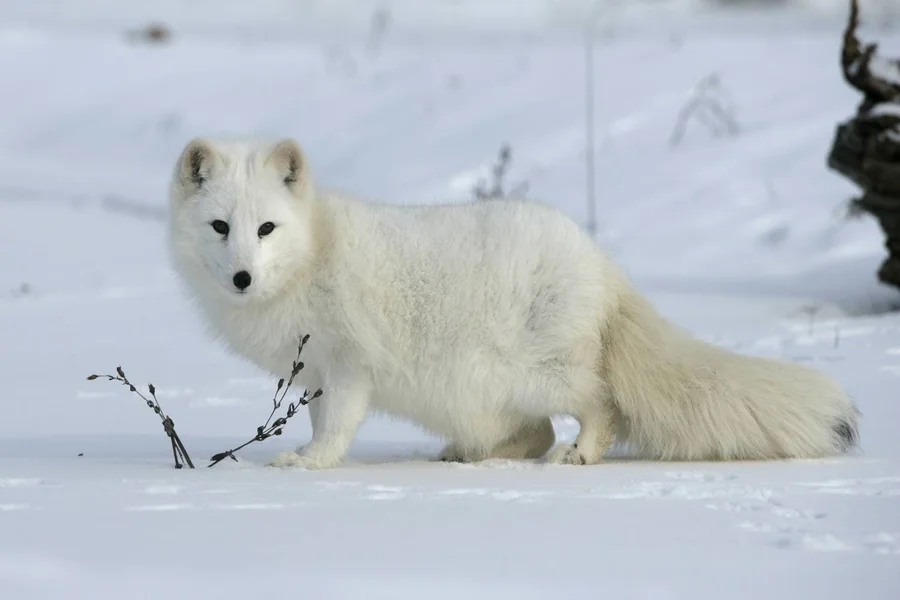
Scientific Name: Vulpes lagopus Class: Mammalia Diet: Omnivore
The Arctic fox is built for cold in a way few animals can match. It inhabits the northern tundras of Europe, Asia, and North America, and is able to tolerate down to minus 70 degrees Fahrenheit without shivering. It has a seasonal coat which turns pure white in winter when it blends in with the snow cover and turns brown/gray in summer. The short legs, short ears and round body shape all help to trap heat and reduce heat loss. This fox goes with polar bears when food is scarce to steal bits and pieces leftover from seal kills. When available it will feed on small mammals such as lemmings and birds and their eggs, berries. The fact that the Arctic fox curls up into a ball and wraps its furry tail over its nose and paws to keep warm in a blizzard is not something one expects to find. It can also detect movement of prey under several feet of snow without ever being able to see it.
Snowy Owl
Scientific Name: Bubo scandiacus Class: Aves Diet: Carnivore
The snowy owl breeds in the Arctic tundra and spends winters as far south as the northern United States when food is scarce up north. It hunts during the day time – unlike most owls this is fitting when the days are long in the Arctic summer. It has almost a full-body cover with its feathers, as if it wore built-in snow boots. Lemmings provide a major source of food for this owl and its numbers fluctuate with those of lemmings from year to year. When lemmings are plentiful, a single owl can eat more than 1,600 of them in one year. Adult males are nearly white and females and young owls have dark barring on their feathers. Snowy owls scan large areas of tundra for activity, from low to the ground, or perched on open mounds. Their nests are seldom built in trees, but rather in flat open ground. They have very good eyesight and hearing and can see and hear their prey moving beneath the snow cover at a distance.
Snow Leopard
Scientific Name: Panthera uncia Class: Mammalia Diet: Carnivore
The snow leopard lives high in the mountain ranges of Central and South Asia, including the Himalayas, often at elevations above 10,000 feet. This has a very dense coat of fur, and wide, furry paws that spread out so that it doesn’t get your feet too deep in deep snow. The tail is nearly as long as the body and a snow leopard curls up its tail around itself while resting to cover its cold rock and ice. This cat preys on blue sheep, ibex and marmots, frequently stalking them up to the very steep and rocky slopes where they move, to which few other predators can follow. It has a light, spotted coat making it almost inky visible on snowy rock formation. Snow leopards are only rarely sighted and live in solitude, and are known as the “ghost of the mountains. They can jump up to 50 feet in a single leap, which aids in crossing rocky chasms, or in pursuit of their prey over difficult snow-covered terrain in their rugged mountain range.
Reindeer (Caribou)
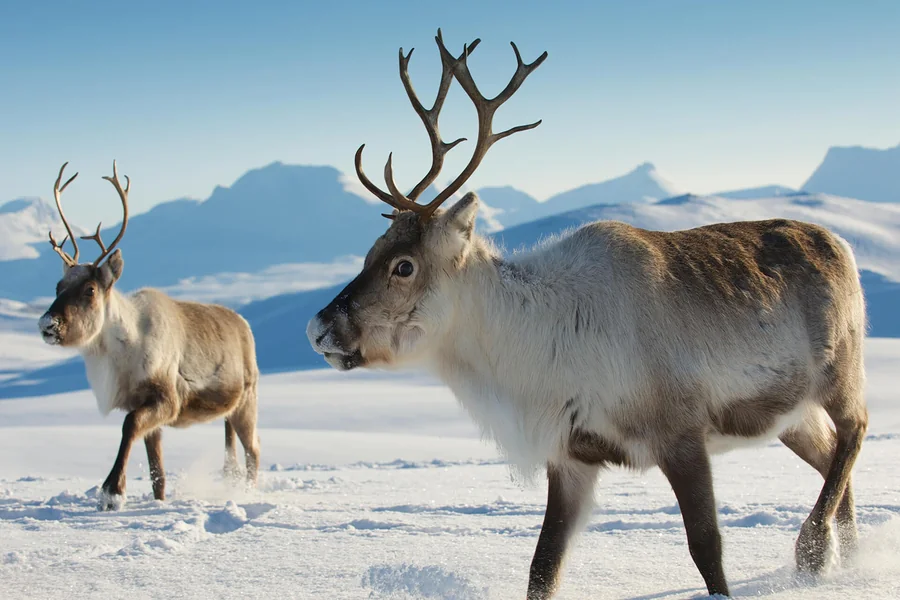
Scientific Name: Rangifer tarandus Class: Mammalia Diet: Herbivore
Reindeer, known as caribou in North America, roam the Arctic and subarctic regions of Europe, Asia, and North America in large herds. They also have hooves that change size through the year: They are wider and harder in winter, which helps them to grip ice and snow and also serves as a digging stick to locate food that is concealed under it. The reindeer feed on lichens, mosses, grasses and shrubs and can sniff out food in several feet of snow. They have two kinds of fur: a thick, woolly inner one and a layer of hollow hairs that act as insulation, keeping warm air next to their bodies. Unlike other species of deer, male and female reindeer develop antlers. Herds move hundreds of miles annually from summer wintering areas, covering more distance than nearly every other land mammal. In fact, their eyes change color during the season, from gold in summer to blue in winter, making them better able to see in the little light of the arctic in winter.
Arctic Hare
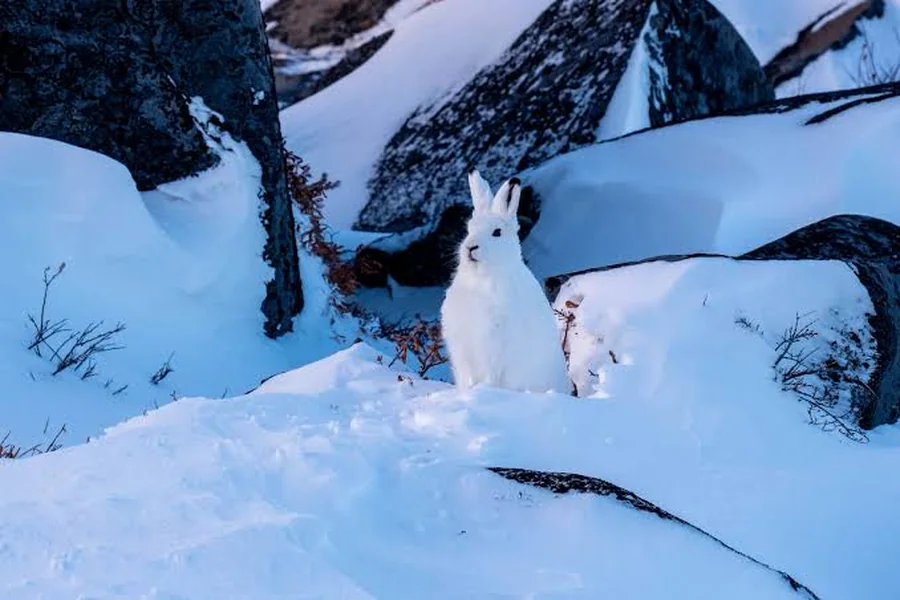
Scientific Name: Lepus arcticus Class: Mammalia Diet: Herbivore
The Arctic hare lives across the tundra regions of northern Canada and Greenland, often in areas where temperatures stay below freezing for most of the year. During the winter months it grows a thick white coat that is almost like snow, and in the summer months, it grows a grayish-brown coat that is in harmony with the exposed rock and soil. The Arctic hare is unique among the species of rabbits and hares in being able to stand on its hind legs, which it does to move around on open flatlands and look out for predators. During storms, it gathers in large numbers (hundreds) to conserve body heat. It has short ears to help it survive the cold temperatures as opposed to hares in warmer climates. This animal eats woody plants, moss and berries and will dig through snow with its front paws to get at buried plants. Arctic hares run at almost 40 miles per hour, a good ability to get out of the way of foxes and wolves in open snow.
Wolverine
Scientific Name: Gulo gulo Class: Mammalia Diet: Carnivore
The wolverine looks like a small bear but is actually the largest member of the weasel family. It is found throughout the northern woodlands and tundra of Canada, Alaska, Scandinavia and Russia, preferring cold, remote regions with deep snow. Its fur is dense and oily, and sheds frost even in very cold weather, such as was used to line coat hoods. Wolverines have big paws with claws for digging through snow and climbing up ice. They can cover vast distances on the ground when they are searching for food, moving up to 15 miles in a day over rough ground. However, in deep snow when large animals can’t easily move, wolverines can kill prey significantly larger than themselves, such as young moose. They also eat other predators’ leftovers. The female wolverines make dens in snow banks where they give birth to their young and the dens may remain until late spring in the coldest areas.
Emperor Penguin
Scientific Name: Aptenodytes forsteri Class: Aves Diet: Carnivore
The emperor penguin is the only animal that breeds on the open ice of Antarctica during the dead of winter, when temperatures drop below minus 40 degrees Fahrenheit. No den, no nest and no wind protection. Rather, males gather in small, compact clusters of thousands, with each rotating in an “inner circle” to the “outer circle” where they are exposed to the cold. The male puts one egg on his feet, protected by a skin and a tuft of feathers and waits for two months for the female to go out to sea for food. Emperor penguins are covered with a thick coat of blubber and four layers of feathers which retain heat around their body. They are also very good swimmers, diving deeper than any other bird – sometimes over 1,800 feet deep – to find fish and squid. Thousands of birds may be in a colony and the loud calling is a way in which parents identify their own chick in the group.
Musk Ox
Scientific Name: Ovibos moschatus Class: Mammalia Diet: Herbivore
The musk ox lives across the Arctic tundra of Canada, Greenland, and Alaska, surviving in some of the coldest and windiest conditions on Earth. The most unique part of it is its fur, consisting of long guard hairs and a soft, dense, warm and fluffy undercoat called qiviut, which is warmer than sheep’s wool by weight. This coat allows the musk ox to remain outdoors in blizzard weather without shelter. When wolves approach, herds circle around with young calves in the center, facing away from the wolves, a tactic that has been effective over thousands of years. When snow covers the ground, musk oxen use their hooves and heads to dig for grasses, moss and lichens that lie beneath the snow. The species was named because males emit a strong scent when they’re in breeding season. Although heavy-bodied like oxen and with curved horns, they are close relatives of the goat and sheep, not oxen.
Ermine (Stoat)
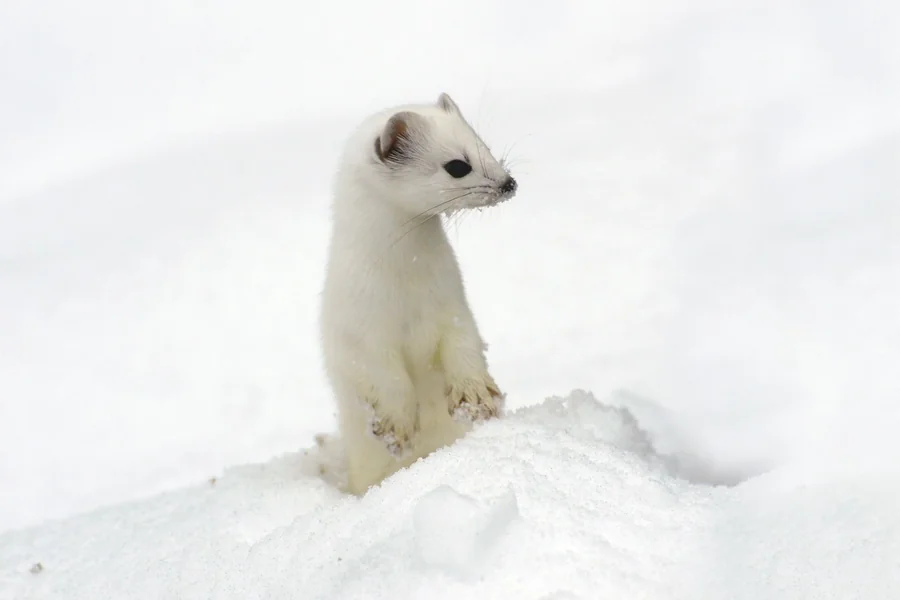
Scientific Name: Mustela erminea Class: Mammalia Diet: Carnivore
The ermine, also called a stoat, is a small, fast predator found across snowy regions of North America, Europe, and Asia. It is almost white in winter, with a black tip on the tail that remains black throughout the year. The colour change is not affected by the temperature, but occurs when days are shorter, and provides the ermine with almost complete camouflage while they are hunting. Although it is a small-sized predator, the ermine is highly aggressive, sometimes killing prey that is much larger than it is, such as rabbits and hares. Their long thin bodies lead them into burrows and tunnels where they prey on. Ermines never sleep and have a rapid metabolism and must feed on a regular basis, even in cold weather. They are frequently detected building animal burrows where they have been successful in their hunting as their own dens, using animal fur as a lining. In the fur trade era, their white winter coat was a much sought-after item for royal clothing.
Snowshoe Hare
Scientific Name: Lepus americanus Class: Mammalia Diet: Herbivore
The snowshoe hare gets its name from its oversized hind feet, which spread out its weight and let it move across deep snow without sinking, much like a snowshoe would. Found throughout forested areas of Canada, Alaska and the northern United States, especially in dense brush and low cover. It is also like the Arctic hare in its seasonal colour change, which in summer is reddish brown and in winter white, providing protection against predators such as lynx and owls all year round. As with many other animals in the Northern region, snowshoe hares are a critical prey for a variety of predators, and their abundance and decline can ripple through the entire boreal ecosystem. In winter, when other plants are covered in snow, they feed on twigs, bark and buds. These hares are primarily crepuscular (active at dawn and dusk), and are quiet and camouflaged during the day. When the snow shoes hare runs away from danger, they can jump more than 10 feet.
Canada Lynx
Scientific Name: Lynx canadensis Class: Mammalia Diet: Carnivore
The Canada lynx is a medium-sized wild cat found across the boreal forests of Canada and Alaska, with a range that stretches into the northern United States. Its large, padded paws are used as natural snowshoes, allowing it to move across the snow, and chase prey that would otherwise sink and struggle. This cat is particularly dependent on snowshoe hare, and when the hare population is high the cat population is high, and when the hare is low, the cat follows suit. It has thick fur all over its body, including under its paws, to keep it warm, so it doesn’t get cold. This animal is easy to recognize when spotted in the wild by its tufted black ears and short stubby tail. Most of the time, Canada lynx hunt during the day time, but they hunt stealthily and catch their prey by short bursts of speed, not long chases. Outside of the breeding season, they are solitary birds, and establish territorial claims which may cover dozens of square miles of snowy woodland.
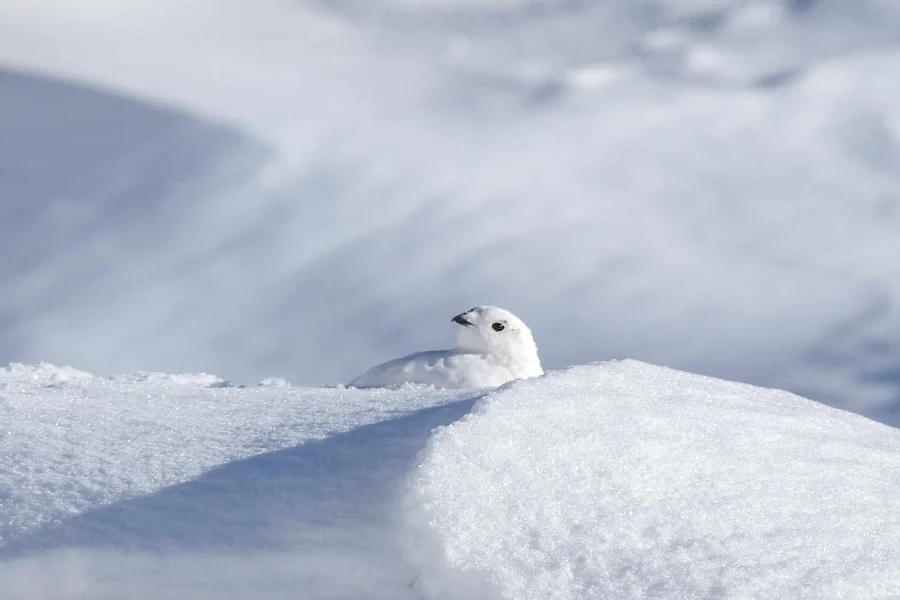
Ptarmigan
Scientific Name: Lagopus muta Class: Aves Diet: Herbivore
The ptarmigan is a ground-dwelling bird found across Arctic and mountain regions of North America, Europe, and Asia. One of the few birds that completely changes color from season to season – pure white in winter and mottled brown in summer to blend in. Even its legs and feet are adorned with feathers that act as a built in snow boot to help provide grip and reduce heat loss. Sometimes after storms, when the snow is very deep, the burrows in which the ptarmigan bury themselves for the night will be deeper than the snow banks have fallen, and the burrows will be shallow. They also change their diet according to the seasons, feeding on buds, twigs and catkins in winter and insects, berries and leaves during the summer months. These birds do not fly far, but prefer to walk or run on snow and rock. The winter camouflage of the ptarmigan is very effective; usually they can only be seen when they move, when they resemble the snow-covered ground almost completely until they are startled into flight.
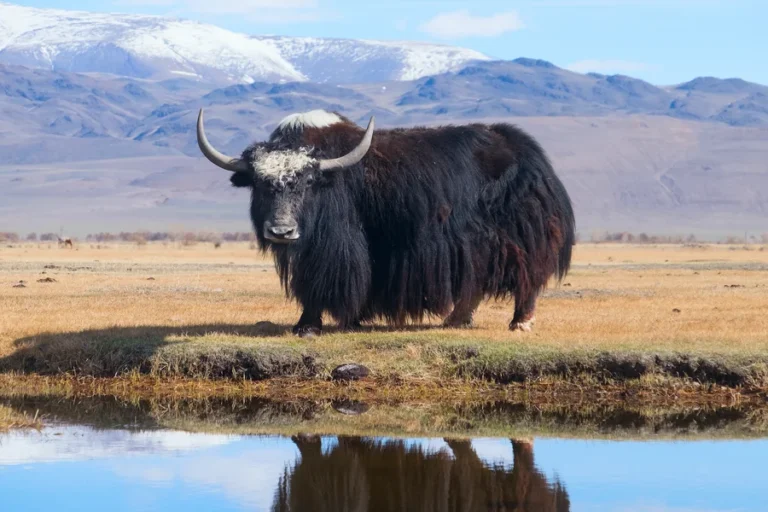
Yak
Scientific Name: Bos grunniens Class: Mammalia Diet: Herbivore
The yak lives across the high-altitude plateaus of the Himalayas, Tibet, and parts of Central Asia, often at elevations above 10,000 feet where oxygen is thin and temperatures stay low year-round. Its body is built for cold, with a long, shaggy outer coat and a soft, dense undercoat that traps heat against the skin. Yaks have larger lungs and hearts relative to their body size compared to lowland cattle, an adaptation that helps them survive in thin mountain air. Their wide hooves grip icy, rocky ground well, letting them move safely across steep, snow-covered slopes. Yaks have been domesticated for thousands of years by communities across the Himalayan region, used for milk, wool, transport, and labor. Wild yaks are larger and more aggressive than their domesticated relatives, and both types graze on grasses, moss, and lichen. Their thick coats are so effective at insulation that yaks can struggle more with heat than with cold.
Arctic Wolf
Scientific Name: Canis lupus arctos Class: Mammalia Diet: Carnivore
The Arctic wolf is a subspecies of the gray wolf found across the northernmost parts of Canada and Greenland, in regions where snow covers the ground for most of the year. It has a thick, white coat that provides both camouflage and heavy insulation against extreme cold, and smaller ears than other wolf types, which reduces heat loss across its body. Arctic wolves live and hunt in packs, working together to bring down prey like muskoxen and Arctic hares across open, snow-covered terrain. Because the Arctic offers weeks of total darkness in winter and constant daylight in summer, these wolves have adapted to hunt in both extremes without relying much on daylight cues. Packs are typically led by a breeding pair, and pups are raised in dens dug into snow or rock. Arctic wolves travel long distances in search of food, since prey is often spread thin across the vast, frozen landscape they call home.
More Animals That Live in Snow
Here’s a quick list of other cold-weather species worth knowing, beyond the 15 covered in the main article:
- Siberian Tiger – Panthera tigris altaica, the largest cat species, found in snowy forests of far eastern Russia.
- Harp Seal – Pagophilus groenlandicus, gives birth on Arctic sea ice.
- Snow Petrel – Pagodroma nivea, one of the few birds that breeds deep in Antarctica.
- Arctic Tern – Sterna paradisaea, migrates between the Arctic and Antarctic every year.
- Pika – Ochotona, a small mammal that survives high snowy mountain slopes.
- Dall Sheep – Ovis dalli, climbs steep, snow-covered terrain in Alaska and northwest Canada.
- Weddell Seal – Leptonychotes weddellii, lives farther south than any other mammal, under Antarctic ice.
- Snow Goose – Anser caerulescens, breeds on Arctic tundra and migrates in massive flocks.
- Chinstrap Penguin – Pygoscelis antarcticus, nests on snowy and icy Antarctic islands.
- Snow Monkey (Japanese Macaque) – Macaca fuscata, known for soaking in hot springs surrounded by snow in Japan.
Final Thoughts
Snow looks like an empty, hostile place. But these 15 animals that live in snow prove otherwise. While all of these species have adapted to freezing conditions in different ways, they have all found a way to make freezing conditions a livable home, from thick fur, to color-changing coats, to wide paws that function like snowshoes. The study of these life coping mechanisms also reveals that this balance is fragile: even relatively small changes in temperature or snow cover can alter food chains that revolve around species such as the snowshoe hare or the lemming. Cold habitat protection is as important as protection of the rainforest or coral reef.
FAQs:
What is the most common animal that lives in snow?
The Arctic fox is one of the most common animals that live in snow, found across the entire Arctic tundra region.
Can polar bears survive without snow and ice?
No, polar bears rely on sea ice to hunt seals, and without it they struggle to find enough food to survive.
What animal changes color to survive in snow?
The Arctic fox, Arctic hare, ptarmigan, and ermine all change their fur or feather color to white in winter for camouflage.
Do any birds live permanently in snow?
Yes, the snowy owl and ptarmigan live year-round in snowy regions, with feathers that grow across their legs and feet for insulation.
What is the largest land animal that lives in snow?
The polar bear is the largest land-based carnivore that lives in snowy Arctic regions, with males weighing over 1,000 pounds.