60 Animals That Start With H You Didn’t Know Existed
Does anyone ever get stuck when trying to name animals that start with H after hippo, horse and hamster? You’re not alone. This list opens the door for that trend. You will find 60 animals beginning with h below ranging from mammals to insects, birds to reptiles, each with real behavior, habitat and diet details for which you can actually use.
List of Animals That Start With H
Here’s the full lineup before we go deeper on each one.
| No. | Animal Name | No. | Animal Name |
| 1 | Hippopotamus | 31 | Halibut |
| 2 | Horse | 32 | Harbor Seal |
| 3 | Spotted Hyena | 33 | Harbor Porpoise |
| 4 | Hedgehog | 34 | Hartebeest |
| 5 | Hamster | 35 | Hoary Marmot |
| 6 | Harp Seal | 36 | Hooded Vulture |
| 7 | Hummingbird | 37 | House Wren |
| 8 | Great Blue Heron | 38 | Hummingbird Hawk-moth |
| 9 | Red-tailed Hawk | 39 | Hyacinth Macaw |
| 10 | Honey Badger | 40 | Hooded Oriole |
| 11 | Howler Monkey | 41 | Lesser Hedgehog Tenrec |
| 12 | Humpback Whale | 42 | Hellbender |
| 13 | Northern Harrier | 43 | Great Horned Owl |
| 14 | Harlequin Duck | 44 | Hog Deer |
| 15 | House Sparrow | 45 | Himalayan Tahr |
| 16 | Hermit Crab | 46 | Horsefly |
| 17 | Horned Lizard | 47 | House Centipede |
| 18 | Horseshoe Crab | 48 | Harvest Mouse |
| 19 | Huntsman Spider | 49 | Hooded Crow |
| 20 | Honeybee | 50 | Humboldt Penguin |
| 21 | Hornbill | 51 | Humboldt Squid |
| 22 | Hoatzin | 52 | Hawksbill Turtle |
| 23 | Hooded Seal | 53 | Harpy Eagle |
| 24 | European Hare | 54 | Hooded Merganser |
| 25 | Highland Cattle | 55 | Desmarest’s Hutia |
| 26 | Rock Hyrax | 56 | Argentine Horned Frog |
| 27 | Hercules Beetle | 57 | Hogfish |
| 28 | Housefly | 58 | Spotted Handfish |
| 29 | Hognose Snake | 59 | Honduran White Bat |
| 30 | Hammerhead Shark | 60 | Hooded Pitohui |
Now let’s get into the details. I’ll cover these in batches of 10 so nothing feels rushed. Here’s the first batch.
60 Animals That Start With H (Full List, Facts & Pictures Guide)
Hippopotamus
Scientific Name: Hippopotamus amphibius Class: Mammalia Diet: Herbivore
Although its bulk is immense, it can run faster than a man on land, and it is to be noted that it never swims out of the water, but spends the greater part of its life in the African rivers and lakes where it keeps cool under the hot sun. At night, Hippos browse on the grass, sometimes going as far as 6 miles for a meal. Live in family pods called bloats. Bulls are very territorial and have one of the strongest bites of any land mammal.
Horse
Scientific Name: Equus ferus caballus Class: Mammalia Diet: Herbivore
Horses have worked side by side with humans for thousands of years, from being used for work on the farm, to racing, to just being with them. They can sleep standing up because of a locking mechanism in their legs, but they must lie down for short periods of time to get deep sleep. A horse has eyes at the side of its head and a nearly 360-degree field of vision that enables him to be alerted to trouble at the earliest moment. The pecking order is well established in a herd and is set by a dominant mare.
Spotted Hyena
Scientific Name: Crocuta crocuta Class: Mammalia Diet: Carnivore/Scavenger
Even though spotted hyenas are known as scavengers, many of their foods are actually hunted by their own group of hyenas, known as a clan. The female members are the leaders of these clans, and they tend to be larger and more aggressive than males. Their jaws put the bone to the grindstone easily and they are able to feed on parts of a carcass that were left behind by other carnivores. Hyenas use an eerie laugh-like call to alert others to danger or a kill, which can hear for miles across the savanna.
Hedgehog
Scientific Name: Erinaceus europaeus Class: Mammalia Diet: Insectivore/Omnivore
When threatened hedgehogs roll into a ball and use thousands of sharp spines to protect themselves from predators. Primarily nocturnal and foraging for insects, worms and slugs in gardens and woods. A hedgehog will go up to 2 miles per night looking for food. They store up fat before hibernating in winter, when they are unable to eat for months. They have a keratin spine.
Hamster
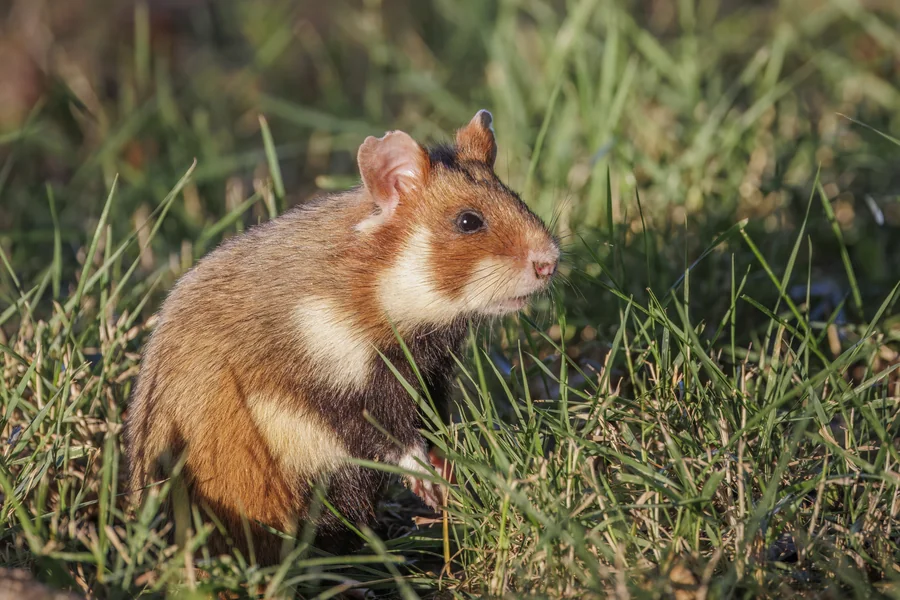
Scientific Name: Cricetinae Class: Mammalia Diet: Omnivore
Hamsters fill up large cheek pouches and take food home to save for later. These small rodents create large burrows in the wild, having distinct sleeping, eating and waste rooms. They are solitary and may be aggressive when breeding with each other as adults. Hamsters have teeth that never stop growing and continuously gnaw to keep them a manageable length. The majority of species are crepuscular.
Harp Seal
Scientific Name: Pagophilus groenlandicus Class: Mammalia Diet: Carnivore
Harp seal pups are born with soft white fur which helps them camouflage themselves in Arctic ice, but which they will shed within weeks. Adult fish hunters dive very, very deep to catch fish and crustaceans, keeping their breath for more than 15 minutes at a time. Every year they fly in flocks of thousands of birds over thousands of miles between their breeding and feeding areas. Harp seals are ice-floaters, whose pupping locations are threatened by shrinking ice as a result of the warming oceans.
Hummingbird
Scientific Name: Trochilidae Class: Aves Diet: Nectarivore/Insectivore
Hummingbirds can beat their wings up to eighty times a second, which allows them to hover, and even to fly backward. Their perpetual activity consumes tremendous amounts of energy and they consume flower nectar all day, visiting hundreds of flowers. Some species enter into a “low power mode” during the night which they use to conserve energy, known as torpor. They fly at speeds of up to 1,100 beats per minute, which is one of the fastest in the animal kingdom.
Great Blue Heron
Scientific Name: Ardea herodias Class: Aves Diet: Carnivore
The great blue heron waits silently at the water’s edge waiting for fish, frogs or small mammals to come into view within his reach. It has a long, coiled neck, and a sharp bill that can move swiftly from side to side. They come back to the same nesting site, called a rookery, year after year, nesting in colonies high in a tree close to water. Great blue herons weigh about 5 to 6 lb. even though they are tall.
Red-tailed Hawk
Scientific Name: Buteo jamaicensis Class: Aves Diet: Carnivore
The red-tailed hawk is one of the most abundant birds of prey in North America and is easily seen soaring over open fields. It is a predator which hunts small mammals such as rodents and rabbits, using its keen eyesight, much better than humans, to spot the prey from a great height. It has a piercing, sharp scream that is so well known that it is usually used for any bird of prey, even eagles, in movies. They are monogamous and re-use nests.
Honey Badger
Scientific Name: Mellivora capensis Class: Mammalia Diet: Omnivore/Carnivore
Fearless beasts that put venomous snakes and even lions to flight when challenged, honey badgers have earned a reputation as one of the most fearless animals on Earth. They have a thick and loose skin which allows them to twist themselves around to bite attackers even when they are being captured. They burrow and forage for larvae and honey in beehives, which they excavate themselves, without being bothered by the stings. They are found throughout Africa and in parts of Asia and devour insects, small reptiles and just about anything else.
Howler Monkey
Scientific Name: Alouatta Class: Mammalia Diet: Herbivore/Frugivore
Howler Monkeys can make one of the loudest calls of all land animals, easily heard 3 miles across dense rain forest. They use their roar to establish their territory and to prevent physical conflict with other troops, and a special throat bone, known as a hyoid, amplifies their roar. Lives almost exclusively in trees, where it has a very strong prehensile tail as its fifth limb. They eat leaves, but fruits and flowers if available.
Humpback Whale
Scientific Name: Megaptera novaeangliae Class: Mammalia Diet: Carnivore
Humpback whales migrate more than almost any other mammal, from icy feeding grounds to warm tropical breeding waters up to five thousand miles apart. They swallow food by forming a bubble net of bubbles to catch schools of fish from which to lunge with an open mouth. During the breeding season males sing long and complex songs, which may last for more than 20 minutes and vary annually. The weight of an adult is up to 40 tons.
Northern Harrier
Scientific Name: Circus hudsonius Class: Aves Diet: Carnivore
The northern harrier is a bird of open fields and marshes that hunts low to the ground, flying slowly and steadily in circles of just a few feet from the ground. It uses sound at least in part to find its prey and has an owl-like facial disc that focuses sound, which is not found in most hawks. Primarily a prey of small mammals and birds, it hunts with a sudden and violent motion when it senses movement beneath it. Very differently coloured, and so different that early observers believed they to be separate species.
Harlequin Duck
Scientific Name: Histrionicus histrionicus Class: Aves Diet: Carnivore
Harlequin ducks live in one of the roughest habitats any waterfowl chooses, riding fast-moving mountain streams and crashing coastal waves. Their bold blue, white, and rust markings make males easy to spot, while females stay a duller brown for camouflage while nesting. They dive underwater to pick small invertebrates like snails and insect larvae off rocky stream beds. Breeding pairs often carry visible scars from years of battling turbulent whitewater rapids each season.
House Sparrow
Scientific Name: Passer domesticus Class: Aves Diet: Omnivore
House sparrows have followed human settlements around the globe, nesting in building gaps, streetlights, and roof eaves rather than natural cavities. They eat seeds and grains most of the year but switch to insects when feeding chicks, giving young birds the protein they need to grow fast. These birds are highly social, forming noisy flocks and dust-bathing together to keep feathers clean. Despite being common everywhere, populations have dropped sharply in many cities.
Hermit Crab
Scientific Name: Paguroidea Class: Malacostraca Diet: Omnivore/Scavenger
Hermit crabs never grow their own hard shell, so they borrow empty snail shells for protection and swap them out as their bodies grow. When a bigger shell becomes available, several crabs sometimes line up by size and trade shells in an orderly sequence. They scavenge along beaches and ocean floors, eating algae, dead animals, and leftover scraps. Left without a suitable shell, a hermit crab becomes vulnerable and stressed until it finds a new one.
Horned Lizard
Scientific Name: Phrynosoma Class: Reptilia Diet: Insectivore
Horned lizards rely on camouflage first, freezing motionless against desert soil to avoid catching a predator’s eye. If that fails, some species can squirt a thin stream of blood from the corners of their eyes, startling attackers long enough to escape. Their diet is dominated by harvester ants, which they lap up with a sticky tongue in large quantities. Their body is covered in spiky scales that make them an uncomfortable meal for many predators.
Horseshoe Crab
Scientific Name: Limulus polyphemus Class: Merostomata Diet: Omnivore/Scavenger
Over four hundred million years later, horseshoe crabs have changed remarkably little, thus the nickname “living fossil. Even though they are called crabs, they are more closely related to spiders and scorpions. Thousands of them come ashore in the spring to spawn, producing eggs that nourish migrating shorebirds while they are doing so. They are also used with a copper-containing compound to give their blood a blue color, which is used in medical testing for bacterial contamination in vaccines and equipment.
Huntsman Spider
Scientific Name: Sparassidae Class: Arachnida Diet: Carnivore
As opposed to most spiders, huntsman spiders do not build a web to catch prey, but rather they rush about to catch their food. They are flattened, allowing them to creep into tight spaces between bark or in houses, sometimes finding their way inside. At night they hunt insects, and sometimes small lizards, and they are able to use strong front legs to hold prey in place before they bite it. Though they are large and swift, they do not pose a threat to human beings.
Honeybee
Scientific Name: Apis mellifera Class: Insecta Diet: Herbivore/Nectarivore
The honeybee society is one of the most organized insect societies in existence, consisting of a single female queen, thousands of female workers and a few male drones. A waggle dance is used to communicate the location of food sources, direction and distance is coded in the movements of the workers. A colony may produce more than it needs, and store the excess for the winter months, when flowers are not available. Bees are also very important pollinators of a large proportion of our food crops.
Hornbill
Scientific Name: Bucerotidae Class: Aves Diet: Omnivore/Frugivore
A peculiar nesting behavior of hornbills is their practice of sealing the female, with mud and droppings, inside a tree hole, with a small hole for the male to feed her. This will keep predators away from her and the chicks while they are hatching. They have large curved bills which are mostly hollow, and made of light bone and keratin. Fruit, insects and small animals are their primary food and they are important agents for seed dispersal in forests.
Hoatzin
Scientific Name: Opisthocomus hoazin Class: Aves Diet: Herbivore
The hoatzin is unusual among birds in having an enlarged crop where leaves are fermented prior to digestion. This process makes it strong and musky smelling, hence its nickname stinkbird. Chicks are born with small claws on their wings to enable them to climb back up a tree if they fall in water below. Hoatzins are clumsy birds that are weak on their feet, but are good swimmers when they are scared of predators.
Hooded Seal
Scientific Name: Cystophora cristata Class: Mammalia Diet: Carnivore
Male hooded seals have an inflatable sac on top of their noses to prepare for impressing other males and females. They also force a membrane out of one of their nostrils, forming a bright red balloon as a warning display. Hooded seals spend hours diving in the cold Arctic and North Atlantic waters to find food, such as fish and squid. Pups double their birth weight in days, and grow faster than nearly any other mammal.
European Hare
Scientific Name: Lepus europaeus Class: Mammalia Diet: Herbivore
European hares are fast animals, capable of running almost 45 miles per hour to escape from foxes and other predators in open fields. They do not use underground burrows as rabbits do, but rather they lie in small hollows called forms and are born furred with open eyes. Boxing is a popular sport in spring between hares, usually between females defending off too forward males and not between males and males. Their diet consists primarily of grasses, herbs and crops.
Highland Cattle
Scientific Name: Bos taurus taurus Class: Mammalia Diet: Herbivore
The Highland cattle sport a shaggy double-coat that helps them to withstand the freezing conditions they enjoy in Scotland year-round, even when they are outside without shelter. They are easy to identify due to their thick fringe of hair and long horns, but are generally calm and easy to handle. This breed can be useful on land that would not be suitable for farming as it thrives on rough pasture which is not suitable for other breeds. Calves usually do not require assistance in birth even in cold weather.
Rock Hyrax
Scientific Name: Procavia capensis Class: Mammalia Diet: Herbivore
Rock hyraxes resemble large guinea pigs, but they are more closely related to elephants, having similar tusks and feet. They inhabit rocky outcrops throughout Africa and the Middle East and, when it gets hot, they all lie in the sun together to keep their bodies warm. Groups post sentries who bark sharply to alert others to a predator so that the other members can dart into crevices. They have rubber-like pads on their feet which enable them to climb smooth rock without any difficulty.
Hercules Beetle
Scientific Name: Dynastes hercules Class: Insecta Diet: Herbivore
This is one of the largest insects on the earth, and during the mating season the males fight with each other for ownership of a tree branch, using a large curved horn. It is a pretty strong beetle for its size, as it can lift more than 100 times its own weight. The larvae live for many years in logs in the rain forests of Central and South America. Adults survive for just a couple of months following the process of maturation.
Housefly
Scientific Name: Musca domestica Class: Insecta Diet: Omnivore
Houseflies taste with their feet; as soon as they step on something that has sugar, they’re able to taste it. They can’t eat solid foods, so they vomit digestive fluid on it, and then lap it up. A female can produce hundreds of eggs during her brief life near food debris, no wonder populations can grow so rapidly. Houseflies are widespread and thrive in human habitats, except in Antarctica.
Hognose Snake
Scientific Name: Heterodon Class: Reptilia Diet: Carnivore
When threatened, hognose snakes will raise the front half of their bodies to form a cobra like stance and hiss noisily. If that bluff doesn’t work, they turn on their back, open their mouth and play dead, even giving off a bad odor to make it believable. Their head is tucked down and they have a powerful snout that they use to dig up toads, their favorite meal, from the loose sand and soil. They are slight poisons and not really dangerous for humans.
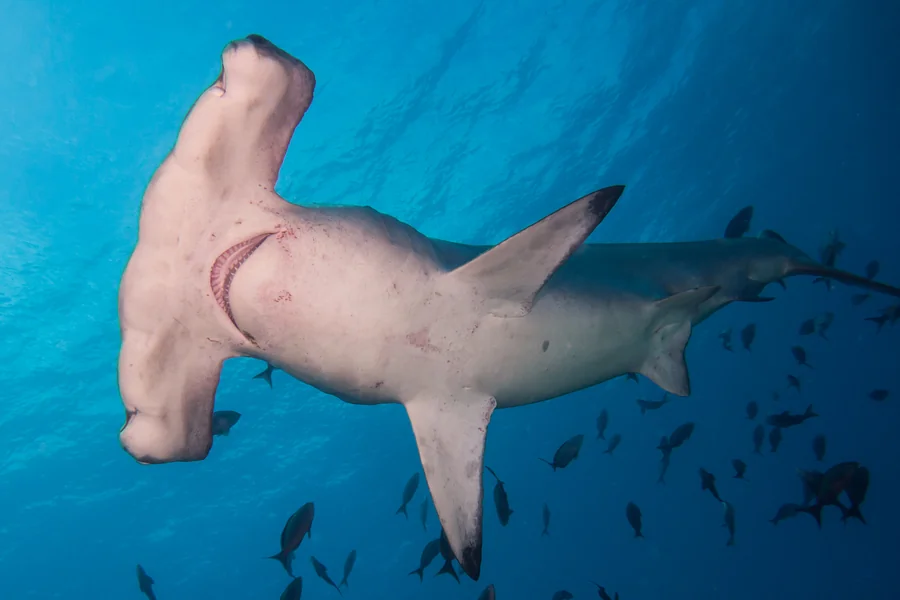
Hammerhead Shark
Scientific Name: Sphyrnidae Class: Chondrichthyes Diet: Carnivore
The hammerhead shark is named for its large flattened head, which is called a cephalofoil, that allows them to see around them in almost a full circle and have their eyes set apart to see depth. The shape also helps fit in additional sensory organs which pick up very small electrical currents emitted by animals hiding in sand, particularly stingrays. A few species form large schools during the day—a very unusual behavior in sharks. They are found in warm coastal waters around the world.
Halibut
Scientific Name: Hippoglossus Class: Actinopterygii Diet: Carnivore
Halibut have an eye on each side of their head when born and as they mature, they move their eye across the head until they are flat. This allows them to lie camouflaged on the bottom of the ocean with both eyes looking up and watching for food. They attack fish, crabs and squid from hiding, launching a dash for speed when prey is found. Pacific halibut are one of the largest flatfish, reaching lengths of more than 8 feet.
Harbor Seal
Scientific Name: Phoca vitulina Class: Mammalia Diet: Carnivore
Harbor seals rest on rocks and sandbars all around the world’s coastlines between hunts where cold and nutrient rich water can be found. They can dive up to 500 feet deep and breathe for almost 30 minutes, chasing fish, squid and shellfish. They are generally solitary and shy, and do not communicate with others by loud calls like some species of seals. Mothers care for their pups for about a few weeks before the young have to look after themselves.
Harbor Porpoise
Scientific Name: Phocoena phocoena Class: Mammalia Diet: Carnivore
Harbor porpoises are one of the smallest marine mammals, seldom exceeding six feet in length, and they are much more wary than dolphins are of disturbing the boats. They click rapidly to navigate and “fish-find” by echolocation, feeding virtually all the time to sustain their high metabolic rate. They burn their energy rapidly; a day or two without food could be lethal. They are not found in large pods, but rather in small, loose groups.
Hartebeest
Scientific Name: Alcelaphus buselaphus Class: Mammalia Diet: Herbivore
Hartebeest are more suited to endurance than to speed, and are capable of running for hours without stopping, in an attempt to avoid being hunted by predators on the savanna. They are ungainly looking with a long face and ringed horns but this shape helps them to pick up on danger over tall grass. They rear their young in herds, and the matriarchs take care of the rest while the males defend a territorial space and mark it with dung piles and scent glands around their eyes. They feed almost exclusively on grass.
Hoary Marmot
Scientific Name: Marmota caligata Class: Mammalia Diet: Herbivore
Dwelling almost eight months underground in cold mountain meadows to survive extreme winters, hoary marmots are found high up in mountain meadows. During the winter months when they are active they feed voraciously on grasses and flowers and store fat for the coming winter sleep. Colonies have a lookout which produces an alarm whistle sound, hence the nickname whistler used in some parts of the world. They are very social and will lie on rocks together during the day while grazing in small intervals.
Hooded Vulture
Scientific Name: Necrosyrtes monachus Class: Aves Diet: Scavenger
As scavengers, hooded vultures are a vital component of the African landscape that help to clean up dead animals rapidly and prevent the spread of disease. Their bald head is believed to be only for hygiene during feeding within the carcass but it also helps to control temperature. They will feed near human habitations on scraps and waste, as well as wild animals. In recent decades, populations have decreased by poisoning, making this common bird now critically endangered in much of its range.
House Wren
Scientific Name: Troglodytes aedon Class: Aves Diet: Insectivore
House wrens are tiny but surprisingly aggressive; sometimes they will destroy the nests of other birds that are nearby, in order to out-compete them for food and space. Several rough nest starts are constructed by the male in varying locations and the female selects her preferred nest and completes the construction. Their loud bubbling song sounds too big for such a small bird, and is frequently heard before the bird is seen. They prey on insects and spiders on low branches and shrubs, nearly all of their diet.
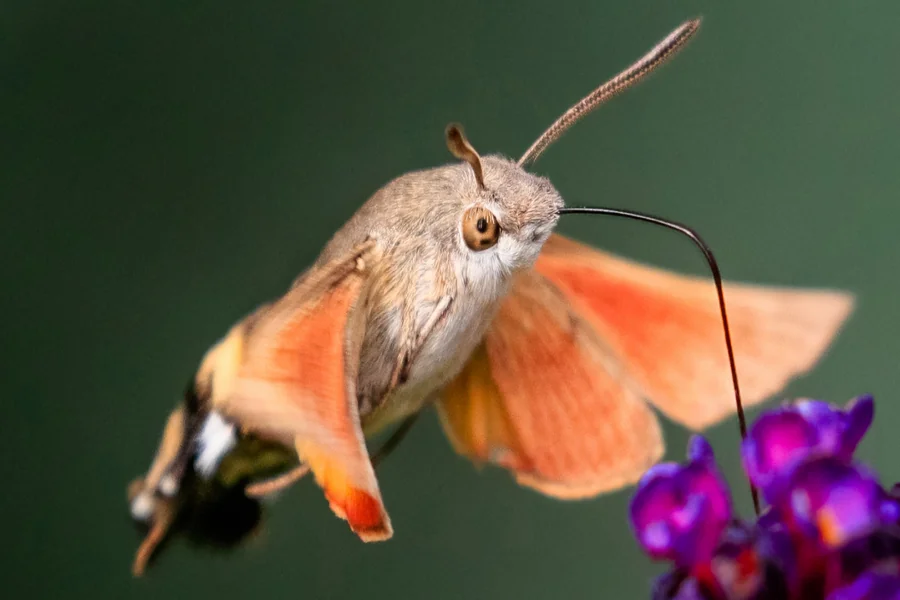
Hummingbird Hawk-moth
Scientific Name: Macroglossum stellatarum Class: Insecta Diet: Nectarivore
The hummingbird hawk-moth can be mistaken for a hummingbird because of its fast wingbeats and hovering flight in front of flowers. It extends a long proboscis into the blossom, and sucks the nectar without alighting on it. Unlike most of its nocturnal relatives, this moth is active during the day and can be seen flitting from one garden flower to another in Europe and Asia. Some people fly hundreds of miles from one season to the other.
Hyacinth Macaw
Scientific Name: Anodorhynchus hyacinthinus Class: Aves Diet: Herbivore/Frugivore
The largest flying parrot is the hyacinth macaw whose long, deep blue feathers make it easily recognizable and whose wingspan can reach more than four feet wide. It has a strong beak that can break open the hardest palm nut, the majority of its diet in its natural habitat. Typically found in woodlands and wetlands, pairs mate for life and remain together throughout the year. In the wild this beautiful bird is vulnerable due to habitat loss and illegal trapping.
Hooded Oriole
Scientific Name: Icterus cucullatus Class: Aves Diet: Omnivore
Hooded orioles prefer palm trees for nesting and make hanging pouches in palm fronds, using plants fibers to make the nests. Males are brightly coloured with an orange and black pattern, females are duller yellow-green to help camouflage them when incubating eggs. They are nectarivorous, insectivorous and fruetivorous, and sometimes visit hummingbird feeders for a ‘sweet treat’. They are found throughout the southwest and migrate to Mexico for the winter.
Lesser Hedgehog Tenrec
Scientific Name: Echinops telfairi Class: Mammalia Diet: Insectivore
The lesser hedgehog tenrec is virtually identical to a hedgehog, but it is not closely related; it is just a case of convergent evolution. It is a native of Madagascar and when disturbed will form a spiky ball as does its look alike. It is nocturnal, hunting insects and small invertebrates from the leaf litter, by using a good sense of smell. It goes into a state of torpor during cooler, drier months, slowing down its metabolism so as to conserve energy.
Hellbender
Scientific Name: Cryptobranchus alleganiensis Class: Amphibia Diet: Carnivore
Hellbenders are massive salamanders with loose folds of skin that allow them to breathe from the cold, rushing water of streams. Strong senses of smell and touch, they hide under flat rocks during the day and hunt for crayfish, small fish and insects at night. They can reach a length of over two feet and are one of North America’s largest salamanders. They are the indicator of healthy water as they cannot survive in polluted or silty streams.
Great Horned Owl
Scientific Name: Bubo virginianus Class: Aves Diet: Carnivore
The great horned owl is a strong, versatile predator of the Americas ranging from woodlands to city parks. It is able to do silent flight, with soft feather edges, so that it attacks it without warning. It eats mice and is known to attack larger animals such as skunks and even other birds of prey. The tufts on its head which are sometimes confused with ears are actually feathers for display and camouflage.
Hog Deer
Scientific Name: Axis porcinus Class: Mammalia Diet: Herbivore
The name comes from the way the hog deer runs low to the ground, rather than bounded through the grass like a normal deer. They grow in dense tall grassland, and are native to floodplains in South and Southeast Asian, predating to avoid predators by using cover in dense tall grassland. Males develop small antlers which are shed and replaced annually, primarily for use in disputes over breeding season. This was one of the most widely seen species, but has become rare in many areas as a result of habitat destruction due to agriculture activity.
Himalayan Tahr
Scientific Name: Hemitragus jemlahicus Class: Mammalia Diet: Herbivore
Himalayan tahr are well adapted to life on the steep, rocky cliff faces where their rubbery hooves are able to cling to narrow ledges which most predators cannot reach. They are insulated with thick and shaggy coats so they can withstand freezing mountain winters at elevations above 10,000 feet. They feed on grasses, herbs, and shrubs, and live in herds that are led by an elderly female. Tahr were introduced to New Zealand in the early 1900s, and now they too flourish here – although in their native land, in the Himalayas, their conservation status is more precarious.
Horsefly
Scientific Name: Tabanidae Class: Insecta Diet: Carnivore/Herbivore
The mouthparts of the female horsefly are blade-like and designed for sharp biting and puncturing of the skin to obtain blood which is essential for egg production. Males on the other hand, only take nectar and pollen and are incapable of biting. They are very fast and strong flying insects and will pursue livestock or humans by open fields on warm summer days. Larvae grow in the soil or water, preying on small invertebrates, and emerge as adults.
House Centipede
Scientific Name: Scutigera coleoptrata Class: Chilopoda Diet: Carnivore
House centipedes are one of the fastest moving arthropods in proportion to their body size, moving in quick, erratic bursts on fifteen pairs of long legs. Although they might seem unsettling, it is helpful to have them around as they will feed on cockroaches, spiders and other house pests. They like dark and damp areas such as bathrooms and basements, and want to stay out of the light wherever possible. They have a potent venom that overcomes their prey, insects, but is not particularly toxic to humans except for mild irritation.
Harvest Mouse
Scientific Name: Micromys minutus Class: Mammalia Diet: Omnivore
The harvest mouse is one of the smallest rodents in the world; it is light enough to climb the tall grass stems without bending them down. Constructs a dense, globular nest on the ground, holding it up between several stems to prevent it being blown away in the wind. It has a flexible, semi-prehensile tail, used for clinging to stems when it is climbing and searching for seeds, grain and insects. It can be found throughout European farmland and meadows, and is in decline due to intensive farming which has lost favorable habitat.
Hooded Crow
Scientific Name: Corvus cornix Class: Aves Diet: Omnivore
Hooded crows are a very intelligent species, dropping hard shelled food such as nuts or shellfish on roads to be broken open by passing cars. They are fairly adaptable and will consume almost anything, including carrion, insects, eggs and human food scraps. They are common all over Northern and Eastern Europe, and can be distinguished from all-black crows by their gray body and black head, wings, and tail. Pairs are monogamous and are territorial.
Humboldt Penguin
Scientific Name: Spheniscus humboldti Class: Aves Diet: Carnivore
Although not living near Antarctica, the Humboldt penguin is comfortable living near the cool beaches of Chile and Peru, where the nutrient-laden Humboldt Current brings warmth. They bury their eggs in the guano piles or holes in rock, and cover their eggs and chicks with guano to keep them cool in hot weather. They are highly adept swimmers and are able to catch anchovies and small fishes while diving out into the open sea, and sometimes they travel great distances in search of food. This species has become vulnerable due to overfishing and habitat disturbance.
Humboldt Squid
Scientific Name: Dosidicus gigas Class: Cephalopoda Diet: Carnivore
Humboldt squid hunt in co-ordinated packs, communicating by flash of patterns of red and white skin in the murky waters they prefer to hunt. They can reach six feet in length, and react instantly with barbed suckers along their tentacles. They can be found primarily in the eastern Pacific, and change their vertical position daily and move towards the surface at night to feed on small squid and fish. They are considered to be aggressive feeders and fishermen call them red devil.
Hawksbill Turtle
Scientific Name: Eretmochelys imbricata Class: Reptilia Diet: Omnivore
The narrow and curved beak of the hawksbill turtle is adapted to burrowing into coral crevices and is used to feed on sponges that other animals don’t like to eat. This diet is a healthy diet for coral reefs as it provides better control of sponge growth that might otherwise outcompete the coral. They have been hunted illegally for this strikingly patterned shell for decades, making them critically endangered. Females will come back to the beach they hatched on to lay their eggs as well.
Harpy Eagle
Scientific Name: Harpia harpyja Class: Aves Diet: Carnivore
The harpy eagle is one of the strongest and largest eagles alive and its talons are as long as those of a grizzly bear. It is an active hunter in the dense rain forest canopies of Central and South America, using a quick dash from one tree to another to locate its prey, such as sloths, monkeys and others. When the bird is alert or threatened, it raises up a prominent crown of feathers. Deforestation is a major threat to its survival as it requires extensive continuous forest for hunting.
Hooded Merganser
Scientific Name: Lophodytes cucullatus Class: Aves Diet: Carnivore
Hooded mergansers hunt for small fishes, crayfish and aquatic insects underwater with a thin, serrated beak that it uses to seize slippery prey. During courtship displays, males raise a spectacular black and white crest, resembling a hand fan. They lay their eggs in holes in trees on or close to water and the ducklings leave the nest opening within a day of hatching and land safely on the ground below. They lay their eggs in wooded wetlands throughout North America.
Desmarest’s Hutia
Scientific Name: Capromys pilorides Class: Mammalia Diet: Herbivore
Desmarest’s hutia is the largest living rodent found in Cuba, and is found on the ground or climbing trees for leaves and fruit. Compared to other rodents it has a slow and steady gait, relying on heavy fur and a calm demeanor to escape danger. These hutias are primarily nocturnal and habitate burrows, rock crevices and tree holes during the day. They have limited their distribution as a result of habitat loss.
Argentine Horned Frog
Scientific Name: Ceratophrys ornata Class: Amphibia Diet: Carnivore
The Argentinean horned frog is an ambush predator that can swallow objects as large as itself, such as small rodents and other frogs. It lives in soil or litter and poking out only its eyes and waits for something to come near enough to strike. It has a stocky body with pointed eye ridges which give it a unique appearance, so that it is also called pacman frog by reptile keepers. Does not move easily except for hunting or when threatened.
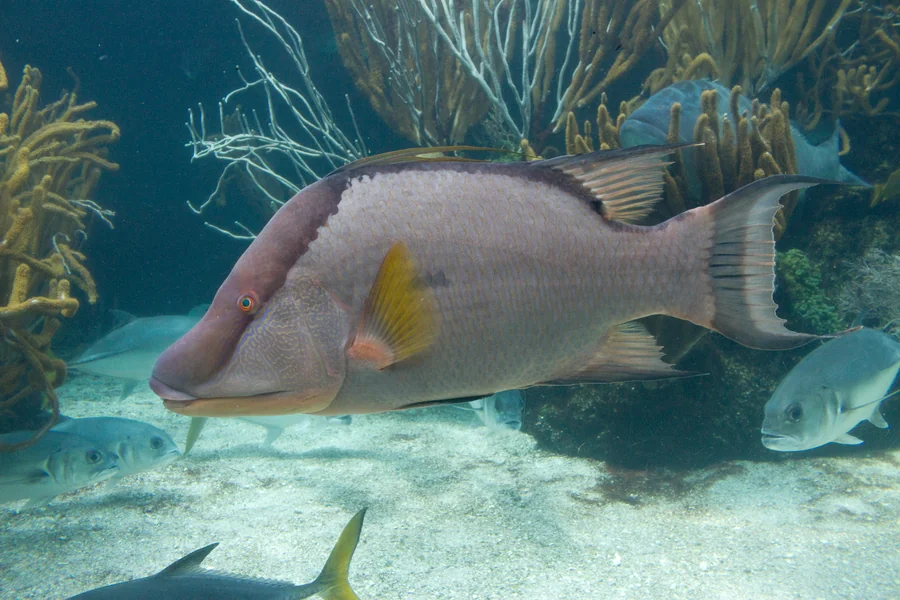
Hogfish
Scientific Name: Lachnolaimus maximus Class: Actinopterygii Diet: Carnivore
Hogfishes have a snout-like mouth, which they use to root out crabs, shrimp, or mollusks, just as a real hog roots out food in soil through the sand and rubble. They are able to rapidly turn a different color to blend in with their surroundings, ranging from mottled red, brown and white for reef environments. All hogfish are born female, and some may switch to a male sex as they mature and grow within their social group, in warm Atlantic waters.
Spotted Handfish
Scientific Name: Brachionichthys hirsutus Class: Actinopterygii Diet: Carnivore
Spotted handfish are unusual bottom fish that do not swim freely, but instead use modified fins that look like small hands to walk around on the seafloor. They are only found in shallow waters off the coast of Tasmania and they lay their eggs on upright objects such as sea squirts, where they watch them hatch. They have a restricted distribution and are slow moving, making them extremely susceptible to disturbance of their habitat, and an introduced starfish species has threatened the egg laying areas they depend upon, potentially bringing them to the brink of extinction.
Honduran White Bat
Scientific Name: Ectophylla alba Class: Mammalia Diet: Herbivore/Frugivore
Honduran white bats create their own roosting shelter, chewing through a large leaf to fold the sides down to form a tent, thus creating a small colony to keep dry and out of the way of predators. They are one of the most unique bats in the world, characterized by their fluffy white fur, and yellow nose and ears. Their fur is greenish in color from the green leaf tent they wear when they are in the sun. They have a nearly exclusive diet of a single species of fig.
Hooded Pitohui
Scientific Name: Pitohui dichrous Class: Aves Diet: Omnivore
A distinctive feature of the hooded pitohui is that the skin and feathers of the bird are poisonous if handled or consumed due to a toxin it acquired from the food it eats, certain beetles. This chemical defence is responsible for the numbness and irritation of predators that try to seize it and provide protection without fleeing. It is found in the forests of Papua New Guinea and feeds on insects and fruits in the upper canopy. Local hunters have long been warned not to touch this striking orange and black coloured bird.
Final Thoughts
That wraps up all 60 animals that start with h, and the range is bigger than most people expect walking in. There are whales as big as giants, rodents as small as harvest mice, birds as poisonous, fish as toothed and a gang-hunting squid. They were all chosen for this list for a real specific characteristic, not just because they share a common starting letter. When asked the next time, “name an animals that start with H,” you have 60 great answers ready.
FAQs:
How many animals start with the letter H?
There are dozens of well-known species, but this guide covers 60 animals that start with H, ranging from mammals like the hippopotamus and hedgehog to birds, reptiles, fish, and insects.
What is the biggest animal that starts with H?
The humpback whale is the largest animal on this list, with adults reaching up to 40 tons and 60 feet in length.
What is a common pet animal that starts with H?
The hamster is one of the most popular small pets that starts with H, known for its cheek pouches and constant burrowing behavior.
What bird starts with the letter H?
Several birds start with H, including the hummingbird, harpy eagle, great horned owl, hornbill, and hooded crow.
Is a hyena a dog or a cat?
Neither. The spotted hyena belongs to its own family, Hyaenidae, and is more closely related genetically to cats and mongooses than to dogs, despite its dog-like appearance.