From Hay Bales to Fence Posts: Matching a Tractor to a Livestock Property
Anyone who keeps animals on acreage reaches the same conclusion sooner or later: the wheelbarrow has limits. Round bales weigh more than a person can argue with, mud gets deep where cattle gather, and a mile of fence line needs mowing whether you feel like it or not. A tractor is usually the answer, but the wrong tractor is an expensive mistake that sits in the shed sulking while you borrow a neighbor’s. The trick is to choose the machine around the chores you actually repeat, then build a maintenance and parts habit that keeps it available on the days it matters most.
Start with your chore list, not the horsepower number
Write down every job you expect the tractor to do over a full year, then note how often each one comes up. A typical small-livestock list looks something like this: move and feed hay, scrape and haul manure or bedding, mow pasture and trim fence lines, drag or harrow paddocks, grade a driveway or lane, dig post holes, haul water or feed, and move material during projects. Now mark the heaviest single task. That one job — usually lifting a round bale or handling a loaded bucket of wet manure — sets your minimum machine. Everything lighter will take care of itself.
Buyers tend to fixate on engine horsepower because it is printed on the hood. For livestock work, three other numbers matter more: front loader lift capacity at full height, three-point hitch lift capacity at the ball ends, and machine weight. A tractor can have plenty of power and still refuse to pick up a dense 1,200-pound bale of wet hay, or it can lift the bale and then tip forward on a slope because it lacks ballast. Ask for lift ratings at full height rather than at the pins, since that is where you are actually stacking.
Compact or utility?
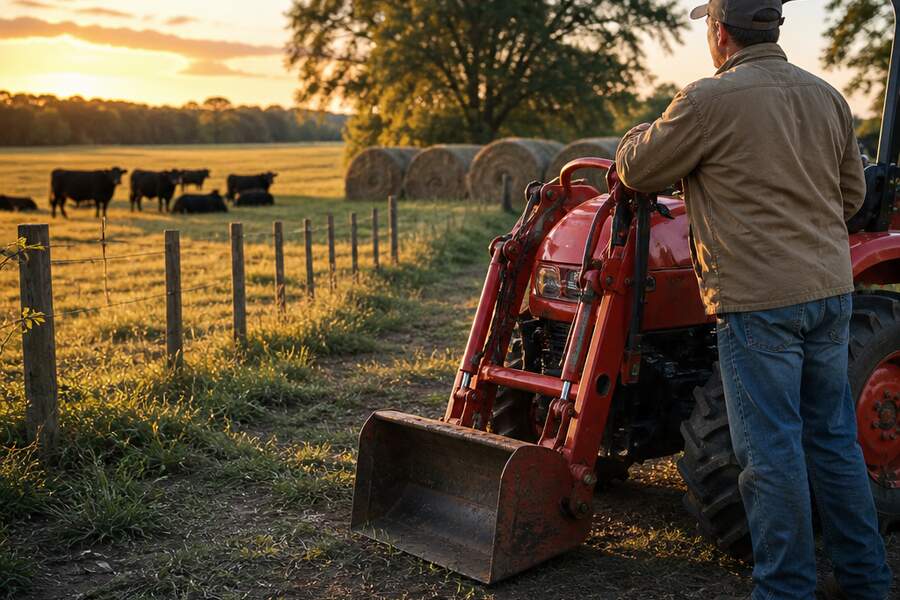
Compact tractors — roughly the 25 to 45 horsepower range — are excellent on small, tight properties with sheep, goats, poultry, horses or a handful of cattle. They fit through gates, do less damage to wet pasture, and handle a rotary cutter, box blade and loader without drama. Utility tractors, from about 45 horsepower upward, earn their keep when you are handling big round bales daily, running a baler or heavy mower, or working uneven ground where weight and stability matter. If you are undecided, imagine your operation three years from now rather than today. Herds grow; tractors do not.
Implements decide more than the tractor does
A tractor is a power source; the implements do the work. Budget for them from the start, because a bare tractor with no loader attachments is close to useless on an animal operation. The core set for most livestock keepers is a front loader with a bucket, a bale spear or grapple, a rotary cutter sized to the tractor’s power take-off rating, and a box blade or rear blade for lanes and gateways. A post hole digger pays for itself on the first fencing project if you are maintaining rotational grazing paddocks.
Two practical cautions. First, match implement width to your gates and alleyways — a six-foot cutter is no bargain if your paddock gates are five feet wide. Second, check the hydraulic flow and number of remote valves the tractor offers before buying a grapple or anything else that needs extra circuits. Retrofitting hydraulics later costs more than specifying them at purchase.
New, used, and the honest math
Used equipment makes sense when the machine has a known service history, when parts are still widely available, and when you can inspect it on the ground: look for loader frame cracks, worn pins and bushings, hydraulic weeping at the cylinders, uneven tire wear, and a clean cold start without blue smoke. New equipment makes sense when downtime is expensive, when you want a loader and implements configured to work together, and when you intend to keep the machine long enough for reliability to outweigh the purchase price. Farm equipment writers have long used crop-based comparisons to frame that decision, and discussions of how many acres of corn it takes to buy a new tractor are a useful reminder that a machine has to be paid for by the work it does, not by how good it looks parked.
Equipment decisions also belong in the conversation long before you own animals. Access roads, gate widths, soil drainage and the shape of your paddocks all dictate what machinery can physically operate on a property, which is one of the quieter items on the checklist of things to know before you sign for land to keep animals. A parcel with a single soft-bottomed lane will fight every tractor you put on it.
A seasonal service rhythm that actually gets followed
Service schedules fail when they live in a manual nobody opens. Tie them to the seasons you already think about instead.
- Before spring mowing: change engine oil and filter, check hydraulic and transmission fluid levels, grease all loader and three-point pivots, inspect power take-off shields, sharpen or replace cutter blades, and check tire pressures front and rear.
- Midsummer: blow out the radiator screen and air filter — hay chaff and seed heads are the leading cause of overheating on livestock farms — and inspect belts and coolant hoses.
- Before hay and bale season: inspect bale spear welds and grapple teeth, check loader quick-attach latches, and test the parking brake on a slope.
- Before winter feeding: replace fuel filters, treat diesel against gelling, test the battery and clean terminals, check block heater function if you have one, and verify lights and beacons for dark-morning chores.
- Every 50 hours, no exceptions: grease points, wheel lug torque, and a walk-around looking for fresh oil drips or loose hardware.
Keep a simple logbook in the cab — date, hour meter, what you did. It takes thirty seconds and it is the single best thing you can do for resale value and for diagnosing problems later.
Parts, service and the value of a dealer relationship
Filters, belts, hydraulic hoses, blades and seals are the consumables that decide whether a breakdown costs an afternoon or a week. The cheapest substitute filter is rarely the bargain it appears to be once you factor in the risk to a hydraulic system full of fine-tolerance components, which is why most people who depend on a machine daily stay with manufacturer-specified replacements and keep a small shelf of common items on hand. For Kubota owners across Kentucky, Tennessee, Indiana and the surrounding states, a dealership like H&R Agri-Power works as both a Kubota parts dealer and a repair shop, carrying genuine parts and replacement components for tractors, mowers and balers alongside new and used equipment — useful when you want the person ordering your parts to understand the machine they came off.
Build that relationship before an emergency. Record your model and serial numbers, note your hour meter reading, and order routine filters ahead of the season rather than the morning you need them. If you run a baler or mower, ask which wear parts are commonly stocked and which take time to arrive, then keep the slow-moving ones yourself.
What a well-matched tractor gives you back
The right machine is the one that starts on the coldest morning of the year, carries the heaviest bale you own, fits through your narrowest gate, and can be put back together with parts you can get quickly. Choose for your real chore list, size the loader before the engine, keep the service log honest, and treat your parts counter as part of the operation rather than an afterthought. Do those four things and the tractor stops being a worry and goes back to being what it should be — the reason feeding time takes twenty minutes instead of two hours.