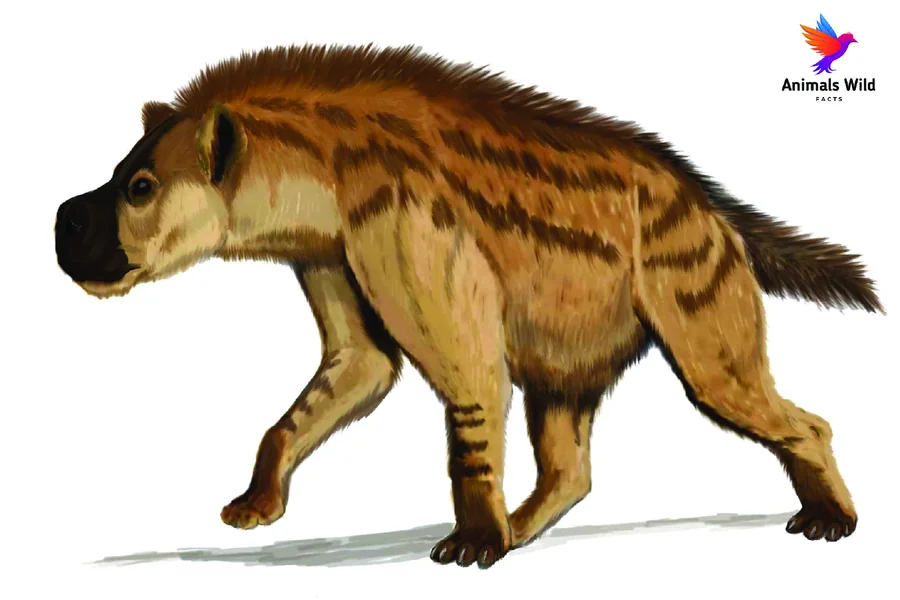
Dinocrocuta — The Prehistoric Beast That Outweighed Lions and Hunted Rhinos
Dinocrocuta is a species most people will never have heard of. Unfortunately, it was one of the most formidable land predators of its day – a formidable, barrel-chest predator with bone-crushing jaws, a skull that was as large as a coffee table and the audacity to attack rhinoceroses.
Dinocrocuta was a Miocene Epoch African-Asian top carnivore, which closely resembled modern hyenas. However, it was not accompanied by a hyena. The name means ‘terrible hyena’ but it was closer to cats and false saber-toothed cats than to the hyenas it looked like.
The resemblance was a trick of evolution. Two separate animal lineages, millions of years apart, arriving at almost the same body plan. The Dinocrocuta just happened to make it bigger.
How Big Was the Dinocrocuta, Really?
Big enough to steal kills from saber-toothed cats. Big enough that other predators moved out of the way.
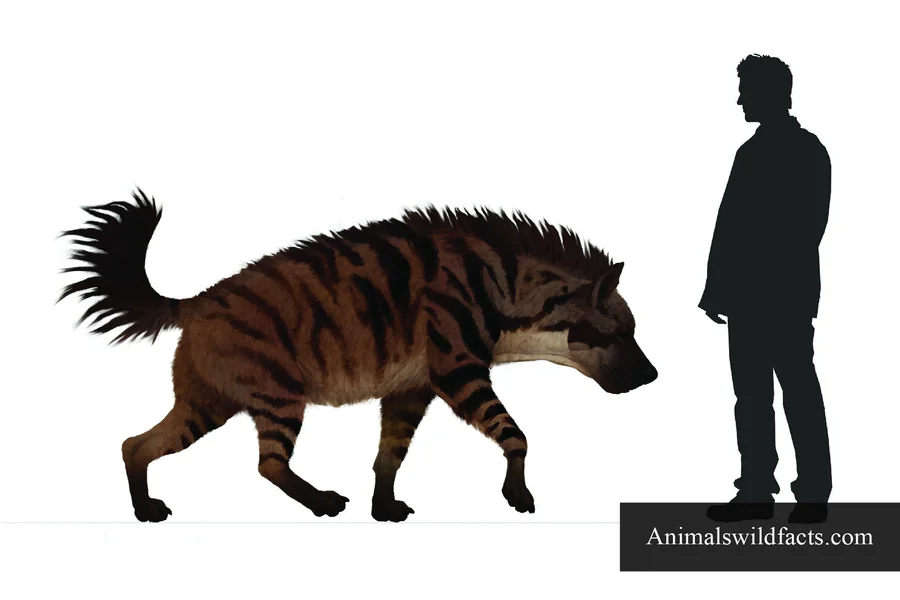
The largest species, Dinocrocuta gigantea, reached lengths of around 6.2 feet with a shoulder height of 4.3 feet. Its skull averaged 17 inches in length and the animal weighed roughly 661 pounds — comparable to the largest tigers alive today.
Some earlier weight estimates put it as high as 380 kg (840 lbs), though a more recent study suggested around 200 kg for a specimen with a 32.2 cm skull. Even at the lower number, it still outweighed Pachycrocuta brevirostris — the largest known true hyena to ever exist.
For scale: a spotted hyena today tops out around 80 kilograms. The Dinocrocuta was anywhere from two and a half to five times heavier.
The head was far more massive than that of any modern hyena — combined with powerful canines and bone-crushing premolars, this was an animal built to cover ground, dominate other predators at a kill site, and take down large prey on its own terms.
Quick Facts — Dinocrocuta at a Glance
| Feature | Detail |
| Name meaning | “Terrible hyena” |
| Family | Percrocutidae (not true Hyaenidae) |
| When it lived | Late Miocene — ~11.6 to 5.3 million years ago |
| Largest species | Dinocrocuta gigantea |
| Shoulder height | ~1 meter (3.3 ft) |
| Body length | ~2.1 meters (6.9 ft) |
| Weight | 200–380 kg (440–840 lbs) |
| Skull length | ~40 cm (16 in) |
| Range | Eurasia and parts of Africa |
| Closest living relatives | Cats, not hyenas |
Hunter, Scavenger — or Both?
For a long time, the debate was open. Fossil evidence closed it.
A fossil rhinoceros skull recovered in China bore puncture marks that matched the canine dimensions of Dinocrocuta gigantea precisely. The single wound and the bone growth over the injury showed the rhino had survived the attack — direct proof that Dinocrocuta was actively hunting, not just scavenging leftovers.
One documented case involves a Dinocrocuta individual — estimated at around 380 kg — attacking a rhinoceros weighing over 1,000 kg. That is a predator going after prey nearly three times its own body weight.
There is also no doubt that Dinocrocuta could crunch through bones to access the marrow inside — a key trait of animals that supplement hunting with scavenging. But assuming it only scavenged would be the same mistake people make about modern hyenas, which are documented active hunters as well.
It did both. That flexibility is part of what made it so successful for millions of years.
Read More: What Is the Loudest Sound
Where Did Dinocrocuta Live?
Dinocrocuta ranged across Eurasia and Africa during the late Miocene, between 11.6 and 5.3 million years ago.
Its preferred terrain was open grassland — savannahs and prairies where visibility was high and prey was plentiful. Think of the African savannah today, but with three-toed horses, giant giraffids, and multiple species of rhinoceros.
Researchers believe early Dinocrocuta forms originated in western Eurasia and gradually moved east into central China through Tibet, before the Tibetan plateau rose to its current elevation — a migration that eventually produced Dinocrocuta gigantea, the largest and most studied of the genus.
In the Dashengou Fauna of China, D. gigantea shared territory with saber-toothed cats, bears, mustelids, and other hyena relatives. Among all large carnivores in that ecosystem, Dinocrocuta was by far the most numerically common.
It wasn’t just a present. It was dominant.
Dinocrocuta vs. Modern Spotted Hyena
| Feature | Dinocrocuta | Spotted Hyena |
| Family | Percrocutidae | Hyaenidae |
| Weight | 200–380 kg | 40–80 kg |
| Skull length | ~40 cm | ~24 cm |
| Closest relatives | Cats, nimravids | True hyenas |
| How similarities arose | Convergent evolution | Direct lineage |
| Apex predator? | Yes — regional dominant | Situationally, yes |
| Status | Extinct (Late Miocene) | Living |
Early researchers assumed Dinocrocuta was a true hyena because of the physical similarities. More detailed work revealed it belonged to Percrocutidae — a separate family — and that the resemblance was the product of convergent evolution. Both lineages independently evolved the same bone-crushing skull architecture, but Dinocrocuta built a far larger version of it.
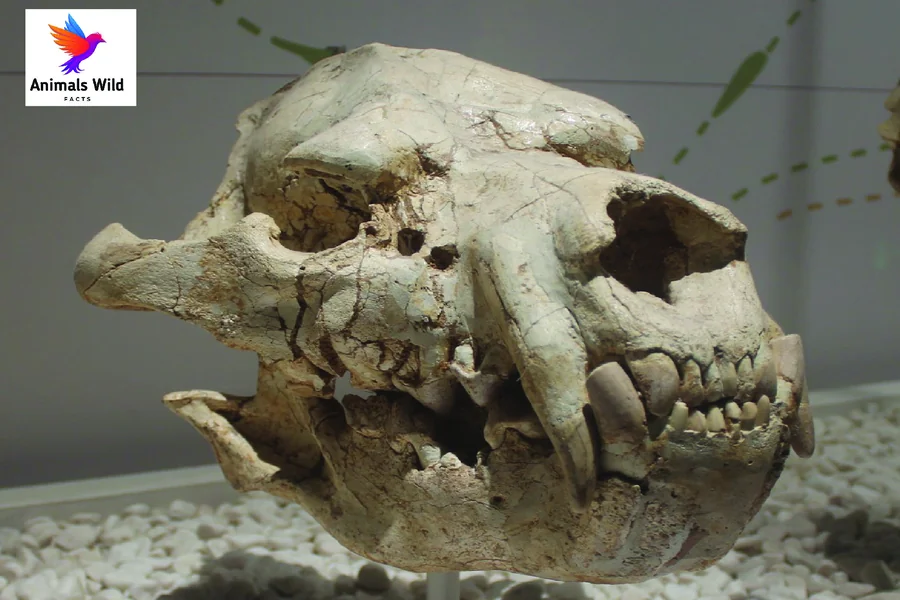
The Fossil Record — What We Actually Have
The first Dinocrocuta remains discovered were dental — teeth only. A formal description followed in 1903. The most significant find came in 1986 in Shaanxi Province, China, and included a complete skull, a partial front skull section with all teeth intact, a broken lower jaw, and several post-cranial bones.
The species Dinocrocuta gigantea was originally described as Hyaena gigantea by Schlosser in 1903, based on fragments sourced from Chinese drug stores. The genus Dinocrocuta itself was only formally created in 1976, and given full genus status in 1988.
The Hezheng Paleozoological Museum in Gansu Province, China, now holds some of the most complete specimens ever recovered — including the skull that first confirmed the animal was hunting, not just scavenging.
Dinocrocuta’s Place at the Top
Dinocrocuta was capable of preying on animals much larger than itself. The tusked rhinoceros Chilotherium — massive but vulnerable when injured or giving birth — was likely a regular target.
Dinocrocuta is also thought to have practiced kleptoparasitism alongside saber-toothed machairodonts — meaning it regularly stole their kills.
Stopping Dinocrocuta from taking a carcass would have been like standing in front of a freight train. Saber-toothed cats in the same ecosystem were probably wise enough not to try.
Dinocrocuta outweighed the saber-tooth cat Machairodus and the contemporary true hyenas that shared its range. It was not competing for the top spot. It held it.
Short Answers
| Question | Short Answer |
| What does Dinocrocuta mean? | “Terrible hyena” — from “dino” (terrible) and “crocuta,” the genus of modern spotted hyenas. |
| Is Dinocrocuta a real hyena? | No. It belongs to Percrocutidae — a separate family more closely related to cats and nimravids. |
| How big was Dinocrocuta gigantea? | Around 6.2 ft long, 3.3 ft at the shoulder, weighing between 440 and 840 lbs depending on estimates. |
| When did Dinocrocuta live? | Late Miocene, roughly 11.6 to 5.3 million years ago. |
| Where were Dinocrocuta fossils found? | China (Gansu, Shaanxi), Spain, and parts of North Africa. |
| What did Dinocrocuta eat? | Large herbivores like rhinoceroses and horses. It also scavenged and stole kills from other predators. |
| Why did Dinocrocuta go extinct? | Likely a combination of climate shifts, habitat loss, and rising competition from other carnivores. |
| Could Dinocrocuta crush bones? | Yes — its premolars were specifically adapted for bone-fracturing, similar to but stronger than modern hyenas. |
Why Did Dinocrocuta Go Extinct?
This is the part that still frustrates paleontologists.
After the Baodean age began, Dinocrocuta became rare in the fossil record and then disappeared, replaced by the much smaller Adcrocuta — a true hyena — while Amphimachairodus simultaneously became far more common as a fossil.
Two main theories compete. The first is environmental — climate shifts altered vegetation and reduced the prey populations Dinocrocuta depended on. The second is competitive pressure from other rising carnivores that could operate on less food or in different terrain.
Climate change, territorial pressure, and reduced food availability all likely played a role. No single cause has been confirmed.
What we do know is that when Dinocrocuta vanished, nothing replaced it. The niche it occupied — a large, bone-crushing, active-hunting apex predator — was simply left empty.
Read More: Open Clam
The Bottom Line
The Dinocrocuta was not a curiosity.It was a very powerful predator over millions of square kilometres of Eurasia and Africa for millions of years. It was a predator that attacked animals 3 times its own weight, the rhino. It was a kedar who displaced saber toothed cats from their prey. It was able to out-compete all other large carnivores in its environment and disappeared, not quite fully understood why.
This is a must-have for any prehistoric carnivores enthusiast! Not just because of the one spectacular fossil, although it’s tough to beat the rhino skull, but because the complete story of Dinocrocuta is just beginning to come into focus. With each new fossil discovery from Gansu or Shaanxi, one of the most compelling predator stories in Miocene paleontology is further elaborated.
FAQs:
Was Dinocrocuta related to dinosaurs?
No. Dinocrocuta lived during the late Miocene, approximately 11 to 5 million years ago — tens of millions of years after non-avian dinosaurs went extinct. The “dino” in its name means “terrible,” not dinosaur.
How many Dinocrocuta species existed?
Four distinct species have been identified within the genus, with D. gigantea being the largest and most thoroughly documented.
Could Dinocrocuta actually crush bone?
Biomechanical studies of D. gigantea‘s jaw show robust premolars and a stress distribution pattern similar to the modern spotted hyena’s, capable of fracturing large bones to access the marrow inside. The spotted hyena already has one of the strongest bites of any land mammal alive. Dinocrocuta’s was stronger — in a much larger animal.
Where can I see Dinocrocuta fossils?
The best collection is at the Hezheng Paleozoological Museum in Gansu Province, China. Key specimens from Shaanxi and North Africa are also held in research collections in Europe and Asia.