
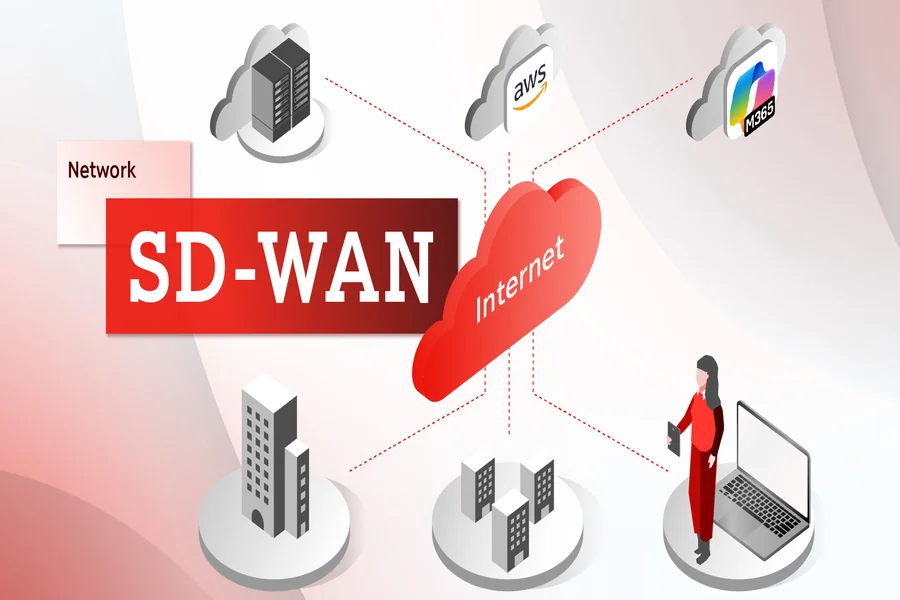
What is Sd-wan? Following the Journey of Data Across a Modern Business Network
Business networks are not always linear. The request might be initiated in a branch office, transmitted over the Internet, sent to a cloud application, and returned along some other path. Network users want their network paths to be smooth regardless of conditions. Knowing what is SD-WAN for businesses will shed light on how contemporary networks cope with such complexity.
Software-defined wide area networking or SD-WAN is a technology, which enables software policies to regulate traffic movement over a wide area network. Unlike traditional WAN, where each link has been regarded as an immutable pathway, SD-WAN makes it possible to take into account needs of applications, performance of the link, and company rules.
Why the Journey of Data Matters
Now let’s take the case of an employee accessing a cloud app from the branch office. The traffic passes through the local network and reaches an SD-WAN edge appliance. Once it is at this point, then the system is able to assess the availability of WAN links and identify which one fulfills the specific policy criteria.
It does not have to be the same for all types of traffic. There are certain cases where applications like voice and video rely on latency, very little jitter, and packet delivery. An update or a regular backup does not necessarily need a similar route.
This has relevance to the general network traffic management concepts. As described in Network Connectivity Center documentation, there are ways for companies to integrate their on-premises networks, cloud services, and SD-WAN technologies by managing the network traffic within a centralized framework. The SD-WAN technology uses a similar approach but at the enterprise level.
What Happens Inside an SD-WAN Environment?
An SD-WAN typically separates intelligence from the connections that move data. Policies can be defined by a central management layer, but those policies are enforced and traffic is forwarded by edge devices deployed at branch offices.
The process involves four stages:
- Definition of policy: Administrators define rules for applications, websites, users, connections, and security.
- Path evaluation: The system evaluates parameters like delay, loss, jitter, and link availability.
- Path selection: The network chooses an appropriate path based on current circumstances and policy.
- Path rerouting: When a path does not meet requirements anymore, traffic may be switched to another existing path if allowed by policy.
This lets the network respond to changing conditions rather than relying entirely on static routes.
Underlay and Overlay: Two Parts of the Journey
It is important to separate the physical network from the software-defined layer. Underlay refers to the connections that can be made available at the premises, such as broadband, leased lines, fiber, or mobile services. Overlay refers to the logical network formed on top of these transports, through which policy rules and secure paths can be set for the transmission of traffic.
This provides a high level of adaptability. The organization does not have to redesign all the application paths if a new transport medium is added or modified. With the availability of a new connection, SD-WAN can include it using the existing policies.
Traditional WAN vs. SD-WAN
The difference is not simply replacing one connection with another. It also changes how the network is operated.
| Area | Traditional WAN | SD-WAN |
| Traffic control | Often route and device based | Policy and application aware |
| Connectivity | Frequently centered on fixed circuits | Can combine multiple link types |
| Management | More device-by-device administration | Centralized policy management |
| Path selection | Often predetermined | Can respond to network conditions |
| Visibility | May rely on separate tools | Designed for centralized monitoring |
| Scaling | Can require manual configuration | Policies can be applied across sites |
Traditional WAN designs can still meet many needs. SD-WAN introduces a different operating model as networks become more distributed and application traffic becomes more varied.
Following a Packet Across the Network
For example, let’s take a look at a company that operates from several different cities, with its applications hosted in different data centers and clouds.
A user requests an application, the branch edge gets the traffic and understands which service is requested. It verifies the available connections with regard to the policy and, in case the preferred connection has increased packet loss or latency, selects some other suitable connection.
This idea can be used to build resilience. In case the connection becomes unavailable, another one may be selected automatically for carrying the traffic without reconfiguring the system manually. Everything will depend on policies, transports, and application.
Also, administrators could think whether the connection is suitable for a certain load instead of whether it is available or not.
Where SD-WAN Fits in a Modern Network
SD-WAN can support several practical networking requirements:
- Performance of applications: Policies could give preference to those applications which are delay, loss, or jitter sensitive.
- Visibility into operations: A centralized management could make observation simpler for various locations.
- Flexibility in connectivity: Rather than designing the network based on one path only, companies can use several transport mechanisms.
- Rapid modifications: Centralized policies can cut down redundant configuration.
These features are important for companies with distributed sites, cloud-based applications, mobile workers, or several WAN links. The importance is determined by network complexity, not just by the number of sites.
With increasing cloud-based applications being used, these decisions are playing an ever-increasing role in determining how well-connected employees access their applications.
Security and SD-WAN
Routing is just a small piece of the process. There is also a need for data to be protected while moving from one location to another and within applications.
Security functions can be directly integrated in an SD-WAN architecture or tied up with standalone security controls.
Traffic classification is yet another interesting term to know. The IETF Differentiated Services specification mentions the definition of a framework for traffic classification and forwarding treatments of IP traffic. Even though Differentiated Services and SD-WAN are not the same technologies, the concept of traffic classification helps explain why application-aware networking is important.
The security design should also consider the path of traffic. When applications move outside data centers, designers have to think about internet access, cloud connectivity, branch security, identity, and inspection altogether.
What SD-WAN Does Not Mean
The concept of SD-WAN is often referred to as a replacement for all the traditional WAN technologies. This is a too wide understanding of SD-WAN.
SD-WAN should be considered rather as a software-defined approach to WAN coordination than as a replacement of anything. It may work over various connections, such as broadband, private lines, and mobile connectivity. An enterprise may keep its current network configuration and install additional software-defined traffic management solutions over it.
It should not be considered as just an increase in the speed of an Internet connection. The performance will still depend on many factors, such as link quality, physical distance between sites, application performance, routing policy, etc.
Is SD-WAN Right for Every Network?
This largely depends on the characteristics of the network.
If the company is small, operates from only one site, and has an uncomplicated internet connection, there might be no need for the introduction of an extra management plane of its WAN. A company that is distributed, has many branches, uses cloud applications, various connections, and changing traffic will be able to justify the use of SD-WAN.
Before implementing SD-WAN, the team has to evaluate traffic characteristics, application requirements, link characteristics, security architecture, monitoring, and administration. The team has to formulate objectives which can be quantified, for example, application performance, ease of management, etc.
Frequently Asked Questions
1. What is SD-WAN in simple terms?
SD-WAN stands for Software-Defined Wide Area Networking. It is a software-based approach to managing wide area networks that uses centralized policies and network conditions to direct traffic across available connections.
2. How does SD-WAN choose a network path?
SD-WAN can consider factors such as latency, packet loss, jitter, link availability, application requirements, and configured policies. It uses these conditions to select a network path that meets the defined performance and security requirements.
3. Can SD-WAN use regular internet connections?
Yes. SD-WAN can use regular broadband internet connections alongside private links, cellular connections, and other available network transports. Using multiple connection types can improve flexibility and network efficiency, although the quality and reliability of each link remain important.
4. Does SD-WAN replace traditional WAN technology?
SD-WAN does not necessarily replace all traditional WAN technologies. Instead, it can work with existing WAN connections while providing software-based management, centralized policies, and dynamic traffic routing across different types of links.