

How to Understand Pretty Scale Through Facial Symmetry in Humans and Animals
Have you ever wondered why certain faces appear balanced or attractive? Facial symmetry plays a role in how humans perceive beauty, and similar patterns can be observed in animals. However, symmetry alone cannot determine attractiveness.
A pretty scale uses automated image analysis to examine facial features, proportions, and symmetry before generating a numerical beauty score.
Understanding how these tools work, what facial symmetry reveals, and where their limitations lie can help you interpret beauty ratings more realistically.
What Is a Pretty Scale?
A pretty scale is an online tool that evaluates facial appearance using automated image analysis.
Depending on the platform, it may examine facial symmetry, eye spacing, facial proportions, and jawline structure before producing an attractiveness score.
Results commonly appear as percentages or ratings out of 10.
However, these scores are not scientifically definitive measurements of beauty. Personal preferences, cultural influences, and individual characteristics affect attractiveness.
For users interested in more detailed facial analysis, tools that examine individual features can provide additional context beyond a single number.
How Does a Pretty Scale Work?
Most AI-powered pretty scale tools follow a similar process.
First, the system identifies a face in an uploaded photograph. It then detects facial landmarks, including the eyes, nose, mouth, and jawline.
These landmarks help calculate distances, angles, and proportions.
Common measurements include:
- Facial symmetry: Similarities between the left and right sides of the face.
- Eye spacing: The distance between the eyes relative to facial width.
- Facial proportions: Relationships between the forehead, midface, and lower face.
- Jawline structure: The visible contour of the lower face.
- Feature balance: How facial characteristics relate to one another.
Some tools reference the golden ratio, approximately 1.618, although no universally accepted mathematical formula determines human attractiveness.
From Selfie to Beauty Score
The process generally begins with uploading a clear, front-facing photograph.
The software identifies facial landmarks and calculates measurements according to its programmed criteria.
A scoring model then interprets those measurements to produce a result.
For users who want to explore these characteristics beyond a basic beauty score, Facefy offers facial analysis tools focused on attractiveness, symmetry, and facial proportions.
This makes Facefy a useful starting point for understanding which visible characteristics contribute to facial appearance rather than relying exclusively on a numerical rating.
Understanding Facial Features and Symmetry in Humans
Facial symmetry describes how closely the left and right sides of a face resemble one another.
Perfect symmetry is uncommon because human faces naturally contain small differences.
One eyebrow may sit slightly higher, one eye may appear larger, or the jawline may have subtle variations.
These differences are normal and do not necessarily make someone less attractive.
Why Facial Symmetry Matters
Some psychological research suggests that facial symmetry can influence perceived attractiveness.
However, symmetry is only one factor among many.
Skin appearance, facial proportions, expressions, and individual preferences also contribute to beauty judgments.
A perfectly symmetrical face is not automatically more attractive than one with natural asymmetry.
Facial Symmetry and the Golden Ratio
The golden ratio is a mathematical relationship sometimes discussed in facial aesthetics.
Certain beauty assessment systems compare facial measurements with proportions inspired by this ratio.
However, facial attractiveness cannot be reliably reduced to one mathematical formula.
Different populations and individuals naturally display varied facial proportions.
Facial Symmetry in Animals
Symmetry is also common throughout the animal kingdom.
Many animals display bilateral symmetry, meaning their left and right sides share broadly similar structures.
This arrangement supports coordinated movement and body organization.
Examples of Symmetry in Animals
Butterflies often display symmetrical wing patterns, although small differences between wings are common.
Cats and dogs generally have corresponding facial structures on both sides, including paired eyes, ears, and whisker arrangements.

Birds also exhibit bilateral symmetry in their bodies and facial features.
However, these patterns primarily reflect biological development and anatomy rather than human beauty standards.
Does Symmetry Indicate Health?
Researchers sometimes examine fluctuating asymmetry, which refers to small, random differences between corresponding body structures.
In certain species and circumstances, these differences may provide information about developmental conditions.
However, the relationship between symmetry, health, and biological fitness is complex.
Symmetry alone cannot reliably establish whether a human or animal is healthy.
What Makes a Face Attractive to AI?
AI beauty scoring systems often evaluate facial proportions, symmetry, and patterns associated with conventional attractiveness.
However, beauty standards differ across cultures, generations, and individuals.
A feature considered attractive in one context may receive different evaluations elsewhere.
AI models may also reflect biases present in their training data or scoring criteria.
Why AI Scores Differ From Human Opinions
Human attraction involves considerably more than facial geometry.
Expressions, movement, voice, personality, confidence, and emotional connection influence how people perceive one another.
A photograph cannot capture these qualities.
Psychological research also describes the halo effect, where perceived attractiveness can influence assumptions about other personal characteristics.
However, appearance does not determine personality, ability, or individual worth.
Understanding Your Pretty Scale Results
A beauty score represents how a particular algorithm interprets one photograph.
Different tools may assign different scores because their models use different criteria.
Lighting, camera distance, facial expression, and image quality can also influence results.
Rather than treating the number as a personal ranking, consider it an interpretation of visible facial characteristics.
Exploring Attractiveness With Facefy
If you want to understand how automated beauty assessments interpret facial characteristics, Facefy’s pretty scale offers a dedicated attractiveness assessment.
This tool provides a relevant option for users interested in exploring AI-generated appearance feedback alongside other facial analysis features available through Facefy.
The results are best treated as informational feedback rather than objective judgments about beauty.
How to Get More Consistent Beauty Scores
Photo quality can significantly affect facial measurements.
For more consistent results:
- Use a clear, front-facing photograph.
- Position the camera at approximately eye level.
- Choose soft, even lighting.
- Avoid beauty filters that alter facial proportions.
- Keep your eyes, nose, mouth, and jawline visible.
- Maintain a neutral expression.
- Avoid extreme close-ups and wide-angle distortion.
Comparing photographs taken under similar conditions can help reduce unnecessary variation.
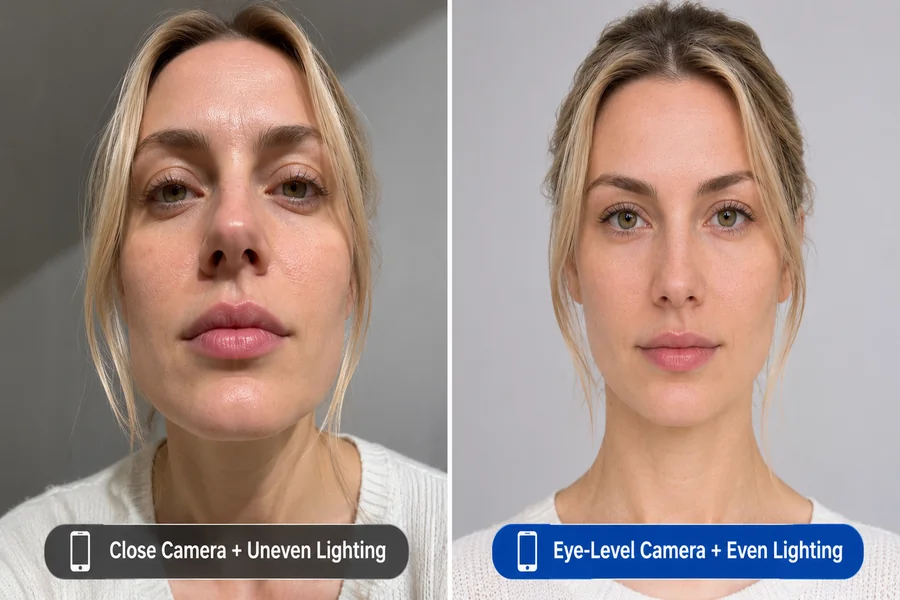
However, consistent photography does not make subjective beauty scoring scientifically definitive.
Using Facial Analysis for Personal Styling
Facial analysis can be useful beyond attractiveness ratings.
Understanding your face shape and proportions may help when choosing hairstyles, glasses, makeup placement, or photography angles.
Someone with a round face might explore hairstyles that add vertical volume, while someone with an angular jawline may prefer softer layers.
These are styling possibilities rather than universal rules.
A hairstyle finder can provide another starting point for exploring looks that complement different facial characteristics.
The goal should be discovering styles that suit your preferences rather than changing your appearance to satisfy an algorithm.
Privacy and Ethical Considerations
Facial photographs contain personal information, so privacy deserves attention when using online beauty assessment tools.
Review each platform’s privacy policy to understand how photographs are processed, stored, and deleted.
Avoid uploading images of other people without permission.
AI attractiveness scoring also raises questions about cultural representation and fairness.
Differences in age, skin tone, facial structure, and image quality may affect automated assessments.
Beauty ratings should never determine someone’s professional suitability, personal potential, or worth.
Final Thoughts
Pretty scales offer an interesting way to explore facial symmetry, proportions, and automated beauty assessments.
Comparing symmetry in humans and animals also demonstrates that balanced structures are common in nature, although their biological significance differs from aesthetic judgments.
Ultimately, beauty cannot be fully defined by mathematical ratios or numerical ratings.
Facial analysis is most useful when approached with curiosity, realistic expectations, and appreciation for individual differences.