Size a Dog Playpen by Behavior Rather Than by Breed
Size a Dog Playpen by Behavior Rather Than by Breed
Enclosure size is usually chosen from a chart that maps breed weight to floor area. The chart is a starting point and it answers the wrong question, because a dog does not use area, it uses distance, and it uses different parts of an enclosure for different things. An outdoor dog kennel playpen works or fails on shape as much as on square footage.
Straight line distance matters more than area
A dog playpen that works is a run rather than a room. Two hundred square feet arranged as a ten by twenty foot rectangle gives a twenty foot straight line; the same area as a fourteen foot square gives fourteen feet and a corner.
That difference shows in behavior within a day. A dog with room to build up speed settles afterward, where a dog that can only turn in circles paces, and pacing is the behavior that turns into digging and fence testing.
Separating rest, toilet and activity zones
Dogs avoid soiling where they sleep, and they will organize a dog playpen into zones if it is long enough to have ends. A short pen gives them nowhere to put the toilet area except next to the bed. A long run solves it without any training. Shelter at one end, water near it, and the far end left open is enough structure for most dogs to sort the space out themselves.
Sight lines and barrier frustration
A dog that can see activity it cannot reach becomes aroused and then frustrated, and the fence takes the result. Barking at a sidewalk, lunging at a neighboring dog and chewing the gate are all versions of the same thing.
Blocking the view along one side changes it. A solid panel, a planted screen or simply siting the run so the long side faces away from traffic removes the trigger rather than punishing the response.
What a chain link kennel does well and badly
Chain link is strong in tension, cheap for the area it covers, and almost impossible for a dog to break through. It is also see through, which is the property that creates the problem above.
Three details matter more than the mesh:
- Block the sight line on the busy side
- Anchor the bottom rail along its length
- Keep the gate latch out of nose reach
The second is where most escapes begin, and it is the one that looks finished from a standing position. A panel that can be lifted at the bottom is a gap, and a dog only needs that gap to be shoulder high for a moment before the rest of the fence stops mattering.
Shade, drainage and the surface underneath
An open mesh dog playpen has all the airflow it needs and no shade at all. Covering roughly a third of the length, on the side the afternoon sun reaches, is enough without trapping heat under a full roof.
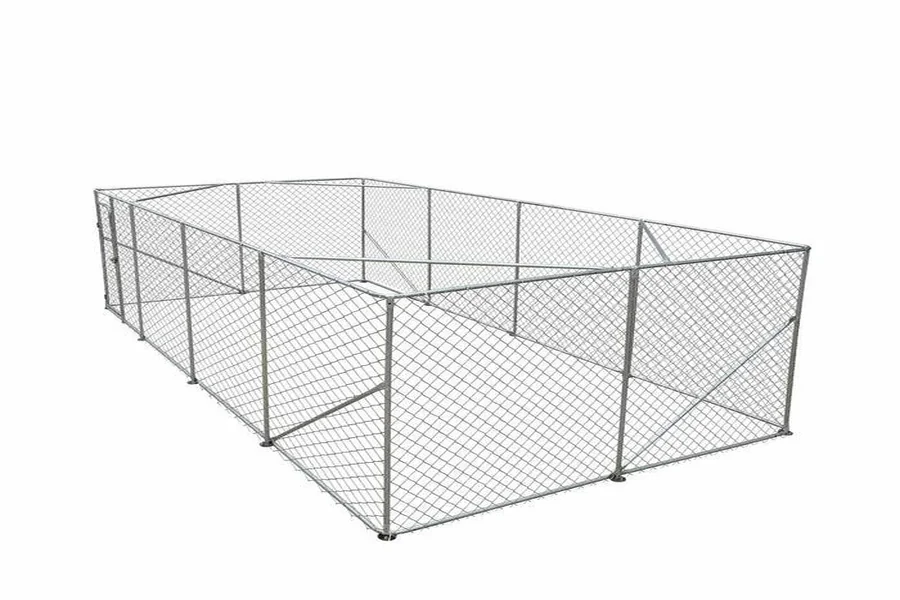
Drainage decides whether the rest is usable. Grass turns to mud in a run that gets daily use, and pea gravel or a drainage layer under the high traffic end keeps the dog and the kennel out of standing water. TMG Industrial builds this one as a ten by twenty foot chain link run with a lockable gate, which is a shape that suits the way a dog actually uses the space.