GPT-5.6 Luna’s 1M Context Window: Whole-Document Work on the Cheap Tier
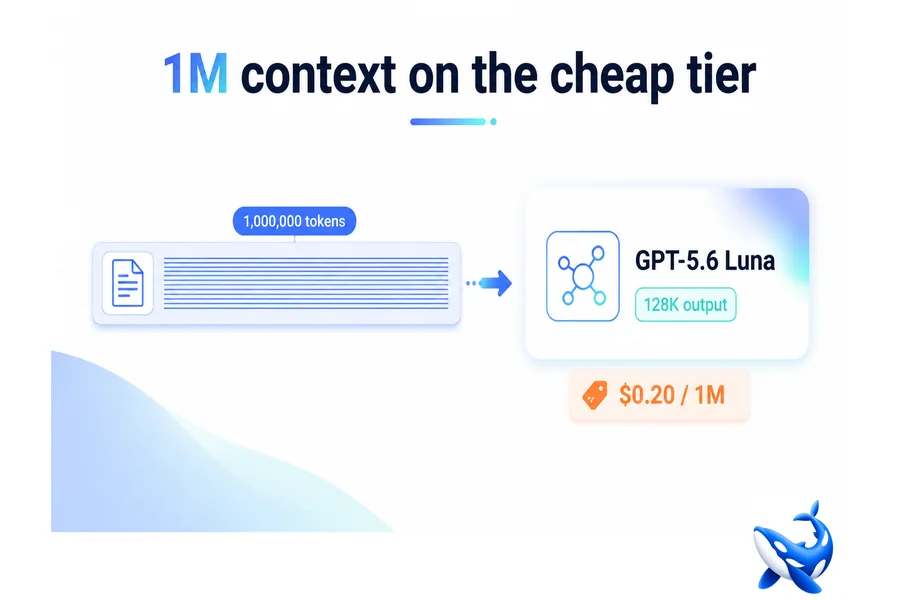
The GPT-5.6 Luna API context window is a one-million-token input, with up to 128K tokens of output. What makes it notable is not the number, which the family shares, but that a one-million-token window sits on the cheap tier at $0.20 per million input tokens. The GPT-5.6 family pricing breakdown shows that all three rungs share roughly the same context, which changes what the cheap tier can do.
The standard expectation is that a large context window belongs to the expensive flagship. Luna inverts that: the workhorse can also hold a whole document, and it can do it at a price that makes whole-document processing on high volume plausible. That is a real capability difference for workloads that combine large inputs with a cost constraint.
What the window holds
A million tokens is large enough for a long contract, a big codebase, a multi-hundred-page book, or a full conversation history. Luna can take these in one pass, without chunking, which removes the retrieval layer from whole-document tasks. For the tasks where the answer depends on content spread across a document, feeding the whole thing is simpler and more reliable than hoping a chunked pipeline retrieves the right pieces. The 78.3 long-context recall score suggests the model uses the window rather than losing track of the early material.
The price that changes the cost math
The striking part is the combination of window and price. At $0.20 per million input tokens, sending a 500K-token document into Luna costs about ten cents per pass. On a flagship at $5 per million, the same document costs two dollars and fifty cents. The difference matters because whole-document work is often repeated — the same contract, the same codebase, the same corpus analyzed from different angles. At Luna’s price, that repetition is affordable; at flagship prices, it adds up fast.
The tier boundary to plan around
Luna has two price tiers divided by context length. The standard tier — $0.20 in, $1.20 out — covers requests up to roughly 272K tokens. Requests that push beyond that into the longer-context range move to the higher tier at $0.40 in and $1.80 out. This matters for whole-document work: a document under 272K tokens runs at the standard price, while a larger one crosses the boundary and pays the higher rate. The boundary is worth knowing before you design a pipeline, because staying under it is a real cost saving and the design of what you send should account for it.
Caching for repeated passes
Whole-document work is usually repeated work, which is exactly what caching rewards. Luna’s cache reads cost about $0.02 per million, against a fresh-input price of $0.20. Send the document once at the fresh price, then ask many questions against the cached prefix at a tenth of the cost. A pipeline that analyzes the same contract or codebase repeatedly turns the input side from twenty cents per million to two cents per million, which is the difference between affordable and negligible.
Where the window is enough
For the majority of whole-document tasks — a single long document that fits the window — Luna removes the need for chunking and retrieval entirely. For material larger than a million tokens, you still need a selection layer, but the window covers the common case. Combined with the price, that means whole-document analysis is no longer a flagship-only workload; it is a task the cheap tier can carry, which changes which workloads you route where.
The recall that makes the window usable
A large context window is only useful if the model actually uses it, which is what the long-context recall score measures. Luna scores 78.3 on long-context recall, which means it tends to answer from the early part of a long input correctly rather than drifting toward the end. That is the number to check for whole-document work, because a window that loses the front of the document is a trap — it looks like the model has the material when it does not. A 78.3 recall is strong, not perfect, so the discipline of citing sources in the output and spot-checking the high-stakes answers still applies. But the score says the window is functional, not cosmetic, which is the difference between whole-document work being a real capability and being a marketing number. Combined with the low price, that makes Luna a practical tool for the large-input tasks that used to require a flagship.
The takeaway
GPT-5.6 Luna’s one-million-token context, at $0.20 per million input tokens, puts whole-document work on the cheap tier for the first time. A 500K-token document costs about ten cents a pass, repeated passes drop to two cents with caching, and the 78.3 recall score says the window is usable. Plan around the 272K tier boundary and cache the repeated prefix, and whole-document analysis becomes an affordable workload on the workhorse rather than a flagship-only expense.