Top 15 Animals That Live in Plains: A Complete Wild Guide
Almost every continent on Earth is dotted with open grasslands & they are teeming with life. When you look at animals that live in plains, you will see that they can all be divided into three groups – hunters, grazers and diggers – which all have one thing in common: they are animals that live in open spaces with little cover. Presents a step-by-step guide to 15 species found in the plains, their survival, and why each species is worth knowing.
Why Animals That Live in Plains Matter
Plains animals keep grassland ecosystems working. Grazers (such as bison, zebra and wildebeest) cut vegetation to size and prevent the domination of one plant species and allow wildflowers and smaller grasses to regrow more vigorously. As they move, their hooves break up soil, spreading the seeds and absorbing the water rather than it running off.
Predators matter just as much. Herds are not allowed to overgraze and turn the land into a desert as the lions, cheetahs and hyenas keep their population in check. Over time, without these hunters, the vegetation and soil will begin to deteriorate.
There are also small animals which do quiet but important work. Burrows allow prairie dogs to breathe the air and provide refuge for owls, ferrets and reptiles who would otherwise perish without prairie dogs. Take one species away, such as the prairie dog, and the consequences work their way out to dozens of other species that rely on it.
People benefit directly from plains animals, too. Wild grazing on grasslands creates better conditions for agriculture and ecotourism around lions, elephants and zebras generates revenue for the local communities of North America and Africa.
In short, animals that live in plains are not just wildlife to observe. It is they who make these grasslands balanced and life-sustaining at every level, from the insects below ground to the greatest herds above.
What Animals Live in Plains?
Plains animals fall into a few clear groups. Big cats and canines hunt in the open. Herds of grazers move together for safety. Small burrowers dig underground to escape heat and predators. Below is the full list, followed by a detailed look at each animal.
| Number | Animal |
| 1 | African Lion |
| 2 | American Bison |
| 3 | Pronghorn |
| 4 | Cheetah |
| 5 | African Elephant |
| 6 | Plains Zebra |
| 7 | Wildebeest |
| 8 | Prairie Dog |
| 9 | Coyote |
| 10 | Ostrich |
| 11 | Spotted Hyena |
| 12 | Thomson’s Gazelle |
| 13 | Giraffe |
| 14 | Black-Footed Ferret |
| 15 | Greater Prairie-Chicken |
Detailed Look at the Animals That Live in Plains
African Lion
Scientific Name: Panthera leo Class: Mammalia Diet: Carnivore
The African lion is the top hunter on the savanna plains. It lives in groups called prides which will typically consist of related females, their cubs and a select few males. Lions sleep for up to 20 hours each day, and conserve the energy they expend for short, sharp hunts at nightfall or early morning. While a lioness may be able to hit speeds in the vicinity of 50 miles per hour over short distances, she tires quickly and most hunts aren’t done by being able to run at the lion.
Lions roar to mark their territory and can roar up to 5 miles over open ground. The call is used by other prides to stay away from the group and by members to help reconnect with others who they are not aware of being part of a pride. Cubs remain with their mothers for approximately 2 years, then they learn to hunt for themselves. Although numbers of lions have declined significantly in the last century owing to habitat loss, protected areas in ESA provide space for this plains predator to roam and raise its cubs.
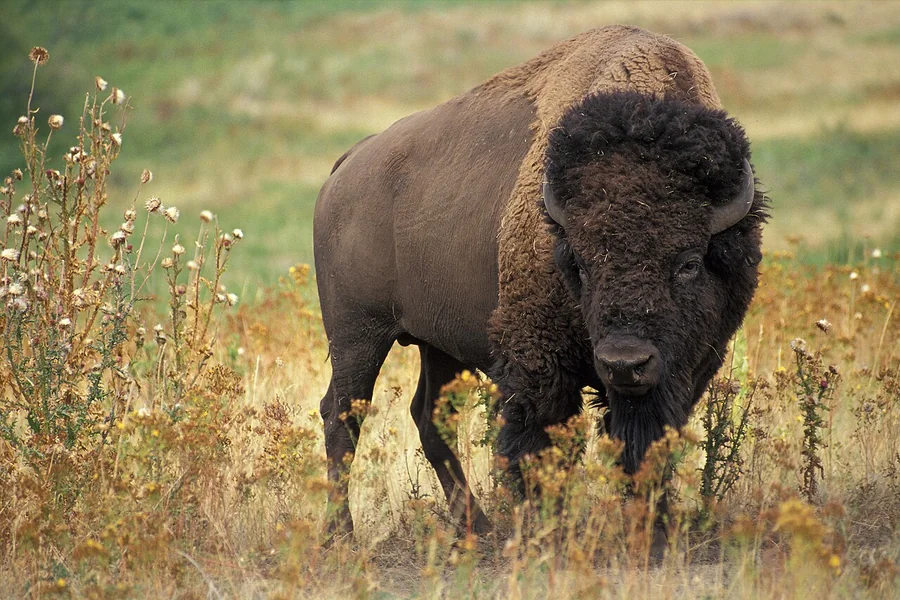
American Bison
Scientific Name: Bison bison Class: Mammalia Diet: Herbivore
The American bison is the largest land animal in North America and a true symbol of the prairie. Bulls can be over 2,000 lb but will run as fast as 35 mi/h if frightened. Herds graze in grasslands, strolling in the grasslands to find fresh grass, and at night lying down in small groups. Their grazing pattern actually contributes to maintaining a good prairie, because it maintains a short grass sward for the wildflowers to grow in.
In the 1800s, the bison population was nearly wiped out and only a few hundred were left in the Wild West.In the 1900s the bison that used to graze the Great Plains in millions was nearly hunted to extinction. However, with the help of conservation programmes their numbers have been restored to several hundred thousand. Their thick coat of fur helps them to handle extreme winter winds and when snow falls, they swish their heavy heads from side to side to dislodge snow and expose grass below. One of the most amazing things that can be seen moving around today on the American plains may be a herd of bison.
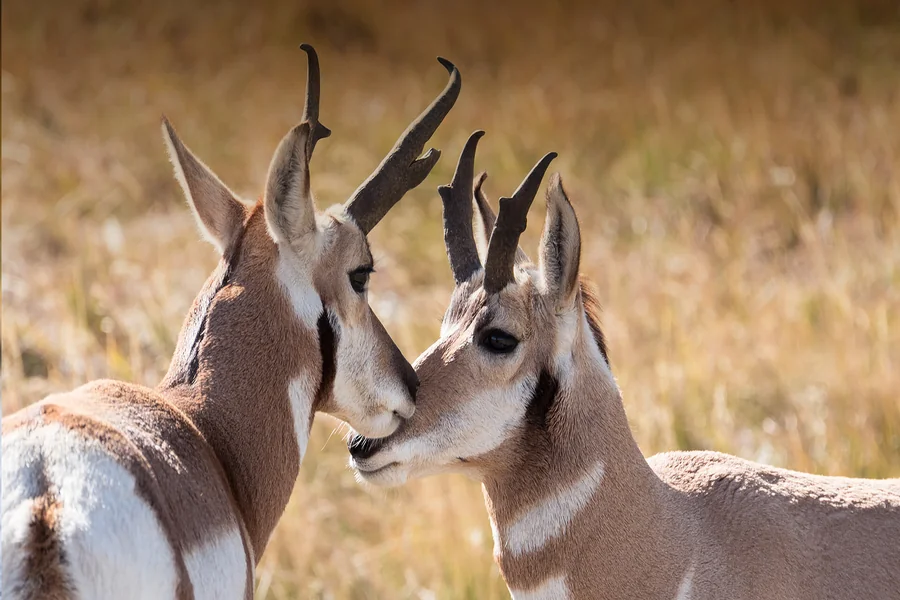
Pronghorn
Scientific Name: Antilocapra americana Class: Mammalia Diet: Herbivore
The pronghorn is the fastest land animal in North America, capable of running 55 miles per hour across open ground. This has been developed to outrun predators that are no longer present, including the American cheetah, hence the reason that pronghorns don’t hide. They have large eyes set far back on their head to help them see what is going on around them.
Herds vary in size throughout the year; they increase in size during the winter season when it is safer to be in larger groups, and they decrease in summer to breed. Unlike deer, pronghorns grow annual growth rings on the outside of their horns, instead of full antlers. They rely on the extensive continuous grasslands for their safe migration from summer to winter habitats, and man-made fences have made migration more difficult in recent times. In recent years, wildlife organizations have been collaborating to construct fence gaps and wildlife corridors to enable the pronghorn herds to continue their migration as they have for thousands of years.
Cheetah
Scientific Name: Acinonyx jubatus Class: Mammalia Diet: Carnivore
The cheetah is built for one thing: speed. The fastest land animal today can reach speeds of up to 70 miles an hour for short bursts. It has a long tail which acts as a rudder, allowing it to turn quickly and catch prey such as gazelles, darting across flat grassland. Cheetahs hunt in small groups (coalitions), unlike lions, and are active during the day, avoiding competition with bigger and stronger carnivores.
The cheetah’s body is built for speed, not brute force, which is what his pursuers, the hyenas or lions, prefer instead, and steal him prey. Cubs stay with their mother for approximately 18 months practicing stalking and chasing skills. The numbers of cheetahs have been declining rapidly because of loss of their habitats and their prey, and today they are found only in portions of East Africa and Southern Africa. Open plains are still significant, though, as they give you the chance to get up to speed on long, flat sections – much to this cat’s liking.
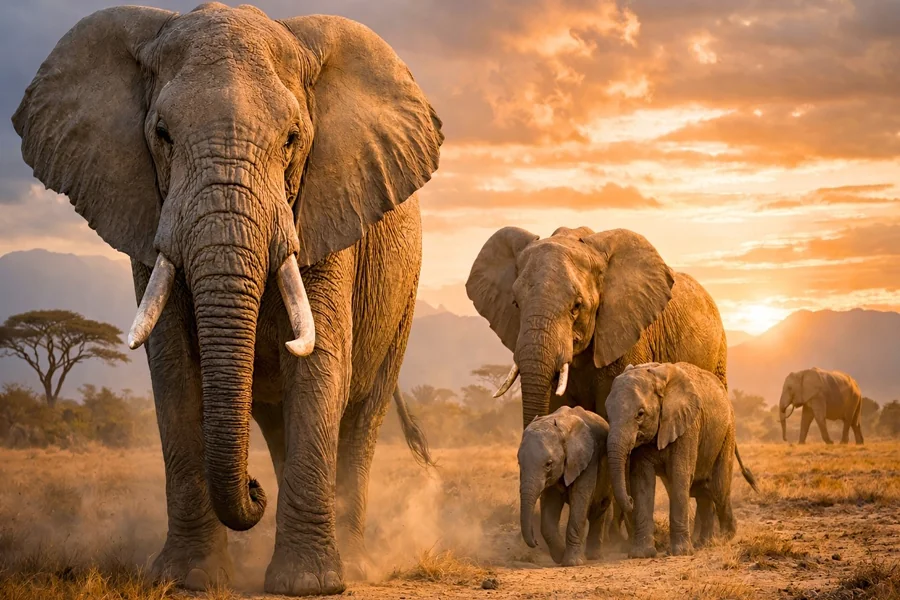
African Elephant
Scientific Name: Loxodonta africana Class: Mammalia Diet: Herbivore
The African elephant is the largest land animal on Earth, and herds regularly cross open savanna plains in search of water and food. Elephant families almost always move about, eating 300 pounds of vegetation daily. These family groups are led by females, who can remember the water source over many years to the distant water sources, especially in dry periods.
The elephants communicate with low rumbles that pass through the ground which can be felt by elephants miles away. Calves stay with their mothers for several years, and live in a close social unit, learning survival skills. They are always in motion, moving about across the plains which help shape the landscape as they fall trees and spread seeds through their dung, thereby facilitating the growth of grass. Although the elephant is still of great conservation value, it is an integral part of the savanna ecology, and has played an important role in the maintenance of the savanna balance in the many challenges the elephant population is faced with today, particularly in Africa.
Plains Zebra
Scientific Name: Equus quagga Class: Mammalia Diet: Herbivore
The plains zebra is one of the most recognizable grazers on the African savanna, known for its bold black and white stripe pattern. The stripes are unique to each zebra, and permit them to identify each other by sight. Often zebras travel with the wildebeest, having an extra set of eyes to watch out for predators.
Though some scientists believe that the stripes deter biting flies and others that they confuse predators when hunting, the explanation for zebras’ stripes remains unclear. Further, zebras live in small family groups in the company of a dominant stallion and they feed on tough grasses which are not consumed by many other plains animals, reducing food competition. A zebra can run as fast as 40 miles an hour and give a lion a powerful kick to injure him/her. Herds are vigilant all day, resting in the meantime while others watch for predators on the broad open grasslands.
Wildebeest
Scientific Name: Connochaetes taurinus Class: Mammalia Diet: Herbivore
The wildebeest, also called the gnu, is famous for its part in the largest land migration on Earth. The wildebeest move around the plains of the Serengeti and the Maasai Mara and return to the plains after the rains for fresh grass. Over a million wildebeest migrate across the plains annually following the rains and returning to the plains after rains to graze on fresh grass. This journey is almost 1,000 miles in length and crosses a few dangerous rivers, where the crocodiles lie in wait for any weak or slow animals.
The predators (lions, hyenas etc) follow the wildebeest closely, but this is a good thing for the wildebeest because they travel in large numbers and in this way are safer. Calves can stand and move away from the dam within minutes of birth and thus have a fighting chance against predators from birth. Ungainly in appearance, Wildebeest can run up to 50 miles an hour if they need to. The grazing and constant movement of a herd of wildebeest fertilizes the plains and helps benefit the rest of the grassland ecosystem, making the animal one of the most important on the African savannah.
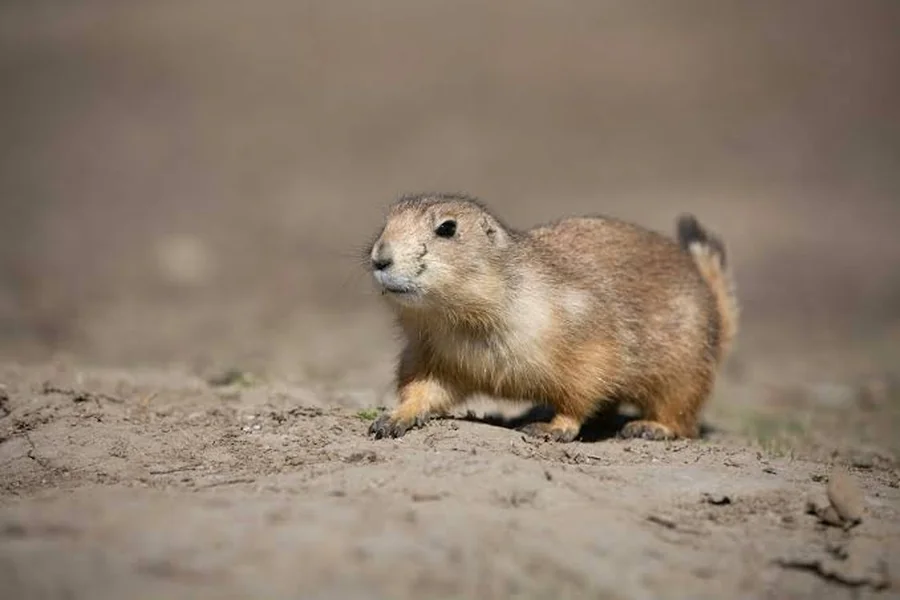
Prairie Dog
Scientific Name: Cynomys Class: Mammalia Diet: Herbivore
The prairie dog is a small rodent that lives in underground burrow systems called towns, which can stretch across many acres of grassland. They live in family groups called “coteries” and prairie dogs cooperate in the creation of tunnels, food storage, and predator surveillance. A prairie dog sentry is standing up near the burrow entrance and barking to alert other prairie dogs if danger approaches.
Unlike other small mammals, studies indicate that prairie dogs make different alarm calls for different predators, describing size, shape, and even color through their calls. Their digging improves soil aeration and their grazing reduces the length of the grass, which is beneficial to the prairie ecosystem as a whole. Abandoned prairie dog burrows are also used for shelter by many other plains animals, such as burrowing owls and black-footed ferrets. Prairie dogs once were abundant in the Great Plains, but today they remain rare except where protected grasslands have been established, thanks to their loss of habitat and disease.
Coyote
Scientific Name: Canis latrans Class: Mammalia Diet: Omnivore
The coyote is one of the most adaptable animals found on open plains, able to survive in grassland, desert, and even near cities. It hunts small mammals such as prairie dogs and rabbits but will also feed on fruits, insects and carrion when available. Sometimes coyotes will work with badgers during a hunt, as one can track downwards and the other can wait up and above for the prey to bolt.
Coyotes are nomadic and communicate from far away on open ground with a variety of howls, yips, and barks. The howling of a pack at dusk is one of the best known sounds of the American plains. Coyotes are not usually found in large packs, but instead are usually seen in lone packs or pairs, which is why they are able to survive on smaller, more dispersed food sources. Coyote’s intelligence and their flexible diet have contributed to their spread throughout North America as other wildlife habitats have been reduced by human development.
Ostrich
Scientific Name: Struthio camelus Class: Aves Diet: Omnivore
The ostrich is the largest and heaviest bird alive, standing up to nine feet tall, yet it cannot fly. It runs faster, though, at up to 45 miles per hour, powered by strong legs, on open plainlands rather than flying. It has a long neck which it uses for getting a good overview of the tall grass, allowing it to detect predators such as cheetahs and lions at a distance.
Ostriches tend to follow the herd of zebra and wildebeest as they have very sharp eyesight which helps in other animals that are grazing around them. One kick from an ostrich can cause serious injuries and on the savanna it can out run other predators because of its speed. Male ostriches make shallow nests in sand, and a number of females can lay eggs in the same nest at the same time, which can contain more than 40 eggs. The eggs are the largest of any bird, about 24 times the size of a chicken egg, and are guarded by both parents in turn.
Spotted Hyena
Scientific Name: Crocuta crocuta Class: Mammalia Diet: Carnivore
The spotted hyena is often misunderstood as a scavenger, but it is actually a skilled hunter that kills most of its own food across the African plains. Hyenas live in large groups (clans) of more than 80 individuals and are led by a dominant female. It’s a social group that’s rare among carnivores, in which females tend to be larger and more aggressive than males.
The hyena has one of the most powerful bites of any mammal, strong enough to bite through bone, so they are able to consume what other predators don’t eat. Their loud “laughing” call is a form of communication to show excitement or warn clan members when on a chase. The hyenas hunt in packs driving their prey, for long distances, for example zebra and wildebeest, until they are too exhausted. Spotted hyenas are feared for their brutality, but they play an important role in the savanna, scavenging carcasses and controlling the number of their prey in open grassland habitats.
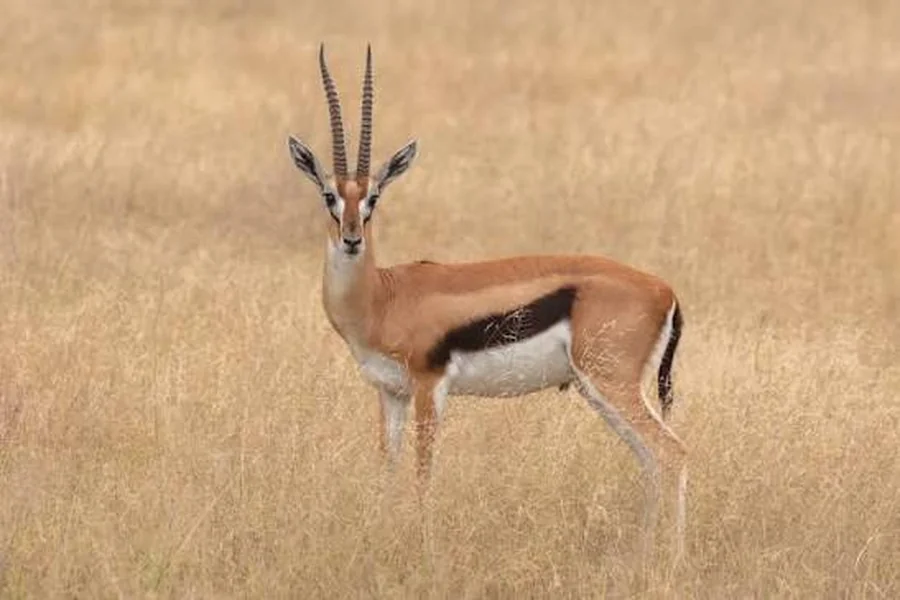
Thomson’s Gazelle
Scientific Name: Eudorcas thomsonii Class: Mammalia Diet: Herbivore
Thomson’s gazelle is a small, fast grazer found across the plains of East Africa, easily recognized by the black stripe along its side. It can reach speeds of 50 miles an hour and it has a peculiar jumping action known as ‘stotting’, in which it leaps stiff-legged into the air to indicate to predators that it is a strong animal and thus not worth their while chasing. This can lead a lion or cheetah that is hunting to search elsewhere for more convenient prey.
The herds of these gazelles may be thousands in size, especially during the dry season, when they follow the Wildebeest and Zebra for increased protection. They are small, and nearly all of the predators of the savanna are potential adversaries, meaning they must always be alert to avoid being killed. Thomson’s gazelles obtain the majority of their water requirements from the plant material they consume, and are able to survive extended periods without drinking water. They are one of the most adaptable grazers on the open plains, as they are fast, highly social and have a keen sense of smell.
Giraffe
Scientific Name: Giraffa camelopardalis Class: Mammalia Diet: Herbivore
The giraffe is the tallest land animal on Earth, standing up to 18 feet tall, which gives it access to leaves high above the reach of most other plains grazers. Its long neck has the same number of bones as a human neck, seven, but each is abnormally large. Much of the day, giraffes keep their heads down eating up to 75 pounds of foliage, as their long necks are continually supported with energy.
The tongue of a giraffe can reach almost 20 inches in length, so it can reach the leaves of thorny branches without getting hurt by the sharp thorns. Giraffes do not sleep much – less than 2 hours per day, usually standing up for short periods. Additionally they are taller and therefore have an early warning system, as they are able to see when predators come onto them from a great distance over the flat plains. Giraffes live in loose, constantly shifting bands and are able to kick and kill a lion in self-defense, with their long legs.
Black-Footed Ferret
Scientific Name: Mustela nigripes Class: Mammalia Diet: Carnivore
The black-footed ferret is one of the rarest mammals in North America and depends almost entirely on prairie dog towns for both food and shelter. Relying on its slender body to fit through narrow burrow openings, it hunts prairie dog burrows directly, from which it digs up the animals. The intimate association of this animal with prairie dogs makes the well-being of prairie dogs within the Great Plains directly linked to the survival of the ferret.
In the 1980s, the black-footed ferret was listed as a species “lost” from the wild, as prairie dog populations had plummeted because of habitat destruction and disease. Remnants of the population still exist in Wyoming, and thousands of ferrets have been reintroduced to grasslands through a captive breeding program. These animals are primarily nocturnal, and sleep in underground burrows during the day to escape heat and predators. Wild populations are still being closely tracked by conservation organizations because the black-footed ferret is one of the most threatened species on the North American plains today.
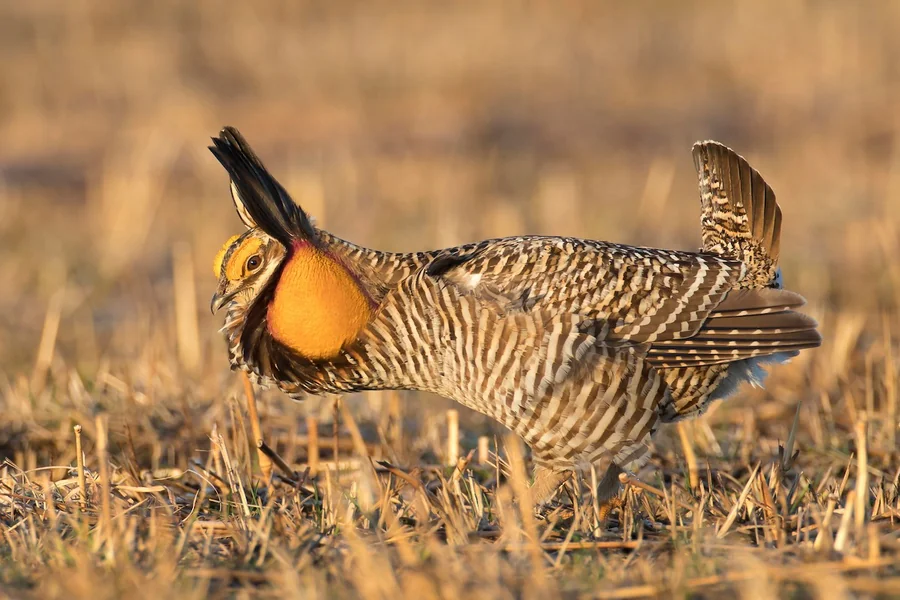
Greater Prairie-Chicken
Scientific Name: Tympanuchus cupido Class: Aves Diet: Omnivore
The greater prairie-chicken is a ground-dwelling bird best known for its dramatic mating display on the open grasslands of the American Midwest. In the spring, males converge at special display areas known as leks to display and boast about their size by stomping their feet and puffing their necks with orange air sacs and making a deep booming call to attract females. This ritual can be heard from more than a mile away across the flat open prairie.
They are very sensitive to habitat loss because they depend on large, continuous tracts of native grassland to nest, feed and mate. They change their diet according to the seasons, eating seeds and insects during the summer and grain and buds in the winter when food is limited. As native prairie has been lost to farmland, greater prairie-chicken populations have declined significantly and the bird has become a symbol of the conservation of the prairie. Maintaining a significant amount of prairie habitat is the most important consideration in preventing the complete loss of this species.
More Animals That Live in Plains
Here are a few more animals that live on the plains, worth knowing beyond the main 15:
- Grey Wolf – a pack hunter that once roamed grasslands across the Northern Hemisphere
- Burrowing Owl – nests underground in old prairie dog holes instead of trees
- Meerkat – lives in tight family groups and takes turns standing guard on open ground
- Bat-Eared Fox – uses its oversized ears to listen for insects moving underground
- Secretary Bird – a tall hunting bird that stomps venomous snakes to death on the savanna
- American Badger – digs fast and deep, often teaming up with coyotes to hunt prairie dogs
- Impala – a quick, alert grazer known for leaping over ten feet in a single bound
- Warthog – forages on its knees and backs into burrows tail-first to face danger head-on
- Jackrabbit – relies on huge ears and sharp bursts of speed to escape predators
- Golden Jackal – an adaptable hunter and scavenger found across open grassland in Africa and Asia
Final Thoughts
The plains may look empty at first glance, but they support an incredible range of wildlife. Every animals that live in plains on this list has evolved differently to survive in today’s world without much cover and with continuous exposure. Conserving these open grassland areas is important as many of these species rely on wide, continuous space which is disappearing as a result of farming and development. Conserving grasslands now ensures they will be there for the animals tomorrow.
FAQs:
What animals live on the plains?
Lions, bison, pronghorn, cheetahs, zebras, wildebeest, and prairie dogs are among the most common animals living on open plains and grasslands worldwide.
Why do so many animals live in herds on the plains?
Open ground offers little cover, so herd living gives animals extra eyes to spot predators and better odds of survival for the group as a whole.
What is the fastest animal that lives on the plains?
The cheetah is the fastest, reaching speeds up to 70 miles per hour, followed closely by the pronghorn at 55 miles per hour.
Do any birds live on open plains?
Yes, birds like the ostrich and the greater prairie-chicken live and breed directly on open grassland, relying on speed or camouflage instead of trees for safety.