What Are Geoducks? The Ancient Giant Clam Living Right Under the Pacific Ocean Floor
Few people have ever heard of geoducks. And those who do hear about them for the first time tend to have the same reaction — disbelief.
The geoduck (pronounced “gooey-duck”) is the largest burrowing clam in the world. It is also one of the longest-lived of all animals, living for an average of 140 years on earth. The oldest known specimen lived for 179 years. That means that a geoduck alive now might have hatched before the American Civil War!
This article explains what geoducks are, where they’re found, how they’re harvested and why they’ve made geoducks a seafood commodity worth big bucks around the world.
What Exactly Are Geoducks?
Panopea generosa, commonly known as a geoduck, is a large and edible saltwater clam. It is named for Lushootseed, a language spoken by the people of the Northwest region. Its name translates to “dig deep”, because the largest species of burrowing clam in the world is this species.
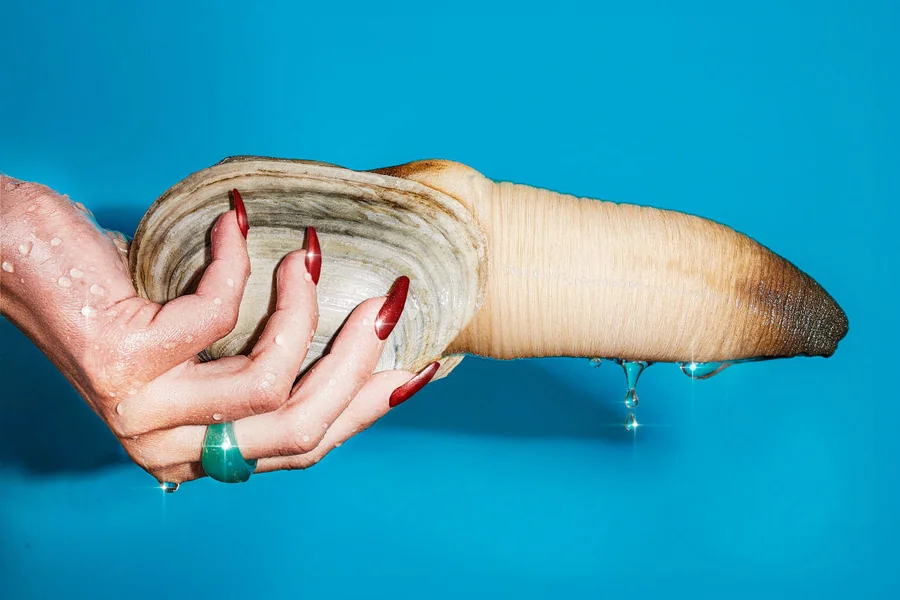
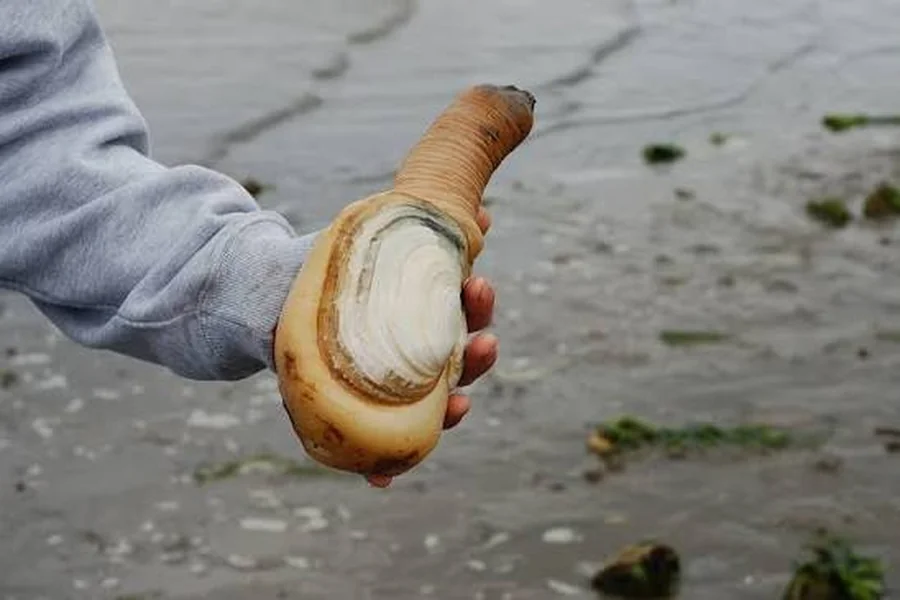
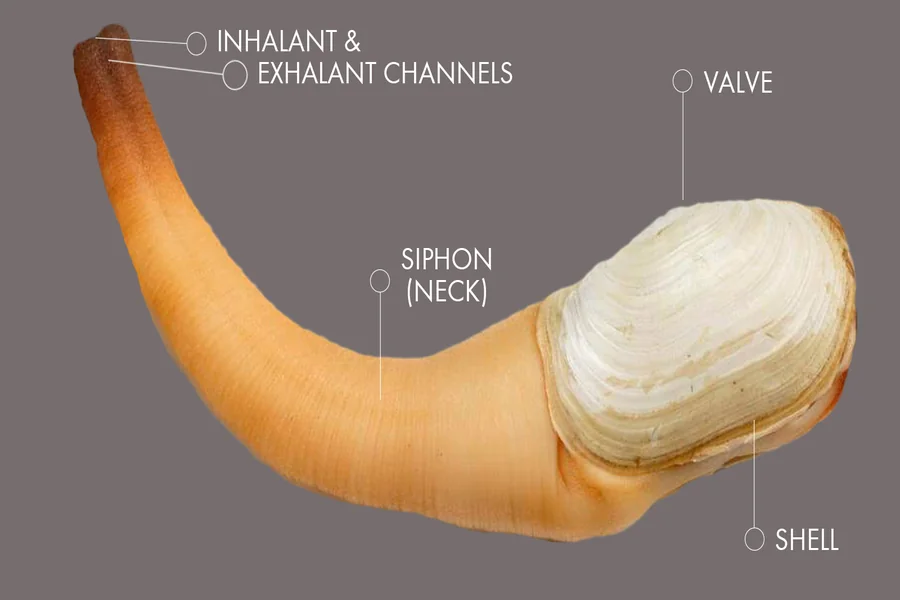
The most distinguishing feature of geoducks is their extended siphon or ‘neck’ that can reach up to 1 m (3 ft) in length. The end of the siphon has two openings, one for eating and breathing, and one for getting rid of excess water.
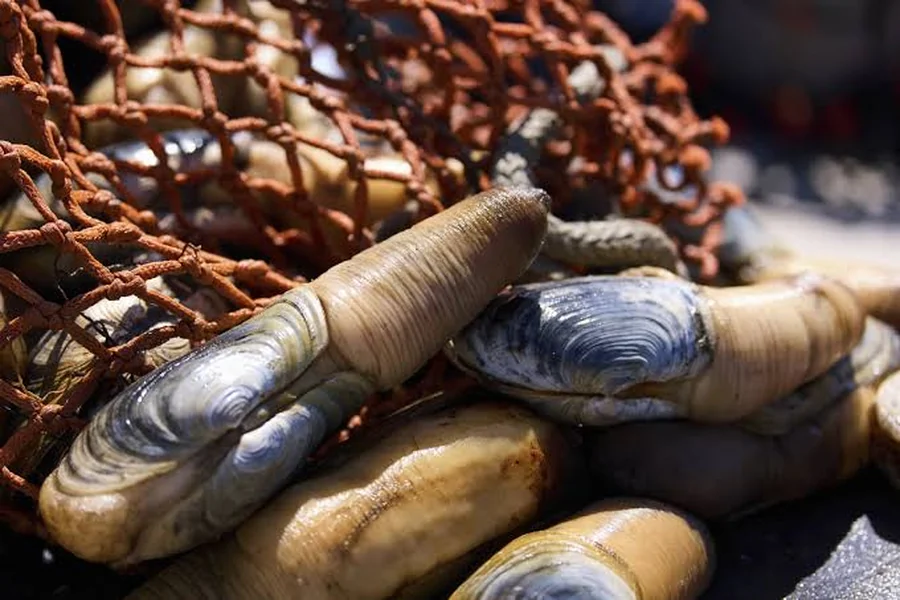
Unlike most clams, the geoduck does not have the ability to close its siphon into its shell. The two rectangular white shell valves are small and brittle, and do not fully envelop the soft body of the clam, leaving a large amount of soft body permanently exposed.
This gives rise to one of the most bizarre looking marine creatures. And one of the most beneficial of them.
Key Geoduck Facts at a Glance
| Fact | Detail |
| Scientific name | Panopea generosa |
| Average lifespan | 140 years |
| Longest recorded lifespan | 179 years |
| Average adult weight | 1.5 lbs (up to 8+ lbs) |
| Siphon length | Up to 1 meter (3.3 feet) |
| Burrowing depth | Up to 3 feet underground |
| Native range | Alaska to Baja California |
| Market price (live) | $20–$150 per pound |
| Industry value | ~$80 million annually |
| Primary export markets | China, Japan, South Korea |
Where Do Geoducks Live?
The geoduck can be found in the coastal waters of the eastern North Pacific Ocean, ranging from Alaska to Baja California.
The geoduck clam is buried 2 to 3 feet in mud, sand or gravel. They have a white shell that is ringed and typically has flaky brown edges.
There are many public beaches in Washington where geoducks are naturally growing but will not be exposed except at tides of less than -2.0 feet. Patches of high density exist only in Puget Sound and Hood Canal. They have been seen as deep as 360 ft. using underwater cameras.
After a geoduck becomes a juvenile, it burrows into the sediment and remains there for its lifetime. The adults are relatively small in size in terms of their feet as they are unable to dig and move about as easily. When they grow up they seldom move from place to place.
How Long Do Geoducks Live?
This is where geoducks get really interesting.
Geoducks can live up to 140 years, although the average is about 100.Geoduck can live up to 179 years, the average being about 100 years. They are able to be aged by counting growth rings on the shell, just as scientists age a tree.
The longevity is thought to be due to deep burrowing, which affords them protection from most predators, and to a low metabolic rate.
Adults when submerged in sediment have significantly lower mortality. Any organism that is buried at least 60 cm from the surface can not be reached by the natural predators.
It’s not only a way to survive. That’s why geoducks can live for nearly all other sea creatures.
Read Also: Dinocrocuta
How Big Do Geoducks Get?
The shell’s length is from 15 to more than 20 centimetres, but the siphons may be as long as 1 metre, which makes the length of the clam exceed the shell’s length by considerably more than threefold.
Geoducks are native to Washington and British Columbia, and grow to an average of 0.7kg when mature. The 8.16-pound specimen, found near Adelma Beach in Discovery Bay, is the largest ever weighed and verified by Washington Department of Fish and Wildlife biologists.
For reference, that’s larger than most household cats.
Why Are Geoducks So Valuable?
Geoducks aren’t something that’s just out of the ordinary. They are an important commercial product.
Alaska, Washington, Oregon and British Columbia have harvest areas and the geoduck is something of a celebrity in the seafood world, worth $80 million.
The live specimens are priced at $20 to $150 per pound and these vary according to market conditions and origin. The majority of geoduck exports from the United States and Canada are sent to China and Hong Kong.
One of the most valuable commercial shellfish resources of the Pacific Northwest, the clam is prized for its fresh, sweet taste and crunchiness.
Asia is a major factor in driving the demand. Geoducks are a luxury food in China and Japan, used as sashimi or hot-pots. Their use in South Korea is in spicy seafood stir-fry.
To keep up with this demand, geoduck aquaculture has also grown. The young geoducks are planted in protected beds until they are large enough to burrow to a protective depth, they may then be protected by netting or PVC tubes.
How Are Geoducks Harvested?
Harvesting wild geoduck is not a piece of cake.
Specialized techniques must be employed and commercial divers have to be used when harvesting in the subtidal zone. A “show” is the small dimple or tip of the clam’s siphon that can be seen on the sea bed, and by spotting this the divers find the clam. The diver uses a high pressure water jet, commonly known as a “stinger”, to disperse the sediment around the clam without causing injury to its delicate shell or siphon. This method is a hydraulically-assisted technique that will gently extract the geoduck from the burrow.
Rec. Digger’s Rules are strict. Tides to harvest intertidal geoduck must be at least -2.0 feet or lower. The daily limit is the first one clam dug per person per day. All geoducks must be retained, no matter their size, quality or condition.
Recent research has shown that geoduck beds take longer to regenerate than previously thought – 55 years, on average. The harvest limits are therefore strictly enforced, which is why. If you over harvest today, you will have none for the next generation of harvesters.
How Are Geoducks Reproduced?
Geoducks are broadcast spawners. A female geoduck produces about 5 billion eggs in her century-long lifespan. However, due to a low rate of recruitment and high mortality for eggs, larvae, and post-settled juveniles, populations are slow to rebound.
Adult geoducks have separate sexes and reach sexual maturity at around 3 years old. Male geoducks are capable of reproducing for more than 100 years.
That combination — high egg production but low survival rates — is what makes sustainable management so critical.
Read More: Are Praying Mantis Dangerous to Dogs
What Does Geoduck Taste Like? (And How Is It Eaten?)
This is the question most first-timers ask before trying it.
Geoduck has a mildly sweet, slightly salty flavor — a balance between clams and oysters. The siphon is crunchy while the body is softer. It works well both raw and cooked.
In Asian cuisine, it is frequently prepared raw as sashimi, where its delicate flavor and firm, crisp texture are most appreciated. Other preparations include stir-frying, soups, or lightly cooking in a fondue-style hot pot. The thicker mantle, or breast meat, is also consumed — sometimes sliced, tenderized, and lightly fried.
One rule stands out in most professional kitchens: do not overcook geoduck. Heat destroys the texture that makes it worth the price.
Quick Answers
| Question | Short Answer |
| How do you pronounce geoduck? | It is pronounced “gooey-duck,” not “geo-duck.” |
| What does a geoduck taste like? | Mildly sweet, slightly salty, with a crunchy siphon and softer body meat. |
| How long do geoducks live? | Typically 140 years; the oldest recorded geoduck lived 179 years. |
| Where are geoducks found? | Along the Pacific coast from Alaska to Baja California, mainly in Puget Sound. |
| Are geoducks edible? | Yes. They are a prized seafood delicacy in China, Japan, and South Korea. |
| How deep do geoducks burrow? | Up to 3 feet underground in sand, mud, or gravel. |
| What is the geoduck’s scientific name? | Panopea generosa, a saltwater bivalve in the family Hiatellidae. |
| Why are geoducks so expensive? | High demand in Asian markets, slow reproduction rates, and difficult harvesting push prices up. |
Geoducks and Indigenous Culture
The word “geoduck” itself comes from Indigenous roots. The name is derived from a Lushootseed (Nisqually) word, either meaning “dig deep” or composed of a first element of unknown meaning and a second element referring to the clam’s shape — possibly a double meaning.
For Pacific Northwest Indigenous tribes, geoducks hold significant cultural value as a traditional food source, harvested for centuries in tribal feasts and ceremonies. Their long lifespan represents strength and resilience.
Tribal communities in Washington State hold legally recognized harvest rights to geoducks in Puget Sound, and they manage their share of the commercial fishery alongside state agencies.
Final Thoughts
Geoducks are one of those animals that push you to rethink what you know about the ocean. A clam that outlives humans, weighs as much as a small dog, sells for more per pound than prime steak, and has been part of Pacific Northwest Indigenous culture for centuries — that is not a minor creature.
Whether you are a seafood lover, a marine biology reader, or someone who just heard the word “geoduck” for the first time and could not believe it was real — now you know. And now you understand why this unusual clam has captured the attention of divers, chefs, scientists, and global markets alike.
FAQs:
Q: What is a geoduck?
A geoduck is the world’s largest burrowing saltwater clam, native to the Pacific Northwest, with a lifespan of up to 179 years.
Q: How do you pronounce geoduck?
It is pronounced “gooey-duck.” The name comes from the Lushootseed Indigenous word meaning “dig deep.”
Q: Are geoducks safe to eat?
Yes. Geoducks are a widely consumed seafood. Commercial beds must be tested and certified clean before harvest.
Q: How much does a geoduck cost?
Live geoducks sell for $20 to $150 per pound depending on the market. In China, they are a luxury item.
Q: How are geoducks different from regular clams?
Geoducks are far larger, live dramatically longer, and have a siphon up to 3 feet long that cannot retract into the shell.
Q: Can I dig for geoducks myself?
Yes, in designated areas in Washington State with a valid shellfish license. The limit is one clam per person per day.