Dire Wolf Size Comparison: How Big Were They Really? (Facts vs. Myths)
Everyone imagines dire wolves as monsters. The movies and TV shows made sure of that. But what was their actual size? The following dire wolf size comparison provides real figures. We examine weight, height, length & the size of the skull. Then we put them against grey wolves, large dogs and even people.
The answer is quite surprising. Dire wolves were big. They were not very large.
How Big Was a Dire Wolf?
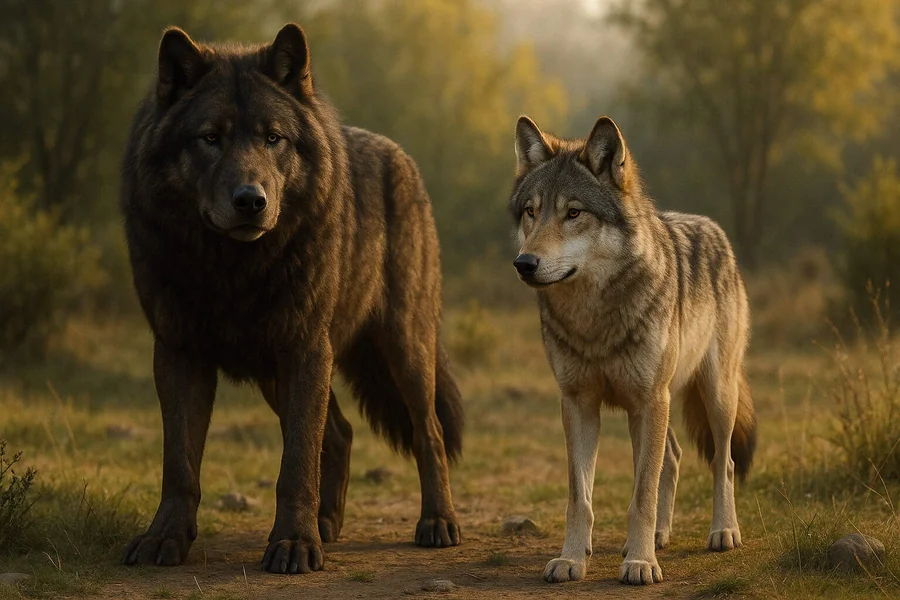
A dire wolf weighed about 60 to 80 kg (130 to 175 lb) on average. The shoulder height of this specimen was approximately 80 cm (31 in). It had a body that was about 1.5 m long (5 ft). This is larger than the largest present-day gray wolves and considerably stronger.
Individuals up to 100 kg (220 lb) or even more were achieved. Those were rare.
Dire Wolf Size at a Glance
| Measurement | Dire Wolf (Aenocyon dirus) |
| Average weight | 60–80 kg (130–175 lb) |
| Large individuals | Up to about 100 kg (220 lb) |
| Shoulder height | About 80 cm (31 in) |
| Head-and-body length | About 1.5 m (5 ft) |
| Time period | Late Pleistocene, until about 13,000 years ago |
| Range | North and South America |
These figures are estimates. Scientists build them from fossil bones. Most of the fossils come from the Rancho La Brea tar pits in Los Angeles. Thousands of dire wolf bones were pulled from that site. That gives researchers a rich sample to measure.
Dire Wolf vs. Gray Wolf Size
This is the comparison most people search for. The gray wolf is the closest animal in size and shape that you can still see alive today.
| Feature | Dire Wolf | Gray Wolf |
| Average weight | 60–80 kg | 30–55 kg |
| Shoulder height | About 80 cm | 65–80 cm |
| Body length | About 1.5 m | 1.0–1.6 m |
| Skull | Broader and heavier | Narrower |
| Teeth | Larger and thicker | Smaller |
| Build | Stocky with strong legs | Lean and long-legged |
Look at the weight row. A typical dire wolf was heavier than a typical gray wolf by a wide margin. Height was close. The difference was bulk.
Think of it like a sprinter and a rugby player of the same height. The rugby player carries far more mass. The dire wolf was the rugby player.
The biggest gray wolves can come close to dire wolf size. A few wolves in Alaska and Canada top 60 kg. But those are the top of the range. For the dire wolf, that weight was normal.
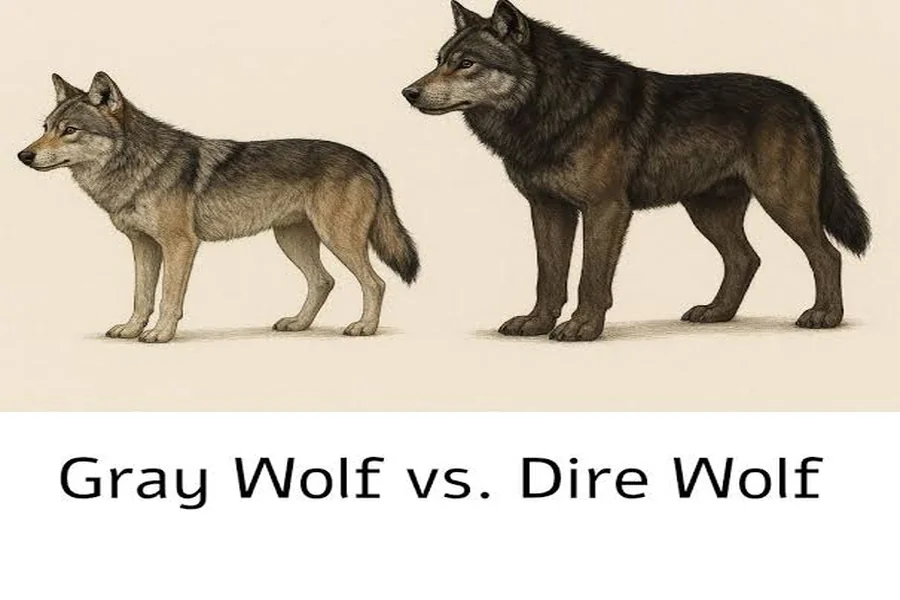
Dire Wolf Size Comparison With Dogs
Gray wolves are not the only way to picture it. Many people have seen large dogs in person. So here is how the dire wolf stacks up.
| Animal | Typical Weight | Shoulder Height |
| Dire wolf | 60–80 kg | About 80 cm |
| Great Dane | 50–80 kg | 71–86 cm |
| Irish wolfhound | 55–70 kg | 79 cm and up |
| English mastiff | 70–90 kg | 70–80 cm |
| German shepherd | 22–40 kg | 55–65 cm |
| Siberian husky | 16–27 kg | 51–60 cm |
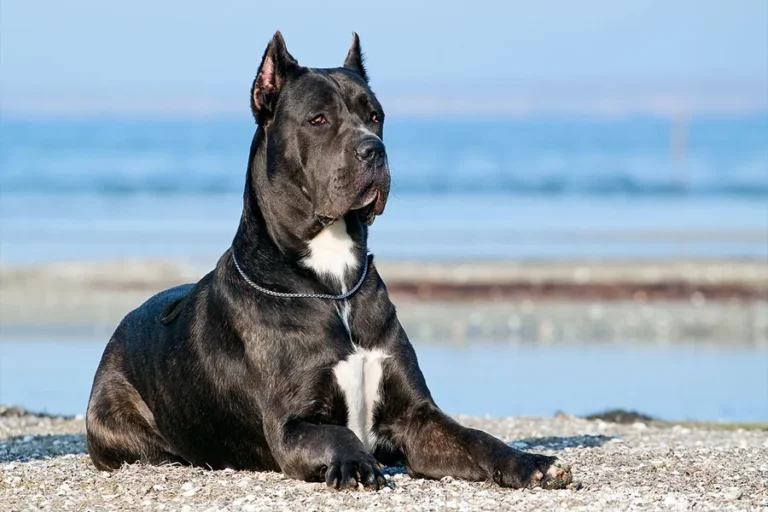
A dire wolf was about the size of a large Great Dane or a mastiff. It was far bigger than a German shepherd. Put one next to a husky and the husky looks like a puppy.
So if you want to picture a dire wolf, think of a big mastiff with a wolf’s head and a much stronger bite.
Dire Wolf Size Compared to a Human
Make it closer to home. The shoulder of a dire wolf was approximately hip high to an adult. Its back would be close to your waist, or slightly below, if you were standing next to one.
The weight is key. An adult dire wolf could have grown up to the size of an adult human. Suppose a 4-legged animal weighing 70 kg, runs at you. It’s not a dog that can be tethered with a leash.
It wouldn’t be condescending from its vantage point. It would only be heavy and strong.
Dire Wolf Skull and Bite: Where Size Really Showed
Body size is just a half story. The rest is revealed by the skull and teeth.
The wide skull of the dire wolf. Its mouth muscles were big. This was because its teeth were larger and stouter than those of a grey wolf. The molars are used for cutting meat and for cracking bones.
The fossils tell the following story:
- The skull was longer and wider than a gray wolf’s.
- The fangs of the canines were broad and robust.
- The main cutting teeth (carnassial teeth) were large.
- For its size, the bite was quite powerful.
This indicates a hunter designed for larger game. It has been suggested that it is associated with horses, bison and camels of the same time period.
Dire Wolf Legs and Build
Gray wolves are long legged. They have been designed for long-distance travel. Dire wolves were, however, a little shorter for the length of their bodies. The bones were very heavy.
This favors an ambush type and short chase style. A dire wolf probably wouldn’t have had to hunt for hours. It had to be a powerful blow and it had to be a lasting one.
This is a key point in any dire wolf size comparison. Animals are not described by just their height. The frame, the thickness of the bones and muscle mass are all important.
Dire Wolf vs. Saber-Toothed Cat
Dire wolves shared the landscape with Smilodon fatalis. This is the famous saber-toothed cat. Their fossils turn up together at Rancho La Brea.
| Feature | Dire Wolf | Smilodon fatalis |
| Weight | 60–80 kg | 160–280 kg |
| Hunting style | Group hunter | Ambush hunter |
| Body shape | Long snout, lean-heavy | Short, very muscular |
The cat was two to three times heavier. A single dire wolf would not take on a Smilodon. A pack might compete for a carcass, though. Both animals fed on the same large grazers.
The Game of Thrones Problem
This is where a lot of the confusion begins. Direwolves are very large in the books and on TV. Some say that they are near horse size. That is fiction.
There were no real dire wolves that big. They were about the size of a large dog. Dire ‘dire’ means ‘fearsome’ in Latin. It was awarded due to the fossil teeth rather than for its monster size.
When people say ‘dire wolf’, picture a pony. Imagine a much stouter wolf instead.
What About the Recent “Revived” Dire Wolves?
In 2025 a company announced that it had brought back dire wolves. There was no end of the publicity surrounding the news. However, the animals are gray wolves that have a limited number of modified genes. These are not real dire wolves.
Studies of ancient DNA also revealed the dire wolf’s distant relationship to the gray wolf. It was a member of its own family. It is now known as Aenocyon dirus.
Thus, the actual size of the dire wolf is not revealed by the animals alive today. They still do the fossils.
Why Did Dire Wolves Disappear?
The dire wolves became extinct around 13,000 years ago. This occurred towards the end of the previous Ice Age. At the same time, many large animals disappeared. They had no food and environmental conditions changed.
Gray wolves survived. These could have a significantly broader food selection. Big herbivores would appear to have been the base of the food chain for dire wolves. Those animals refused and the dire wolf went with them.
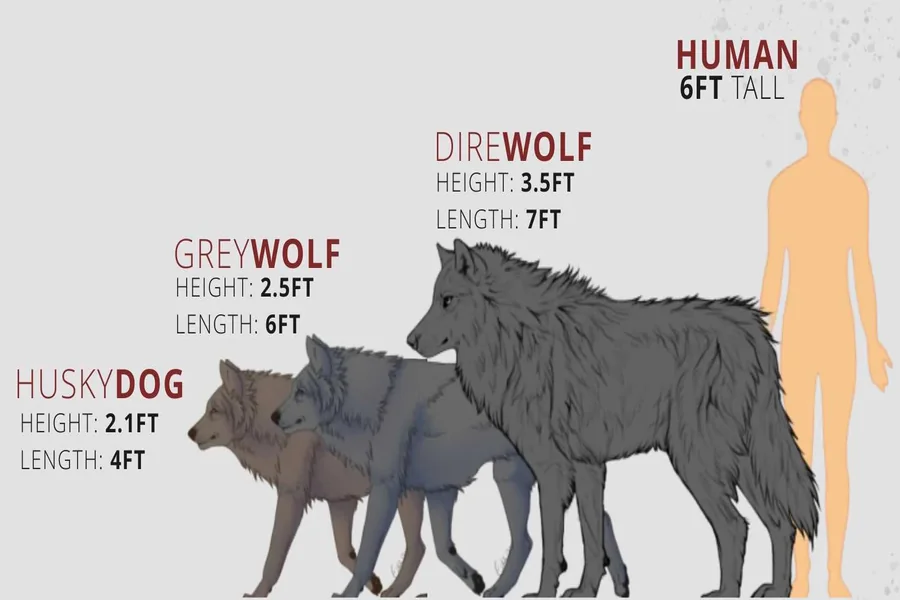
Dire Wolf Size Myths vs. Facts
| Myth | Fact |
| Dire wolves were as big as horses | They were about as big as large dogs |
| They were twice the size of gray wolves | They were about 1.5 to 2 times heavier on average and similar in height |
| They were just big gray wolves | They were a separate species with a different build |
| The 2025 pups are dire wolves | They are edited gray wolves |
| They were faster than gray wolves | Their shorter limbs suggest less speed |
Key Takeaways
- A dire wolf weighed about 60 to 80 kg on average.
- It stood about 80 cm at the shoulder.
- It was heavier and sturdier than any typical gray wolf.
- Its skull and teeth were larger and stronger.
- It matched a Great Dane or mastiff in size.
- It was far smaller than fictional versions.
- It died out roughly 13,000 years ago.
Final Thoughts
So how does the real dire wolf size comparison end up? It was a good size, but not too large. In size, it was as big as a large Mastiff, as tall as a large gray wolf. What made it special was the bulk, bone and bite.
That still doesn’t seem too bad. A 70 kg predator with powerful jaws was a predator that hunted in packs in the Americas. It didn’t have to be as big as a horse to be dangerous.
When the next person mentions dire wolves as being giants, you now have the numbers.
FAQs:
How big was a dire wolf compared to a gray wolf?
A dire wolf was about 1.5 to 2 times heavier than an average gray wolf. Height was similar. The dire wolf had a wider skull and thicker bones.
How much did a dire wolf weigh?
Most weighed 60 to 80 kg (130 to 175 lb). Rare individuals may have reached 100 kg.
How tall was a dire wolf?
About 80 cm (31 in) at the shoulder.
Were dire wolves bigger than Great Danes?
They were about the same size. A dire wolf was heavier than many Great Danes but not much taller.
Were dire wolves as big as in Game of Thrones?
No. The show’s direwolves are far larger than the real animals.
Is the dire wolf the same as a gray wolf?
No. Genetic studies show it was a separate lineage called Aenocyon dirus.
When did dire wolves go extinct?
Around 13,000 years ago at the end of the Pleistocene.
Could a dire wolf kill a human?
It had the weight and bite to do so. But no record exists of dire wolves living alongside the kind of encounters that people imagine, and any attack claim today is speculation.