Top 18 Animals With Stripes: Striped Animals Explained With Facts, Habitat & Behavior
One of the most evident patterns in the wild is stripes. From forests to oceans, animals with stripes use this pattern for survival, identity & movement. Certain stripes are used to aid in camouflage. Others warn predators. Some of them assist animals in identifying their group members.
Here in this elaborated wildlife guide you will get to know about striped mammals, birds, reptiles, fish, and insects. The profiles contain a scientific name, class, diet, habitat and behavior. The article has been easily readable and snippet optimization.
Quick List Of The Top 18 Animals With Stripes
| Rank | Common Name | Scientific Name | Class | Primary Habitat |
| 1 | Tiger | Panthera tigris | Mammalia | Forests, grasslands |
| 2 | Zebra | Equus quagga | Mammalia | African savannas |
| 3 | Okapi | Okapia johnstoni | Mammalia | Congo rainforests |
| 4 | Banded Mongoose | Mungos mungo | Mammalia | African woodlands |
| 5 | Striped Hyena | Hyaena hyaena | Mammalia | Dry regions |
| 6 | Bengal Cat (wild type) | Prionailurus bengalensis | Mammalia | Asian forests |
| 7 | Ring-tailed Lemur | Lemur catta | Mammalia | Madagascar |
| 8 | Striped Skunk | Mephitis mephitis | Mammalia | North America |
| 9 | Coral Snake | Micrurus fulvius | Reptilia | Forest floors |
| 10 | Tiger Salamander | Ambystoma tigrinum | Amphibia | Wetlands |
| 11 | Clownfish | Amphiprion ocellaris | Actinopterygii | Coral reefs |
| 12 | Convict Tang | Acanthurus triostegus | Actinopterygii | Tropical oceans |
| 13 | Bumblebee | Bombus terrestris | Insecta | Meadows |
| 14 | Striped Dolphin | Stenella coeruleoalba | Mammalia | Open oceans |
| 15 | Chipmunk | Tamias striatus | Mammalia | Forest edges |
| 16 | Malayan Tapir | Tapirus indicus | Mammalia | Southeast Asia |
| 17 | Striped Marlin | Kajikia audax | Actinopterygii | Pacific Ocean |
| 18 | Numbat | Myrmecobius fasciatus | Mammalia | Western Australia |
Read Also: Top 20 Animals That Gallop
Detailed List Of Animals With Stripes
1. Tiger
Scientific Name: Panthera tigris
Class: Mammalia
Diet: Carnivore
Range Map: South and Southeast Asia including India, Nepal, Russia, and Indonesia.
Habitat: Tropical forests, mangroves, grasslands, and cold woodland.
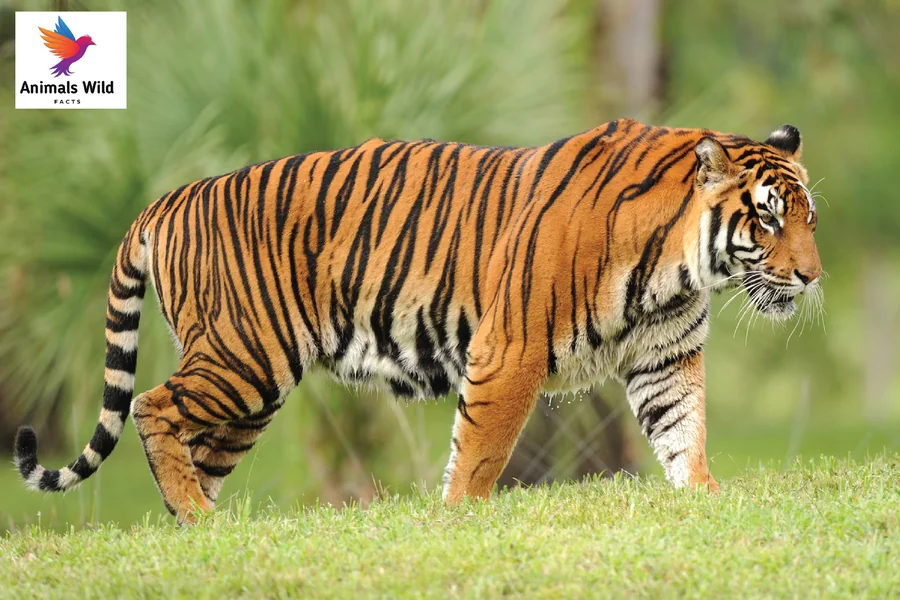
In the world, the tiger is the biggest striped cat. Its shape is interrupted by its dark vertical lines in tall grass and forest color. Each pattern is unique. The pattern of the stripe is never the same in two tigers.
Tigers live alone. They protect huge territories. Males dominate larger areas compared to females. They hunt mostly at night. They feed on deer, wild boar and buffalo. They rely on stealth. They move slowly. Then they strike with swift sudden jabs.
Tigers are strong swimmers. They cross rivers with ease. The Cubs stayed with their mother for two years. It is during this that they are taught how to stalk.
The tiger is able to blend into broken light with the help of the stripes. Shadow lines are done by sunlight penetrating through trees. The tiger blends in.
Wild populations have been decreased by poaching and by habitat loss. These days there are numerous groups guarded by conservation parks.
Fun Fact: A tiger’s skin is striped beneath its fur.

2. Zebra
Scientific Name: Equus quagga
Class: Mammalia
Diet: Herbivore
Range Map: Eastern and Southern Africa.
Habitat: Savannas, open grasslands, and woodland edges.
The zebra is one of the most recognized animals with stripes. It has black and white cover on the whole body. There is a specific pattern of each zebra. The marks of the stripes are like the prints of fingers.
Zebras live in herds. The group has a powerful stallion in charge. The members of the herd remain near together to protect themselves. Zebras huddle together when exposed to their predators. Lions are at a loss with the moving stripes. It makes it difficult to single out a target.
Zebras spend the greater part of the day grazing. Grass forms the main diet. To seek new pasture and water they go a long way. In dry areas seasonal migration is the order of things.
It is also proposed by researchers that stripes can also decrease biting flies. The trend disrupts the eyesight of insects. This reduces annoyance and transmission of diseases.
Zebras speak through sounds and positions of ears. They run fast when chased. The speed may be up to 65 kilometers per hour.
Young foals stand an hour after birth. They soon get to know the pattern of stripes in their mother.
Fun Fact: Even the mane of a zebra follows the stripe pattern.

3. Okapi
Scientific Name: Okapia johnstoni
Class: Mammalia
Diet: Herbivore
Range Map: Democratic Republic of Congo.
Habitat: Dense tropical rainforest.
At first sight, the okapi is strange. It has a small giraffe-like body. It has white zebra-like bold stripes on its hind legs. This makes it one of the most unique animals with stripes.
Okapis survive in the inner central African forests. They like dense vegetation. Thick growth shelters them against predators. There is low light due to the canopy of the forest.
They feed on fruits, fruits, buds and fungi. They have a long bendable tongue that helps them to acquire plants. All day they forage and are silent.
Okapis are solitary animals. They identify territory by dropping odiferous glands on their feet. Communication occurs in low tones and scent marks.
The legs which are striped might assist the calves in tracking their mothers during the dark forest conditions. It follows the motto on the shaded undergrowth.
Okapi is associated with giraffes. Both are similar in the structure of the skull and the length of the tongue. This was proved by scientists through genetic study.
The loss of habitat endangers the wild. There are now core areas which are safeguarded by the use of reserves.
Fun Fact: The okapi was unknown to western science until 1901.
Read Also: Top 13 Small Monkey Breeds In The World
4. Banded Mongoose
Scientific Name: Mungos mungo
Class: Mammalia
Diet: Omnivore
Range Map: Sub-Saharan Africa.
Habitat: Woodlands, savannas, and grasslands.
Banded mongoose is a small mammal whose back has horizontal stripes. These are not as striking as those of a zebra. They are among the smaller animals with stripes in Africa.
The banded mongooses exist in groups. The number of members in groups can reach fifty. They sleep and hunt together. Predators can be spotted fast through the use of group cooperation.
They are diurnal. The majority of the action happens when one is awake. They scavenge insects, small reptiles, seeds and fruits. Hunting is usually provided in groups. The striped design is not a form of camouflage. Rather it can aid group members to recognize one another.
There are growls, chirps, and scent marks. All members take care of young pups. This pattern of rearing differs survival probability.
The predators are the eagles, large snakes and lions. Mongoese people depend on figures and vigilance to live. Threats will be mobbed by groups.
Banded mongooses may be inquisitive and active. They dig burrows for shelter. Burrows are necessary to the safety and rearing.
Fun Fact: The banded mongoose can eat venomous snakes without serious harm. Its immunity helps protect the group during hunts.

5. Striped Hyena
Scientific Name: Hyaena hyaena
Class: Mammalia
Diet: Carnivore
Range Map: North Africa, Middle East, and South Asia.
Habitat: Dry plains, scrublands, and semi-deserts.
The striped hyena or hyena medium is a medium hyena with a pale gray coat and a vertical dark colored band on its body. It is not as big as the spotted hyena, it is also not as aggressive.
They are mostly nocturnal. Striped hyenas shun humans and giant predators. They mostly feed on garbage. They are carrion eaters and bone eaters and in some cases, they feed on fruits. They have strong jaws which enable them to break bones and also to get out the marrow.
Striped hyenas exist in small families or live alone. They use scent and communication in terms of growls, howls and body language.
The stripes can serve as a small alert to the predators or competitors. Her fur may be bristling along the back to make it look bigger. This display deters threats.
Striped hyenas have extensive areas of search for food. Water is often scarce. They go at night to keep out of the heat.
They are afraid and withdrawn despite their frightening look. The hunting and loss of habitats causes population decline. In core areas, conservation programs are meant to conserve them.
Fun Fact: Striped hyenas can eat nearly all parts of a carcass, including hair and skin, which few other animals can digest.
Read Also: Top 20 Animals That are Skinny
6. Ring-tailed Lemur
Scientific Name: Lemur catta
Class: Mammalia
Diet: Omnivore
Range Map: Southern and southwestern Madagascar.
Habitat: Dry forests, scrub, and gallery forests.
Ring-tailed lemur is a primate with a long black white striped tail. The tail is the primary visual aspect, unlike the body stripes. The communication in group movement is facilitated by the stripes.
They coexist in groups of thirty or so people. During movement the tail is frequently raised up. This gives cues to the members of the group in thick vegetation.
Ring tailed lemurs are primarily terrestrial, and there is tree climbing ability. They use fruits, leaves, flowers, and at times insects as food. The daytime is when they forage and they are diurnal.
Scent marking is important. Both the females and males possess scent glands. Troops mark out their areas of operation using vocal signals, scent markings, and visual communication.
Another use of the striped tail is in mating displays and social hierarchy. Dominating people are apt to shake their tails.
The ring-tailed lemurs sunbathe in the morning, where they sit up in order to heat their bodies. This assists them in the regulation of temperature. Fossas, birds of prey and human beings all make predators.
Fun Fact: The ring-tailed lemur’s tail can measure twice the length of its body, making it one of the most recognizable striped tails in the animal kingdom.

7. Bengal Cat (Wild Type)
Scientific Name: Prionailurus bengalensis
Class: Mammalia
Diet: Carnivore
Range Map: South and Southeast Asia, including India, Nepal, China, and Indonesia.
Habitat: Tropical forests, grasslands, and mangroves.
The leopard cat or wild Bengal cat is a small and agile cat that has a spot and stripe covered body. Its dark stripes on its face and legs are most noticeable which assists in disruption of its outline in thick foliage.
They are lone hunters, most of what they do is by night. Bengal cats predate on rodents, birds, frogs and insects. They depend on ambush and speed in capturing their prey.
These are cats that like thick forest cover around water bodies. They are fine swimmers and climbers. The trees act as a shelter and hunting posts.
There are also stripe patterns that are used to camouflage. The Bengal cat is virtually invisible in the shade and the light strikes that intersect on the cat during stalking.
There are hisses, growls, and meows. The urine and gland secretions are used as the marks to mark the territory.
The larger cats, snakes, and humans are predators. Populations in the wild are threatened by habitat loss and hunting. Conservation programs emphasize the protection of habitats.
Fun Fact: Bengal cats are skilled swimmers, unlike many domestic cats. They often hunt near water for frogs and fish.
Read Also: Top 20 Animals That Gallop
8. Striped Skunk
Scientific Name: Mephitis mephitis
Class: Mammalia
Diet: Omnivore
Range Map: North America, including the United States, Canada, and Mexico.
Habitat: Forest edges, grasslands, and urban areas.
The striped skunk is small and has a bold and black fur with two white stripes that run along his head up to his tail. These stripes are given as a signal to the predators.
Skunks are night animals, which live by day in burrows. Insects, small rodents, fruits, and plants are foraged by them at night.
Skunks are known to raise their tail, stamp their feet and spray foul smell on the air in case they are threatened. The danger is indicated in the striped texture before the spraying.
Skunks are predominantly lone animals except when the season changes to mating. Communication is done by hissing, growling and scent marking.
They are great excavators, and make dens to live in. Burrows are used several times.
Skunks are opportunistic feeders and they aid in the population of the insects. They possess only minor predators because they possess a protective spray.
Fun Fact: The striped skunk’s spray can reach up to 3 meters and is strong enough to deter large predators.

9. Coral Snake
Scientific Name: Micrurus fulvius
Class: Reptilia
Diet: Carnivore
Range Map: Southeastern United States.
Habitat: Forest floors, sandy areas, and dense vegetation.
One of the most familiar striped reptiles is the coral snake. Its red, yellow and black bands alert predators against its poisonous sting. These patterns are aposematic coloration.
Coral snakes are shrewd and in the majority of cases they spend their time underground or under the leaves. They prey on little lizards, frogs, other snakes.
They are primarily nighttime, coming out and preying at night. Coral snakes snatch their prey by immobilization which is achieved by the use of venom.
Communication is largely chemical and visual. They hardly bite without provocation. They are smaller than other animals and can therefore fit into small holes.
We have birds of prey and other snakes that are predators. The bright stripes however, serve to be a deterrent.
Coral snakes lay eggs in hidden, damp areas. Hatchlings are fully venomous from birth.
Fun Fact: The rhyme “Red touches yellow, kills a fellow; red touches black, venom lack” helps distinguish coral snakes from harmless mimics in North America.
10. Tiger Salamander
Scientific Name: Ambystoma tigrinum
Class: Amphibia
Diet: Carnivore
Range Map: North America, from Canada to Mexico.
Habitat: Wetlands, grasslands, and forested ponds.
The tiger salamander is a strong amphibian which has dark stripes or blotches on a light background. These stripes make it look like a component of leaf litter and muddy soil.
Tiger salamanders are predominantly nocturnal. They are insect feeders, worm feeders and small amphibian feeders. Juveniles are mostly water-dwelling and adult terrestrials.
During the day, they explore hole burrows during the day or even under logs. Burrows shelter them against heat and predators.
At breeding season, adults revert to water. The eggs are deposited in shallow ponds and they hatch into aquatic larvae. Stripes assist the juveniles to be concealed within water vegetation.
The form of communication is confined to body posture and minute vibrations. The predators are mammals, snakes, and birds. When attacked, Salamanders are able to lose their tail.
Tiger salamanders are valuable to the ecosystems. They regulate the population of insects and act as food to the higher predators.
Fun Fact: Some tiger salamanders can live up to 25 years in captivity.

11. Clownfish
Scientific Name: Amphiprion ocellaris
Class: Actinopterygii
Diet: Omnivore
Range Map: Indian and western Pacific Oceans, including Australia, Southeast Asia, and Japan.
Habitat: Coral reefs and shallow lagoons.
The clownfish is a small, yellow, and striped fish in orange, white, and black color. These stripes are the most known feature of it which allows it to blend with the tentacles of sea anemones.
Clownfish establish symbiotic interactions with sea anemones. The anemone gives shelter against predators. The fish in its turn clean the anemone and scare away the intruders.
They are day time creatures and spend the greater part of the day among the tentacles. They consume small invertebrates and algae and plankton.
Clownfish exist in small colonies. The groups have a female leader. In case the female dies, the biggest male transforms to replace her.
Stripes make individual identification also. Every fish is able to identify his/her group members using patterns.
There is the use of popping sounds, movement of body and biting of people to create hierarchy.
Such predators are larger fish and eels, but the anemone is safe in the stinging tentacles.
Fun Fact: Clownfish can lay hundreds of eggs at a time on flat surfaces near their host anemone.
Read Also: Top 15 Animals With Bushy Tails
12. Convict Tang
Scientific Name: Acanthurus triostegus
Class: Actinopterygii
Diet: Herbivore
Range Map: Tropical Pacific Ocean, including Hawaii, Fiji, and French Polynesia.
Habitat: Coral reefs and shallow lagoons.
The convict tang is a tiny fish and bears black vertical stripes on a light-colored body. It has stripes similar to the uniform of a prisoner hence its general name of convict fish.
Convict tangs are primarily feeders of algae. They also feed on the reefs to ensure that the coral is in good health.
They spend their days and nights in crevices. The stripes are used to confuse the predators by discontinuing the outline of the fish as it swims in a school.
Convict tangs are social and tend to travel in large groups. Education is safe and helps in organized feeding.
They possess a keen spine almost at the tail which could provide a stubbing bite to the predator or danger.
The reproduction takes place in the open water. The release and fertilization of eggs occurs externally. Schools of fry can be spotted at the time of their hatching.
Fun Fact: Convict tangs help prevent algae overgrowth on reefs, supporting coral health.
13. Bumblebee
Scientific Name: Bombus terrestris
Class: Insecta
Diet: Herbivore
Range Map: Europe, western Asia, and parts of North Africa.
Habitat: Meadows, gardens, and woodland edges.
Bumbles are flying insects that are black and yellow in color, which have stripes. The predators are warned by the stripes not to attack because it stings.
They are nectar and pollen feeders. Flowers ensure food and pollination to plants.
Bumblebees are social insects that are found in colonies with a queen, workers and males. The colonies nest in soil, abandoned rodent burrows or thick grass.
They are nocturnal in that they fly in the day, visiting hundreds of flowers. Stripes are also used in identifying the same species.
The communication is done via buzzing and pheromones. The employees assist in feeding larvae and keeping the nest.
Examples of predators are birds, spiders and small mammals. They are insulated with stingers and warning stripes.
The bumblebees play a significant role as pollinators. They favour eco systems and farming.
Fun Fact: Bumblebees can regulate body temperature by vibrating muscles, allowing them to fly in cooler conditions than most insects.

14. Striped Dolphin
Scientific Name: Stenella coeruleoalba
Class: Mammalia
Diet: Carnivore
Range Map: Temperate and tropical oceans worldwide.
Habitat: Open seas, continental shelves, and coastal waters.
The striped dolphin possesses a smooth body which is uniquely marked with blue, grey and white lines. Such stripes assist it in camouflage at open water and make it one of the quickest recognizable dolphins.
They are very sociable, and live in groups of a few to a hundred. The hunting is organized by pods and they communicate with the help of clicks and whistles.
Fish and squid are the food of Striped dolphins. Hunting takes place in gangs through coordinated efforts. Their stripes have the potential to keep members of the group in an organized manner when they move in a rapid motion.
They are acrobatic in nature, and tend to jump over the water surface. Dolphins also surf in the wake of vessels as well as communicate with other sea mammals.
Some of the predators are sharks and killer whales. They are risk-reducing through their speed and coordinated actions.
Reproduction is seasonal. Calves spend more than one year with the mother. Learning through social learning is essential to survival.
Fun Fact: Striped dolphins are known for high-energy displays like spinning leaps, which may help strengthen pod cohesion and practice hunting skills.
Read Also: Top 20 Animals With Horns
15. Chipmunk
Scientific Name: Tamias striatus
Class: Mammalia
Diet: Omnivore
Range Map: Eastern North America, including the United States and Canada.
Habitat: Forest edges, gardens, and rocky areas.
The chipmunk is a rodent of small size, which has stripes of black, brown and white running all the way to the tail. This is aided by these stripes which help to disband the outline of it among fallen leaves and shadows on the forest.
Chipmunks are daytime Non-night animals. They search seeds, nuts, fruits, and insects. They save food in cheek bags during winter.
The chipmunks live in burrows that have more than one chamber. Burrows keep off predators and bad weather. They can also get up the trees to find food or to flee.
There is chirping and flicking of tails. Stripes could be helpful in species identification, particularly in young chipmunks pursuing their mother.
Among the predators, there are snakes, birds of prey, foxes and domestic cats. Burrowing and fast movements assist the chipmunks in evading danger.
Chipmunks are also solitary except when during mating. In spring, the males go to seek receptive females. Females raise litters alone.
Fun Fact: Chipmunks can run up to 20 km per hour and dig extensive burrow networks with multiple entrances for safety.
16. Malayan Tapir
Scientific Name: Tapirus indicus
Class: Mammalia
Diet: Herbivore
Range Map: Southeast Asia, including Malaysia, Thailand, and Sumatra.
Habitat: Tropical forests, wetlands, and grasslands.
Malaya tapir is a black and white colored mammal of great size. Its black front and rear combined with white white in the middle of its body serve as stripes, thus assisting it to blend with filtered sunlight in woods.
Tapirs are mostly solitary. They feed on aquatic plants, leaves, fruits, and shoots. Night activities assist in shunning predators.
They are so good at swimming and always jump into water to cool down or to feed. Among the sun-spots of the clearings stripes take up their work.
Tapirs use whistles, squeaks and chemical signs. Male and female beings just get together to mate. Women have striped calves and these remain unnoticed in the bushes.
Tigers and crocodiles are predators, but adult tapirs are not much threatened on the basis of size.
Fun Fact: Calves have bold stripes and spots, which fade as they grow, helping them stay hidden from predators in forest undergrowth.

17. Striped Marlin
Scientific Name: Kajikia audax
Class: Actinopterygii
Diet: Carnivore
Range Map: Pacific Ocean, including waters near Hawaii, Japan, and Australia.
Habitat: Open ocean, offshore deep waters.
Striped marlin is a large fish whose body has vertical blue stripes. When the sun is shining, the outline is broken, which makes the hunting more effective.
They are extremely mobile and cover thousands of kilometers in search of food. Marlins consume squids, small fishes and crustaceans.
Marlins have a striped body. In hunting or to avoid predators, they are able to jump out of the water. In schools, stripes can be used as an aid to personal identity.
They typically live alone although they might be temporary when feeding. Reproduction is by broadcast spawning, the eggs and sperm are released in the open water.
Sharks and bigger tuna are predators. Striped marlins are speedy, agile & stealthy to survive.
Fun Fact: Striped marlins can swim up to 80 km per hour, making them one of the fastest fish in the ocean.

18. Numbat
Scientific Name: Myrmecobius fasciatus
Class: Mammalia
Diet: Insectivore
Range Map: Southwestern Australia.
Habitat: Eucalypt forests, woodland, and scrubland.
Numbat is a small marsupial of reddish-brown fur and white stripes on the back. The shadows on the forests have stripes which create a discontinuity and conceal it against predators.
Numbats are active in the daytime, which is unusual among the marsupials. They almost only feed on termites with their sticky long tongue sucking out prey.
During rest periods they take up their abodes in hollow logs or burrows. Numbats are solitary animals, unless when breeding.
There is limited communication based on smell and the use of calls every now and then. The use of stripes also enables people to identify one another when there is a thin cover of forest.
Examples of predators are feral cats, foxes and birds of prey. Numbats have been reintroduced to predator-free reserves through conservation programs.
Numbats have large energy requirements because they feed on termites. They take several hours of foraging a day.
Fun Fact: Numbats can eat up to 20,000 termites per day and have no pouch. Young cling to the mother’s belly fur.
Read Also: Top 15 Animals With Thick Fur
Conclusion
Animals with stripes show how simple patterns can serve powerful purposes in nature. Stripes enable species to live in forests, oceans, grasslands, and reefs. They break up body shape. They warn predators. They support group movement. They are even useful in controlling temperature or insect protection in certain instances.
Stealth of Tiger to herd confusion trick of the Zebra, stripes are the means of evolution. When striped Marlin goes hunting, it applies a burst of hunting using bright lines under water. On the mainland of Australia, the Numbat is absorbed in dry woodland light. Bold contrast is the definite warning signal even to small creatures such as the Bumblebee.
These trends do not occur by chance. All stripes are associated with a habitat, diet, and behavior. Stripes are used to create confusion in motion in the open plains. They imitated dark and light in thick forests. They assist fish in determining the members of their species in reefs.
Conservation of striped wildlife conserves whole ecosystems. Hunting, pollution, and climate change pressure these species when the habitats reduce in size. Conservation is not only beneficial to the animals but also to the equilibrium of the environments that they create.
Stripes may look simple. In nature, it is written on skin, fur, scales & wings, a survival strategy.
FAQs:
What are animals with stripes?
Animals that have stripes are species that have line patterns on their bodies. These lines can help with camouflage, warning signals, or group recognition.
Why do animals have stripes?
Stripes help animals survive. They can break up body shape, confuse predators, reduce insect bites, or act as warning colors.
Which mammal is most famous for stripes?
The Tiger is the most famous striped mammal. Its vertical stripes help it hide in tall grass and forest shadows.
Do stripes help animals avoid predators?
Yes. Stripes can confuse predators during movement. For example, the Zebra uses herd movement and bold stripes to make targeting harder.
Are striped animals only mammals?
No. Many fish, reptiles, birds, and insects also have stripes. The Clownfish and the Bumblebee are common examples.
Are all striped animals dangerous?
No. Some striped animals use warning colors, but many are harmless. Stripes do not always mean danger.
What is the rarest striped animal?
Rarity depends on region and conservation status. Species like the Numbat are less common due to habitat loss.