
Black Beetles in Your Home or Garden? 10 Types and What They Really Do
You see a black bug on the ground and freeze. Is it a pest or a helper? Black beetles are one of two types. Some munch on your woolen sweaters. Others feed on the slugs that feed on your lettuce. In this guide, you’ll learn about 10 of them. You will find out where they live and what they do. You will also know at what time to intervene and at what time not to.
What Are Black Beetles?
Black beetles are beetles with black or very dark brown bodies and hard wing covers called elytra. They are members of the Coleoptera Order. It contains helpful predators and scavengers. Pests that attack crops, cloth, stored food or plants are also included.
They’re different from other bugs in the following ways:
- They have 6 legs and 2 antennae.
- The hard shells that cover the soft back wings are located on their front wings.
- They have four life stages: egg, larva, pupa and adult.
- There are many species that are nocturnal.
- Their larvae frequently do not resemble adults.
The largest group of animals on earth are beetles. About 400,000 species have been described. Many of them are dark colored.
Black Beetles at a Glance: Comparison Table
Use this table to sort the types fast.
| Type | Typical Size | Common Habitat | Main Food | Pest or Helper |
| Darkling beetle | 3–30 mm | Deserts, fields, grain stores | Plants, fungi, grain | Both |
| Ground beetle | 10–30 mm | Gardens, forests, wetlands | Slugs, caterpillars | Helper |
| Black carpet beetle | 3–5 mm | Homes, closets, attics | Wool, fur, silk | Pest |
| Stag beetle | Up to 7 cm | Woodland, parks, old gardens | Tree sap (adults) | Harmless |
| Coconut rhinoceros beetle | 3–5 cm | Tropical palm regions | Palm sap | Pest |
| Black blister beetle | About 1 cm | Meadows, fields | Flowers, leaves | Both |
| Black vine weevil | About 9 mm | Gardens, greenhouses | Leaves, roots | Pest |
| Black oil beetle | Up to 3 cm | Grassland, heath | Plants | Harmless |
| Dung beetle | Varies | Pastures, savannas | Dung | Helper |
| Devil’s coach horse | Up to 3 cm | Gardens, hedgerows | Slugs, worms | Helper |
10 Types of Black Beetles
Each entry covers behavior, habitat and one fun fact.
1. Darkling Beetle (Tenebrionidae)
There are 20,000+ species of darkling beetles. Numerous are black and oval. They are found throughout all continents except Antarctica in deserts, grasslands, forests and grain stores. They move slowly and are active during the night. Most of them are phytophagous, feeding on stored grain, fungi and plant matter. Many species cannot fly and their wing covers are fused. One of the well-known beetles is the stink beetle. If disturbed, it raises its tail end up and squirts a foul-tasting fluid. Mealworms are the larvae of one darkling species. The flour beetles are also members of this family. They are sometimes discovered by gardeners under logs and rocks.
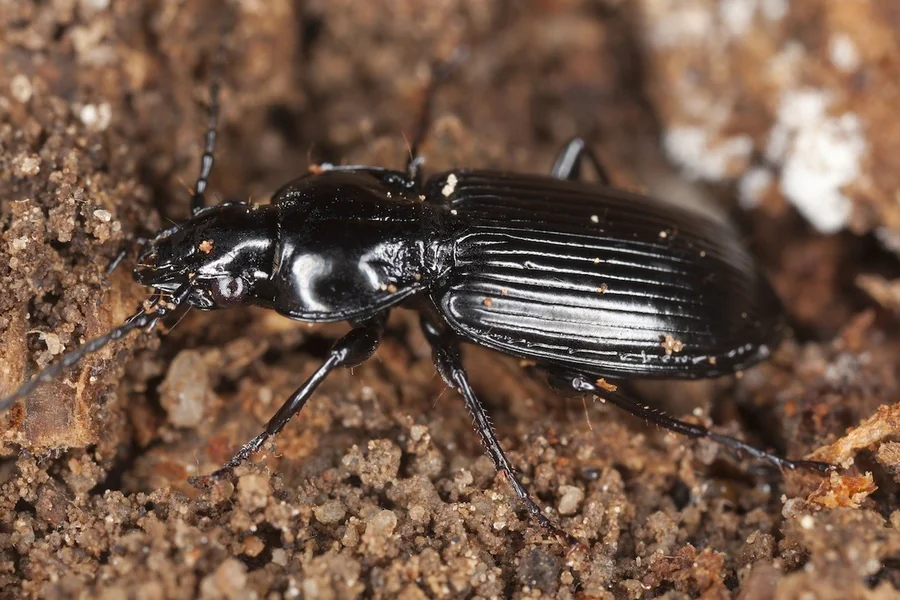
2. Ground Beetle (Carabidae)
Ground beetles are quick predators. The majority are black and 1-3cm in length. Found throughout North America, Europe and Asia, in gardens, fields, forests and wetlands. By day most hide under stones or litter on the ground. They are nocturnal and will feed on slugs, caterpillars and root maggots. This makes them handy garden helpers. They have long legs that they run rather than fly. There are many species that are unable to fly. Others have a pungent smell when handled. The bombardier beetle is in this family. It sprays a hot chemical from its tail. For a beetle, the lifespan of ground beetles can be as long as several years.
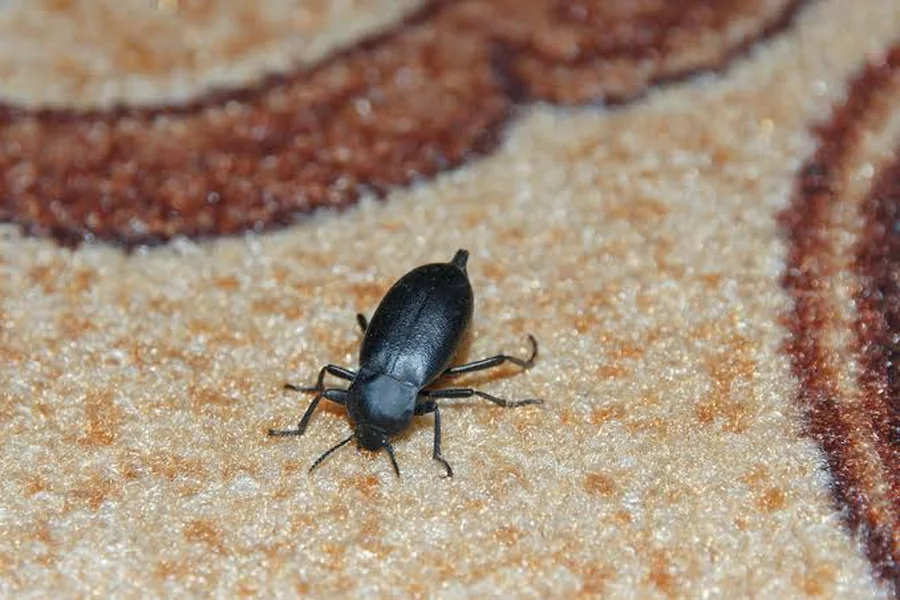
3. Black Carpet Beetle (Attagenus unicolor)
The black carpet beetle is an indoor pest that is common. The adults are small, about 3 to 5 mm long. They are dark brown or black, oval in shape. Adults are out in the open and are pollen feeders. In spring, they wander in search of shelter inside the home where they deposit eggs. Damage is done by the larvae. They are carrot-shaped and are a golden colour, with a tuft of tails. They eat wool, fur, feathers, silk and dried pet food. They can be found in attics, under rugs and in closets. Usually the first sign is the cast skins. The larvae can live for a year or longer. Vacuum frequently and keep wool products in airtight containers to exclude.
4. Stag Beetle (Lucanus cervus)
Stag beetles appear fearsome but are in fact gentle. Male has large jaws similar to deer antlers. During the mating season, they fight with the rivals using them. The jaws rarely hurt people. The females are more powerful biter. In the case of the European stag beetle, it is dark brown to black. They are found in woodland edges, parks and old gardens throughout Europe and grow to an approximate size of 7 cm. The adult flies in the early summer at dusk. Their life span is for a few weeks only. Larvae feed for 3 to 7 years in the ground, feeding on decaying wood. That’s why dead stumps are important for the species. The shrinking of the habitat of the stag beetle has led to its protection in a number of countries.
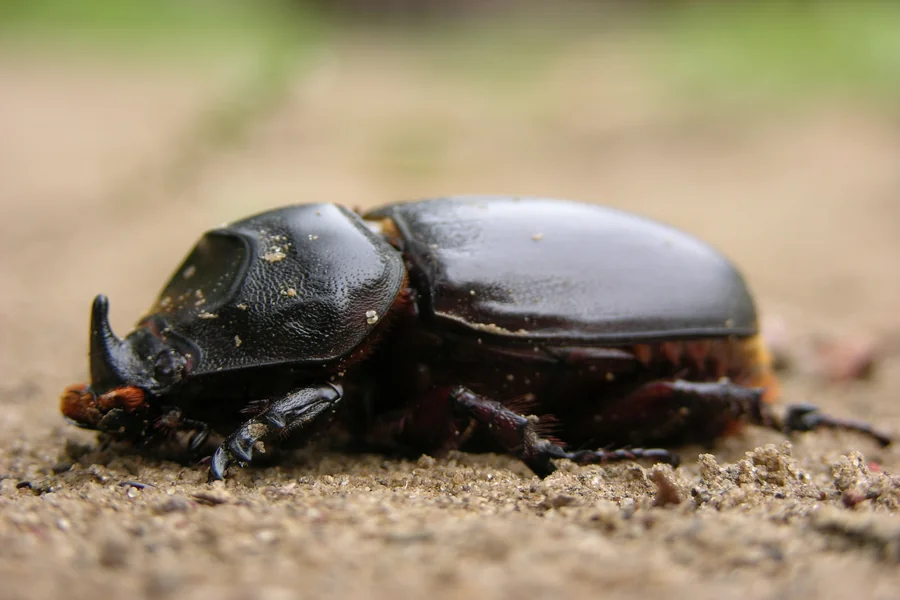
5. Coconut Rhinoceros Beetle (Oryctes rhinoceros)
Coconut rhinoceros beetle is a dark brown to black beetle with a horn on its head. The adult is 3-5cm. They are found throughout tropical Asia and Pacific islands. Adults fly at night and bore into the crown of palm trees. They suck the sap and defoliate emerging foliage. Very vigorous and dense attacks may kill young palms. Females deposit their eggs in rotting logs, compost and mulch. Thick, white grubs with brown heads. Control is usually directed towards the elimination of breeding grounds. In recent years, it has become established in Guam & Hawaii. Both sexes have a horn but the male’s is usually longer. This beetle is a particular concern of farmers in coconut and oil palm areas.
6. Black Blister Beetle (Epicauta pensylvanica)
The black blister beetle is soft-bodied & thin. The adults are approximately 1 cm long. They are found in the fields, meadows and roadsides of much of North America. In late summer adults are found on goldenrod and other flowers. Feed in flocks by day in leaves and flowers. Beetle produce a chemical called cantharidin. It may lead to small blisters and irritation of human skin. It is poisonous to horses as well. Crushed beetles can cause hay to be poisonous to them. The larvae take a different path. They feed on grasshopper egg pods in the ground. This renders the species a pest and a helper. When handling one, wash hands afterwards.
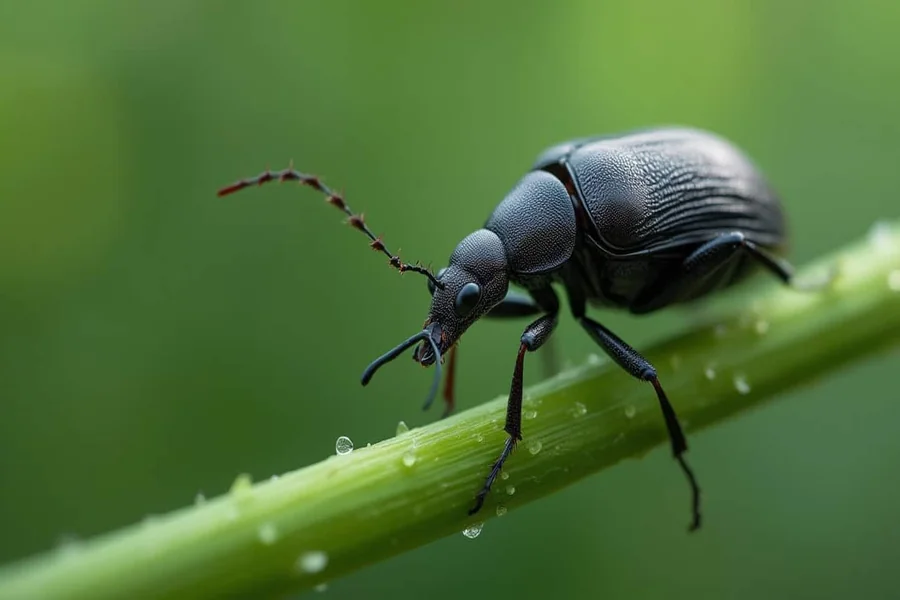
7. Black Vine Weevil (Otiorhynchus sulcatus)
Black vine weevil is a long nosed garden pest. The adults are a dull black and about 9 mm long. They cannot fly. They are nocturnal, crawling on leaves of rhododendron, yew and strawberry plants, notching edges of leaves. The most obvious indication is the notched leaves. Larvae cause more damage. These little white grubs eat roots and can destroy potted plants. The weevil is known to occur in Europe, and has also been introduced to North America. Almost all adults are females. They obtained their eggs without mating. This contributes to high population growth. Adults can be caught in sticky bands on the stems of plants. Beneficial nematodes in the soil can control larvae.
8. Black Oil Beetle (Meloe proscarabaeus)
Short wing covers and a swollen belly are key characters to the black oil beetle. Adults grow to approximately 3 cm. long. They are found all over Europe in grassland, heath and coastal slopes. Can see them walking in the open in Spring. The name beetle is derived from the oil it spits when it is disturbed. The fluid may cause blisters to the skin. The life cycle: The question is why is it so weird? Thousands of eggs are laid in the soil by the females. Larvae are minute and cling to visiting solitary bees, climbing flowers. It takes them to the bee’s nest. In there the larvae feed on bee’s egg and food stores. The species is uncommon in many habitats and requires bee communities and flower rich grassland.
9. Dung Beetle (Scarabaeinae)
A large number of dung beetles are black or dark brown and are found on all continents apart from Antarctica. They inhabit grasslands, farms and savanna areas where grazing animals drop their dung. Rollers make balls of dung and push them out of the way. It is placed under the droppings by tunnelers. It’s home to its inhabitants. The dung is used by the beetles as food and also as a place for rearing young. One African species is known to be able to navigate by the Milky Way. Avoids other teams by rolling its ball in a straight line. They loosen the soil with their work. It also reduces fly and parasites. Dung beetles have been introduced to Australia to control cattle dung. Beetles are very powerful and can lift balls that are far heavier than themselves.
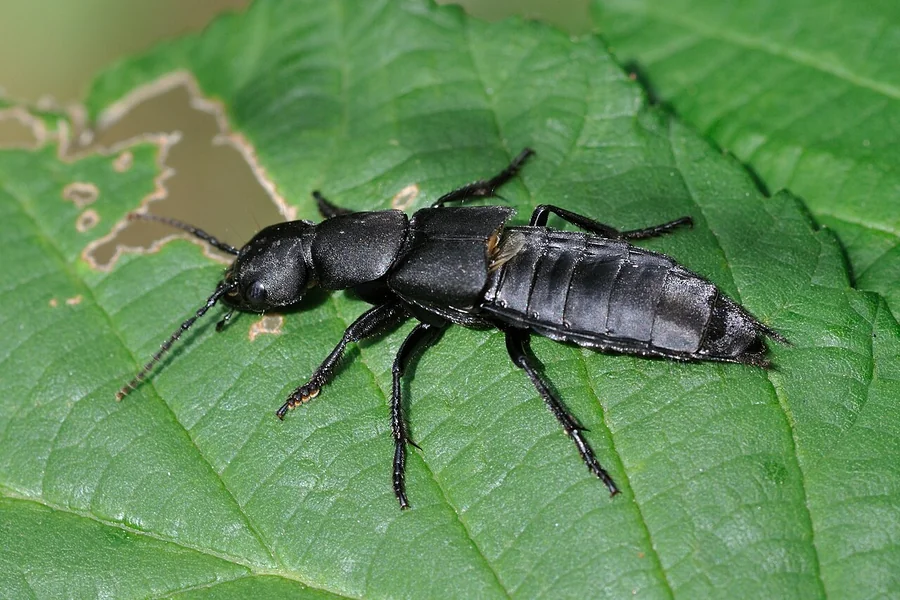
10. Devil’s Coach Horse (Ocypus olens)
The devil’s coach horse is a long-legged, black coloured rove beetle. Grows to approximately 3cm. It is widespread throughout Europe, western Asia and north Africa, but is not found in the boreal or colder regions. Inhabits under stones and logs during the day. It is an active predator at night, feeding on slugs, worms and insects. Threatened it raises its tail like a scorpion and opens its jaws. Can bite and emit an unpleasant odor. The beetle is not harmful to people but is a stinging pest for other insects. Looks are deceiving and it is beneficial to gardeners as a pest eater. It was a part of old folklore which was connected to the devil. This is the reason for its name. Adults are able to survive over a year.
How to Tell Helpful Beetles from Harmful Ones
Look at where you find the beetle first. That tells you most of the story.
- Found indoors near fabric or food? It is likely a carpet beetle or a pantry beetle.
- Found on garden soil at night? It is likely a ground beetle or a rove beetle. Leave it be.
- Found chewing leaves in notches? Suspect a vine weevil.
- Found in a pile of animal droppings? It is a dung beetle. It is doing good work.
- Found on palm crowns in the tropics? Check for rhinoceros beetle damage.
Size and shape help too. Long and fast usually means a predator. Small and oval often means a pest of stored goods. Slow and heavy often means a scavenger.
What to Do When Black Beetles Move In
Most species outdoors need no action. Indoor pests are different. Follow these steps.
- Identify first. Take a clear photo and compare it with the table above.
- Find the source. Check wool, rugs, pet food, pantry goods and dead insects in light fixtures.
- Clean deeply. Vacuum edges, closets and cracks. Empty the bag outside.
- Seal and store. Use airtight jars for grain and flour. Use sealed bins for wool.
- Reduce moisture. Fix leaks and run a fan in damp rooms.
- Close entry points. Repair window screens and door gaps.
- Call a pest professional if you see larvae or shed skins again after two weeks.
In the garden, remove old mulch piles near plants. Use traps and nematodes before you reach for chemicals. Chemicals can harm ground beetles and other helpers.
Why Black Beetles Matter
It is easy to dislike bugs. However, there are plenty of black beetles who do real work. Pastures are cleaned by dung beetles. Slugs are controlled by ground beetles. The larvae of the Stag beetles decompose dead wood. Take away these insects and ecosystems slow down.
However, there are some species that are truly expensive. Carpet beetles destroy fabrics. Vine weevils are a plant killer in potted plants. Palm crops are at risk from rhinoceros beetles. This knowledge will save money and keep beneficial bugs alive.
Final Thoughts
Black beetles are not one problem. They are a big family, and it is far from homogeneous. Spot the type first. Next, determine if some action is necessary. Generally, a healthy garden and a clean home maintain the equilibrium.
Stumbled on a name that you are unable to remember? Make a picture and compare it to the above table.
FAQs:
What are black beetles?
Black beetles are beetles with black or very dark brown bodies and hard wing covers. They belong to the order Coleoptera. Types range from helpful ground beetles to pests like the black carpet beetle.
Are black beetles harmful to humans?
Most do not bite or sting. A few release irritants. Blister beetles and oil beetles can cause skin blisters if you crush or handle them. Wash your hands after contact.
Why do I have black beetles in my house?
They usually come in for food or shelter. Common draws include wool, pet food, flour, dead insects and damp corners. Gaps around doors and windows give them easy access.
How do I get rid of black beetles?
Find the source and remove it. Vacuum often and store food in sealed containers. Fix damp areas and close entry points. Call a pest professional if the problem returns.
Are black beetles good for gardens?
Many are. Ground beetles and devil’s coach horses eat slugs and other pests. Dung beetles improve soil. Vine weevils are the main exception in gardens.
What do black beetles eat?
It depends on the species. Some eat plants and fungi. Others hunt slugs and insects. Carpet beetle larvae eat wool and fur. Dung beetles eat animal droppings.
Do black beetles fly?
Some do and some don’t. Stag beetles and rhinoceros beetles fly at dusk or night. Vine weevils and many darkling beetles cannot fly.