What Keeps Dog Kennel Panels Square Through a Year of Wind and Leaning Dogs
A fence is only as square as its corners
A twenty by twenty foot enclosure built from bolted panels looks, on the day it goes up, like a solid structure. Six months later many of them lean, the gate drags on the ground, and one corner has opened up enough that a determined dog can push a nose through. Nothing broke. The outdoor dog kennel playpen simply racked, which is what rectangles made of hinged joints do unless something stops them.
Understanding why that happens is worth more than buying heavier panels, because the failure is geometric rather than a matter of strength. Thicker steel in the same arrangement racks just as readily; what resists it is how the parts are joined and held.
Why a rectangle of panels wants to become a parallelogram
Four rigid panels joined at four corners form a shape that can still change angle at every joint. Push on one side and the whole rectangle leans: the panels themselves do not bend, but the corners open and close like a hinge.
Engineers deal with this by triangulating, because a triangle cannot change shape without something physically stretching or breaking. A panel kennel has no triangles in it, so the resistance to racking comes entirely from how tightly the corner connections are made and how firmly the frame is held at ground level.
That is why two kennels built from identical dog kennel panels can behave completely differently after a year. One was bolted up tight with the corners pulled square and anchored; the other was assembled hand-tight on uneven ground and left to find its own shape.
Where the load actually comes from
Dogs apply less force than the weather does, which surprises most owners. A large dog leaning on a panel might push fifty or sixty pounds for a few seconds at a time, and while that is a real load it is an occasional one that the structure recovers from.
Wind is relentless. A six foot chain link panel presents a surprising amount of area, and although mesh lets most air through, it does not let all of it through: the fabric catches enough to put a steady sideways force on the frame, and in winter it catches snow as well.
The combination is what does the damage. Wind leans the structure slightly, the ground softens in spring, a dog leans on the same corner, and the geometry drifts a little further out of square each time.
Keeping it square: the three things that matter
Squareness is set during assembly and maintained by anchoring:
- Level ground: shim low points before bolting
- Diagonals: measure corner to corner, both equal
- Ground anchors: one at every corner post
- Hardware: re-torque after the first month
Measuring both diagonals is the step people skip. If the two measurements match, the enclosure is square; if they differ by an inch, it is already a parallelogram and will keep going in that direction.
The gate is where racking shows first
A gate is the only part of a chain link kennel with a moving tolerance, so it is the first thing to complain about. A gate that swung freely in summer and scrapes by late fall has not usually sagged on its hinges: the frame around it has moved, and the opening is no longer rectangular.
That makes the gate a useful instrument rather than just an annoyance. Checking whether it still swings and latches cleanly tells you whether the whole structure is holding its shape, and it does so without measuring anything or walking the perimeter with a tape.
It also explains why gates should be hung on the most anchored corner available. A gate post that is free to move takes all the geometry errors of the whole enclosure and concentrates them in the one place where a quarter inch matters.
What the ground does underneath
Anchoring fails for the same reasons fence posts fail. A stake driven into soft spring ground holds considerably less than the same stake driven in summer, and ground that freezes and thaws through a Canadian winter will lift anything shallow out of position over a couple of seasons.
Where the surface allows it, anchors that reach below the usual frost disturbance hold their grip through the seasons. Where it does not, as on a gravel pad or a patio, weighted feet or a ground frame spread the load instead, which works provided the mass is genuinely sufficient.
Digging is the other ground problem, and it is worth separating from racking. A dog that digs is not attacking the structure; it is going under it. A buried apron of mesh turned outward, or a perimeter of patio slabs, removes that route without any change to the panels above.
A kennel is not a dog run, structurally speaking
It is worth separating two things that often share a name. A long narrow dog run is braced by its own proportions: the short ends are close together, so the structure has little room to lean. A square enclosure of the same panel count has long unsupported sides in both directions and far more freedom to move.
That is why advice written for runs transfers badly to square pens. The square shape is better for the animal, which is the point of a playpen, but it asks more of the assembly and the anchoring than a narrow run ever does.
Why the size changes the structural problem
A twenty by twenty enclosure is not simply a bigger ten by ten. Longer panel runs mean more joints between one corner and the next, and every joint is another place where the run can bow outward under load.
Long runs of dog kennel panels usually benefit from an intermediate anchor partway along each side, which breaks the span into two shorter and much stiffer sections. The alternative, which many owners discover by accident, is a kennel that stays square at the corners while the middle of each long side slowly bows outward into a shape closer to a barrel.
Buying with the second year in mind
Most comparisons between kennels focus on mesh gauge and coating, which matter for corrosion but say nothing about whether the structure will hold its shape. The things that decide it are the corner connection design, the number of anchoring points provided, and whether the gate frame is noticeably stiffer than the dog kennel panels around it.
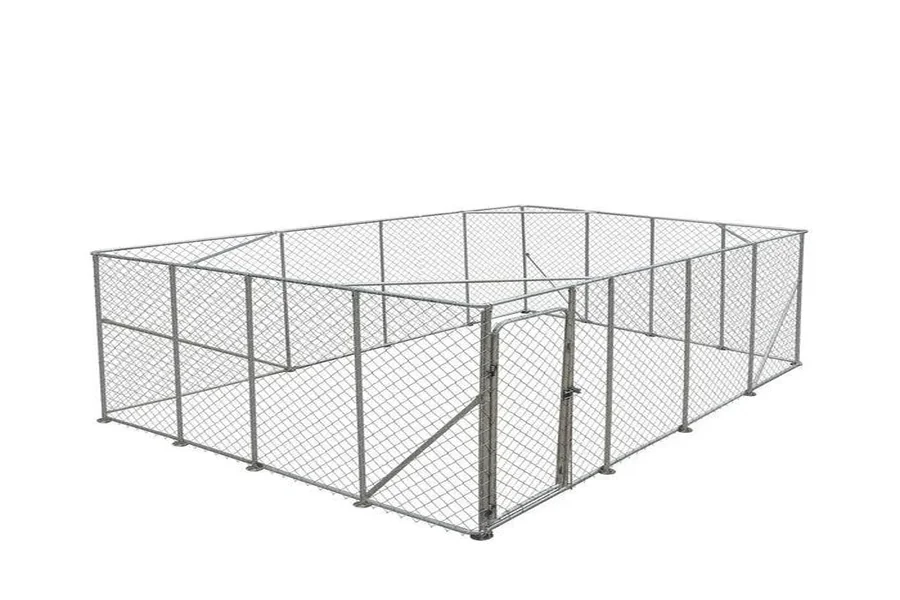
TMG Industrial supplies this one as a twenty by twenty foot outdoor dog kennel with six foot chain link panels and a lockable gate. Whichever system you choose, the time to get it right is the hour you spend making the diagonals equal before anything is bolted tight, because every problem described above starts with a structure that was slightly out of square on day one.