How to Create a Pet-Friendly Home Without Sacrificing Style
According to the ASPCA’s Animal Poison Control Center, true lilies (including Easter, Tiger, and Asiatic varieties) cause acute kidney failure in cats even in small amounts, making them one of the most commonly overlooked household hazards in homes that are otherwise thoughtfully designed for pets.
That statistic is the starting point for a broader truth: creating a cat-friendly home is a safety question first, a behavioral enrichment question second, and an aesthetic question third. Owners who approach it in that order consistently produce homes that are genuinely comfortable for their cats, durable for the long term, and still visually cohesive.
Pet-friendly home design guidelines for cat owners rest on three non-negotiable foundations: removing hazards before they cause harm, providing the vertical and territorial space cats need to feel secure, and choosing materials that survive daily feline life without requiring the home to look like a shelter.
A Persian Kitten, for example, moves through a home differently from a Bengal Cat or a Maine Coon: its calm, low-to-the-ground lifestyle means ramp access, soft resting surfaces, and face-fold cleaning stations matter more than high climbing structures. An Abyssinian, by contrast, needs vertical territory and interactive surfaces throughout every room.
Understanding your specific breed’s behavioral profile is the first design decision, and it shapes every subsequent one.
How to Create a Pet-Friendly Home: The Priority Order
Step 1: Remove Hazards First
Before purchasing a single piece of cat furniture, audit the home for the hazards that cause the most preventable veterinary emergencies.
The ASPCA’s Animal Poison Control Center toxic plant database is the most comprehensive official resource available and should be cross-referenced against every plant currently in the home. Beyond lilies, the following are among the most commonly present and dangerous for cats:
- Sago palm: causes severe liver failure in both cats and dogs
- Pothos and philodendron: cause oral and gastrointestinal irritation
- Aloe vera: causes vomiting, lethargy, and potential organ involvement
- Tulips and daffodils: frequently gifted flowers with significant cat toxicity
Non-plant hazards requiring action before a cat arrives:
- Electrical cords: route along baseboards, use cord covers, or enclose in cable management boxes
- Blind and curtain pull cords: tie up or replace with cordless alternatives; strangulation risk is documented in cats and kittens
- Small objects: rubber bands, buttons, hair ties, and small toys are swallowing hazards for kittens exploring new environments
Step 2: Design for the Cat’s Behavioral Needs
A cat-friendly home provides three things that cats require for psychological wellbeing, as established by the American Association of Feline Practitioners’ Five Pillars of a Healthy Feline Environment: vertical space, hiding opportunities, and clear territorial resources.
Vertical space does not require dedicated cat furniture in every room. Built-in floating shelves, cleared window ledges with non-slip mats, and strategically placed cat trees in the rooms the cat uses most satisfy the instinct to survey territory from height. A Siberian Cat or Maine Coon will use every vertical inch available. A Persian Kitten will prefer elevated platforms it can reach without large jumps.
Hiding opportunities are equally important and frequently overlooked. Covered beds, boxes with entry holes, and furniture with accessible undersides give cats the retreat options they need to self-regulate during household activity without withdrawing to inaccessible areas.
Step 3: Choose Materials That Work for Both the Cat and the Design
Material selection is where the style and practicality of a cat-friendly home intersect most directly. The table below covers the most relevant surfaces by category:
| Surface | Best Option | Avoid | Reason |
| Upholstery | Microfiber, Crypton, Sunbrella (tight weave) | Velvet, bouclé, loose weave | Tight weaves resist claw snags and clean more easily |
| Flooring | Luxury vinyl plank | Unsealed hardwood | Scratch-resistant, waterproof, easy to clean |
| Rugs | Low-pile, tight weave; indoor-outdoor | High-pile, wool, natural fiber | Resists fur embedding; vacuums cleanly |
| Color palette | Tone-matched to cat’s coat color | High contrast to cat’s coat | Reduces visible shedding between cleaning sessions |
| Leather/faux-leather | Acceptable if hygiene is the priority | Avoid if scratch appearance is a concern | Wipes clean; shows claw marks over time |
What Pet-Friendly Home Design Actually Looks Like in Practice
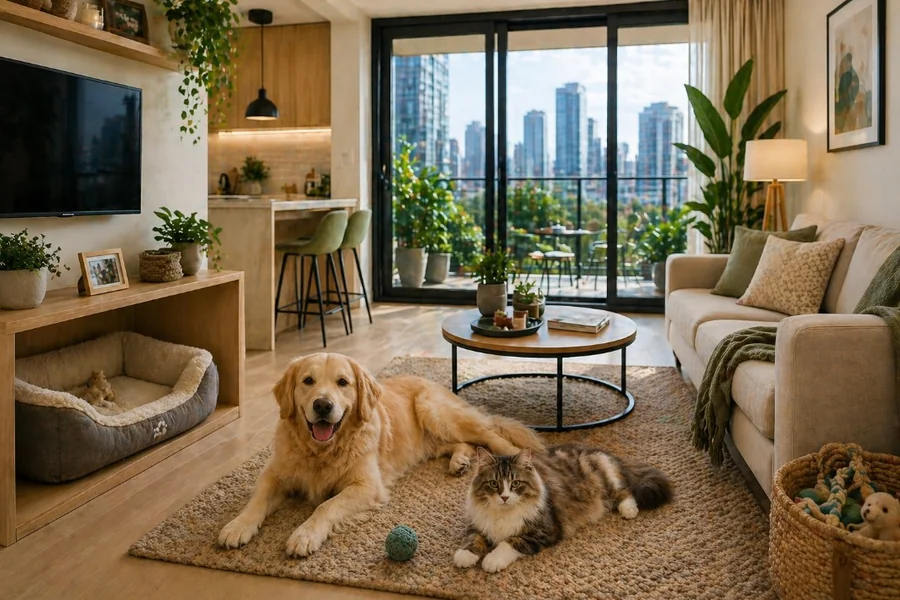
A pet-friendly home does not look like a catalogue of cat products arranged around furniture. It looks like a home whose material choices are informed, whose plant selection has been reviewed, and whose spatial layout gives the cat routes, retreat options, and elevated vantage points that integrate with the existing design rather than competing with it.
The following integration approaches work in most home styles without compromising the aesthetic:
- Mount cat shelves in the same finish as existing wall shelving so they read as intentional design elements rather than pet accessories
- Install a feeding station inside a kitchen cabinet toe-kick to keep bowls off the floor visually while giving the cat a defined, contained resource area.
A Home That Works for You and Your Cat
The homes that successfully serve both human aesthetics and cat wellbeing are those designed from the cat’s behavioral requirements outward, rather than from the furniture catalog inward.
Remove hazards. Provide territory. Choose durable materials. Those three steps, applied before any decorating decision, produce a home that looks considered and lives comfortably for a cat and its owner across the full length of a 12 to 15-year relationship.
Frequently Asked Questions
How do I create a pet-friendly home without making it look like a cat haven?
Choose cat furniture and accessories in neutral colors and natural materials that match the existing design palette. Wall-mounted shelves in the room’s existing finish, linen-covered cat beds that double as accent pieces, and built-in feeding stations inside cabinetry integrate the cat’s environmental needs without making them the visual focal point of the room.
Which houseplants are safe for cats?
The ASPCA’s Animal Poison Control Center maintains an official database of toxic and non-toxic plants searchable by pet type. Cat-safe options that are also aesthetically useful include spider plants, calathea, Boston ferns, parlor palms, and most herbs including rosemary and basil. True lilies in any form are critically toxic and should be removed immediately from any home with a cat.
What are the most important pet-friendly home design guidelines for flooring?
Luxury vinyl plank is the most practical choice: it resists scratching, is fully waterproof for easy cleanup, and replicates hardwood appearance convincingly. Avoid unsealed hardwood, which scratches visibly and absorbs liquid. For rugs, tight low-pile weaves resist fur embedding and clean more easily than natural fiber or high-pile options. Non-slip backing on all area rugs prevents the skidding that can injure cats landing from elevated surfaces.
How much vertical space does a cat actually need in a home?
The AAFP’s Five Pillars of a Healthy Feline Environment identifies access to vertical space as a documented component of feline psychological wellbeing. In practice, one vertical structure or elevated surface per room where the cat spends significant time is the functional minimum. For high-energy breeds like the Bengal Cat or Abyssinian, more extensive vertical territory produces measurably better behavioral outcomes than a single cat tree in one room.
What fabrics hold up best in homes with cats?
Performance fabrics with tight weaves (microfiber, Crypton, and Sunbrella) resist claw snags, repel liquid, and clean without special products. Loose weaves, velvet, and bouclé catch claws and are difficult to clean once saturated. Leather and faux-leather scratch over time but wipe clean and may be preferable for owners who prioritize hygiene over scratch resistance.