
From Wings to Fuselage: Key Components in Aircraft Structure
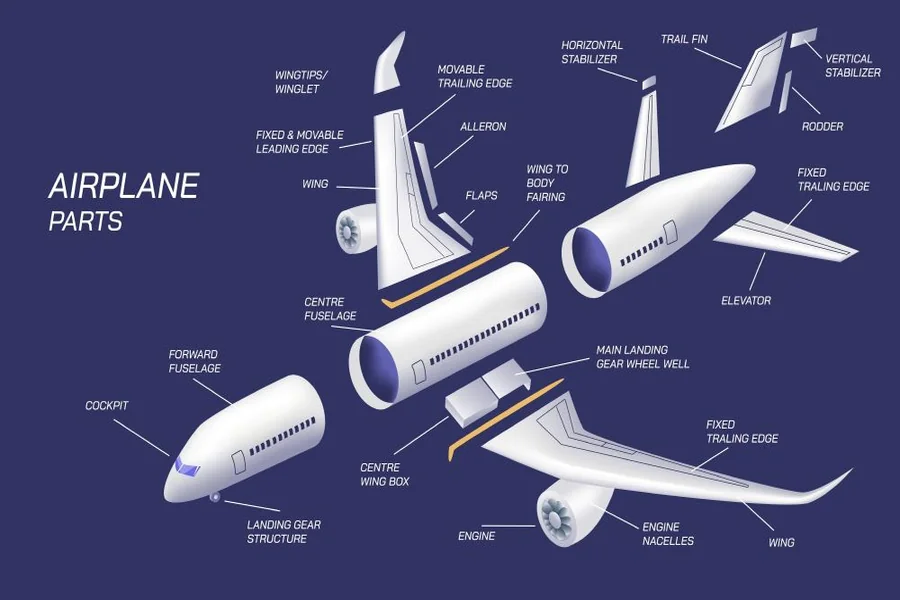
Aircraft may seem like a single, seamless machine soaring through the skies, but every airplane is a sophisticated assembly of structural components, each playing a crucial role in ensuring safety, performance, and efficiency. From the wings that provide lift to the fuselage that houses passengers and cargo, understanding these components gives insight into the engineering marvels behind modern aviation.
The Fuselage: The Central Backbone
At the heart of every aircraft is the fuselage—the main body that connects all other components. It serves multiple purposes: housing passengers, cargo, and avionics, and providing structural integrity for the entire aircraft. Typically designed with a cylindrical shape, the fuselage must balance strength and weight. Modern aircraft often use lightweight yet durable materials like aluminum alloys and composites to ensure fuel efficiency without compromising safety. Internal frames, stringers, and longerons reinforce the fuselage, distributing stress from aerodynamic forces during flight and ground operations.
Wings: Lifting the Aircraft
The wings are the most recognizable structural components, responsible for generating lift and supporting the aircraft in flight. They are carefully engineered to handle enormous aerodynamic forces while remaining lightweight. Wing structures generally consist of spars, ribs, and skin panels. The spars run spanwise from root to tip, acting as the primary load-bearing element, while ribs maintain the wing’s airfoil shape and distribute forces. Wing skins cover the structure and contribute to aerodynamic efficiency. Modern wings may also incorporate fuel tanks, control surfaces, and advanced materials such as carbon-fiber composites to maximize strength while reducing weight.
Empennage: Stability and Control
The empennage, or tail assembly, provides stability and control during flight. Comprising the horizontal stabilizer, vertical stabilizer, elevators, and rudder, this structure ensures the aircraft maintains balance and responds accurately to pilot inputs. The horizontal stabilizer prevents unwanted pitch motions, while the elevators allow the pilot to control the nose’s up-and-down movement. The vertical stabilizer, together with the rudder, controls yaw and helps the plane track straight. Like wings and fuselage, the empennage must withstand aerodynamic stress and is often constructed with lightweight aluminum or composite materials.
Landing Gear: Supporting Takeoff and Landing
Though often overlooked, the landing gear is a critical structural component. It absorbs the shocks of takeoff, landing, and taxiing, protecting both the aircraft and its occupants. Landing gear may be retractable or fixed, depending on the aircraft type, and includes wheels, struts, brakes, and shock absorbers. The design must balance strength, durability, and weight. Engineers carefully calculate load distribution to ensure the landing gear can safely handle the aircraft’s weight under various operating conditions.
Engines and Pylons: Integrating Power with Structure
While engines provide propulsion, they are intricately connected to the aircraft’s structure through pylons or nacelles. These mounting points must handle significant forces, including thrust, torque, and vibration, without compromising the aircraft’s integrity. Proper integration ensures that engines operate efficiently while minimizing stress on surrounding structural components.
Control Surfaces: Maneuvering with Precision
Control surfaces, including ailerons, flaps, spoilers, and slats, are extensions of the wing and tail structures that enable precise maneuvering. Ailerons control roll, flaps assist with lift during takeoff and landing, spoilers help with descent and braking, and slats improve aerodynamic performance at low speeds. These components require careful structural support and linkage to ensure reliability under repeated stress cycles.
In Conclusion
An aircraft’s structure is far more than a simple assembly of metals and composites; it is a sophisticated, interconnected system engineered to achieve the perfect balance of strength, flexibility, and efficiency. Key components—from the fuselage that serves as the central backbone, to the wings that provide lift, and the tail that ensures stability—work together seamlessly. Many of these critical parts, such as landing gear, engine mounts, and structural supports, often utilize 4140 steel, a high-strength alloy known for its toughness, fatigue resistance, and durability under extreme stress.
Appreciating these elements not only showcases the ingenuity behind aerospace engineering but also underscores the precision and attention to safety that every flight demands. The next time you watch a plane soar into the sky, remember that beneath its sleek exterior lies a meticulously engineered framework, with 4140 steel and other materials forming the backbone of this airborne marvel.