
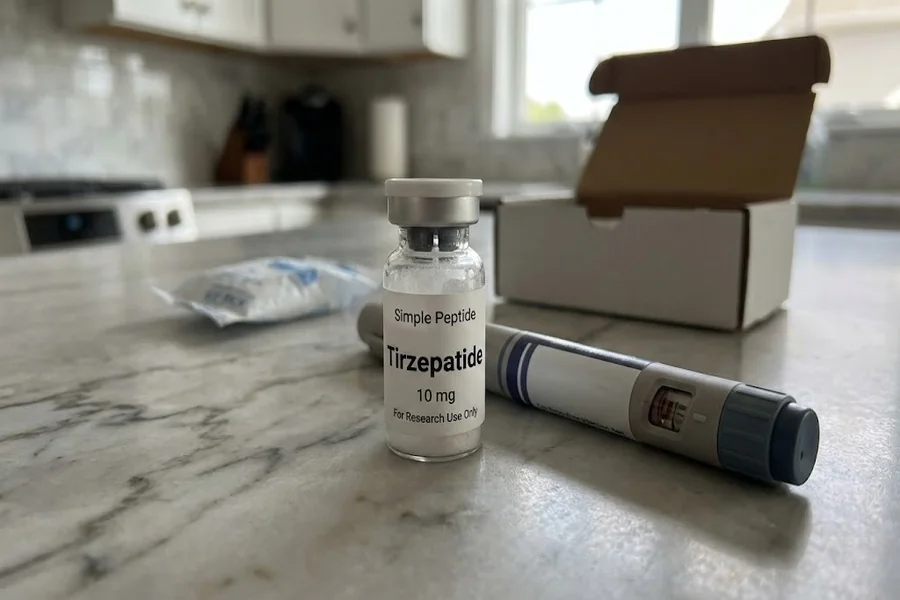
Tirzepatide GLP-2 Research and the Rise of Dual-Receptor Peptide Science
The development of peptide-based research has expanded significantly as scientists continue to explore the relationship between hormones, receptors, and complex biological systems.
Early research often concentrated on individual receptor pathways. Over time, scientists began investigating whether targeting multiple pathways could provide a broader understanding of biological signaling.
Tirzepatide has become an important example of this shift.
Often referred to as Tirzepatide GLP-2 in some research and commercial discussions, tirzepatide is associated with activity involving both the GLP-1 and GIP receptor pathways. This dual-receptor design has made it a significant subject of interest within modern peptide research.
The study of tirzepatide illustrates how researchers are moving beyond single-pathway models and exploring more interconnected approaches to peptide science.
What Is Tirzepatide GLP-2?
Tirzepatide is a synthetic peptide compound studied in relation to two important receptor pathways.
These include:
- GLP-1 receptor activity
- GIP receptor activity
GLP-1 and GIP are naturally occurring hormones that have been widely studied for their involvement in metabolic signaling.
The ability to investigate both pathways within one molecular framework has made tirzepatide an important compound for researchers examining dual-receptor peptide design.
The scientific interest surrounding tirzepatide is not based simply on the number of receptors involved. Researchers are also interested in how the molecular structure of the compound influences its interactions with different biological targets.
Why Dual-Receptor Research Matters
Biological systems are rarely controlled by a single pathway.
Multiple hormones and receptors can work together to influence physiological processes. This has encouraged scientists to explore whether dual-receptor compounds may provide a useful model for studying interactions between different signaling systems.
Tirzepatide provides researchers with an opportunity to investigate questions such as:
- How do GLP-1 and GIP pathways interact?
- What role does receptor selectivity play?
- How does molecular structure affect activity?
- How stable is the peptide under research conditions?
- What differences exist between single and dual-receptor compounds?
These questions are important for understanding the broader development of multi-pathway peptide research.
GLP-1 and GIP: Two Important Research Pathways
The GLP-1 Pathway
GLP-1 has been extensively studied because of its involvement in several biological processes.
Researchers have investigated its role in glucose-dependent signaling, appetite-related pathways, gastrointestinal activity, and other physiological functions.
This extensive research has made GLP-1 one of the most important receptor pathways in modern peptide science.
The GIP Pathway
GIP is another hormone that has attracted significant scientific attention.
Researchers have explored its role in metabolic signaling and its potential interactions with other hormone pathways.
The study of GIP has become increasingly important as scientists investigate dual-receptor compounds designed to influence both GIP and GLP-1 pathways.
Tirzepatide provides an example of how these two research areas can be examined within a single peptide framework.
From Semaglutide to Tirzepatide
The evolution of peptide research can be illustrated by comparing semaglutide and tirzepatide.
Semaglutide is primarily associated with GLP-1 receptor activity.
Tirzepatide was developed with activity involving both GLP-1 and GIP receptor pathways.
This difference provides researchers with an opportunity to compare single-receptor and dual-receptor approaches.
Such comparisons can help scientists examine how receptor combinations influence molecular behavior and biological signaling.
The development of tirzepatide demonstrates how peptide research has continued to evolve toward more complex molecular designs.
The Importance of Molecular Structure
A peptide’s molecular structure can influence several important characteristics.
Researchers may evaluate:
- Receptor binding
- Molecular stability
- Biological activity
- Half-life
- Selectivity
- Pharmacokinetic behavior
These characteristics can influence how a compound behaves in laboratory research models.
For this reason, researchers studying tirzepatide must consider more than its receptor profile.
The relationship between molecular structure and biological activity remains a central area of peptide science.
Evaluating Research Materials
The growing interest in dual-receptor peptides has increased the importance of evaluating research materials carefully.
Researchers may review analytical information to confirm the identity and purity of a compound.
Laboratory testing methods such as high-performance liquid chromatography and mass spectrometry can provide valuable analytical information.
Researchers interested in laboratory research may search for opportunities to buy Tirzepatide GLP-2 from suppliers that provide appropriate research-focused information and documentation.
Research compounds should be used only for legitimate laboratory research and handled according to applicable procedures and regulations.
Why Analytical Documentation Is Important
Analytical documentation provides researchers with valuable information about a research compound.
Depending on the supplier and product, documentation may include information related to:
- Purity
- Compound identity
- Batch information
- Testing methods
- Storage conditions
This information can help researchers make more informed decisions when evaluating research materials.
Peptides Source is a research-focused platform providing materials and information for those exploring the field of peptide science.
Reliable documentation is particularly important when researchers are comparing multiple compounds or designing laboratory investigations.
The Role of Research-Focused Peptide Platforms
The peptide research sector has expanded considerably.
As more researchers explore advanced peptide compounds, accessible information has become increasingly valuable.
Research platforms can help provide product details, analytical information, and educational resources related to peptide research.
Paradigm Peptides operates within this growing sector and provides research-oriented peptide materials for laboratory use.
Researchers should always evaluate available documentation and follow appropriate laboratory procedures when working with research compounds.
Comparing Single, Dual, and Triple-Receptor Research
Tirzepatide can also be understood within the broader development of receptor-targeting research.
Semaglutide represents a primarily single-receptor approach.
Tirzepatide represents a dual-receptor model involving GLP-1 and GIP.
Retatrutide represents a triple-receptor model involving GLP-1, GIP, and glucagon pathways.
These different approaches allow scientists to compare how receptor combinations may influence peptide research.
Each molecular design presents its own research questions.
The goal of scientific investigation is to understand these differences rather than assuming that one approach is automatically superior to another.
Future Directions in Dual-Receptor Peptide Research
The study of dual-receptor compounds is likely to remain an important area of peptide science.
Researchers may continue investigating receptor interactions, molecular optimization, peptide stability, and new methods for evaluating biological activity.
Advances in analytical testing and molecular modeling may also help scientists better understand how compounds such as tirzepatide interact with different receptor systems.
This could contribute to the development of new research models and a deeper understanding of interconnected biological pathways.
Conclusion
Tirzepatide represents an important development in the evolution of peptide research.
Its association with both GLP-1 and GIP receptor pathways provides researchers with an opportunity to study dual-receptor activity within a single molecular framework.
The compound also demonstrates how peptide science has progressed from single-pathway research toward increasingly complex approaches.
As the field continues to develop, researchers will likely place greater emphasis on molecular structure, receptor interactions, analytical testing, and accurate documentation.
The study of tirzepatide and other multi-receptor peptide candidates may help scientists gain a better understanding of how interconnected biological pathways can be investigated through advanced peptide research.